 Work Quest Hub
A Day in the Life of a Veterinary Technician
From kennel rounds at 6:45 a.m. to the last anesthesia recovery, see how a credentialed vet tech's shift actually breaks down, hour by hour.

By Desmond OkaforNov 15, 2026 · 9 min read
A veterinary technician is the nurse, anesthetist, radiographer and lab tech of a veterinary practice. On a typical day you restrain animals for exams, place IV catheters, induce and monitor anesthesia, run blood counts and urinalyses, take x-rays, and give prescribed medications, vaccines and treatments (U.S. Bureau of Labor Statistics, 2025).
The day below is a composite general-practice day shift, not a profile of a real person. Hours, caseload and the tasks you may legally perform vary by employer and by state, since each state regulates veterinary technicians differently (National Association of Veterinary Technicians in America).
Hour-by-Hour: A Typical Shift
This is a composite day shift at a small-animal general practice. Emergency, equine, shelter and research schedules look different.
6:45 a.m.–7:15 a.m. — Kennel rounds and handover. You read the overnight technician's notes on the treatment whiteboard, walk the ward with the other day tech, check each cage card for appetite and attitude, and flag a post-op dog's slipped bandage for the veterinarian on duty.
7:15 a.m.–8:00 a.m. — Morning treatments. Temperature, pulse and respiration on every inpatient, fluid rates recalculated on the infusion pumps, injectable medications given, each entry logged in the practice management software. Controlled drugs come out of the locked safe and are signed out with the veterinarian.
8:00 a.m.–10:00 a.m. — Outpatient appointments. You room clients, take histories, weigh patients and restrain cats and dogs for exams — a common way techs are bitten or scratched, part of why this occupation has one of the highest injury and illness rates of all occupations (U.S. Bureau of Labor Statistics, 2025). You draw blood for heartworm tests and give the vaccines the veterinarian prescribed.
10:00 a.m.–11:30 a.m. — Surgery. You place an IV catheter in a spay patient, induce anesthesia under the veterinarian's direction, intubate, and connect the anesthetic machine and multiparameter monitor. For 45 minutes you watch capnography, pulse oximetry and blood pressure, adjust the vaporizer and record vitals on the anesthesia sheet every five minutes while the surgeon operates. Instrument packs then go through the ultrasonic cleaner and autoclave.
11:30 a.m.–12:15 p.m. — Recovery, lab and imaging. You extubate and monitor the spay, run a complete blood count and urinalysis on a sick cat using the in-house analyzers, then take two digital x-ray views of a limping retriever — the other tech positions while you set exposure, in lead and dosimeter badge.
12:15 p.m.–1:00 p.m. — Lunch, often interrupted. A walk-in arrives with a dog that ate chocolate. You triage, get a weight and call the toxicology hotline for the veterinarian.
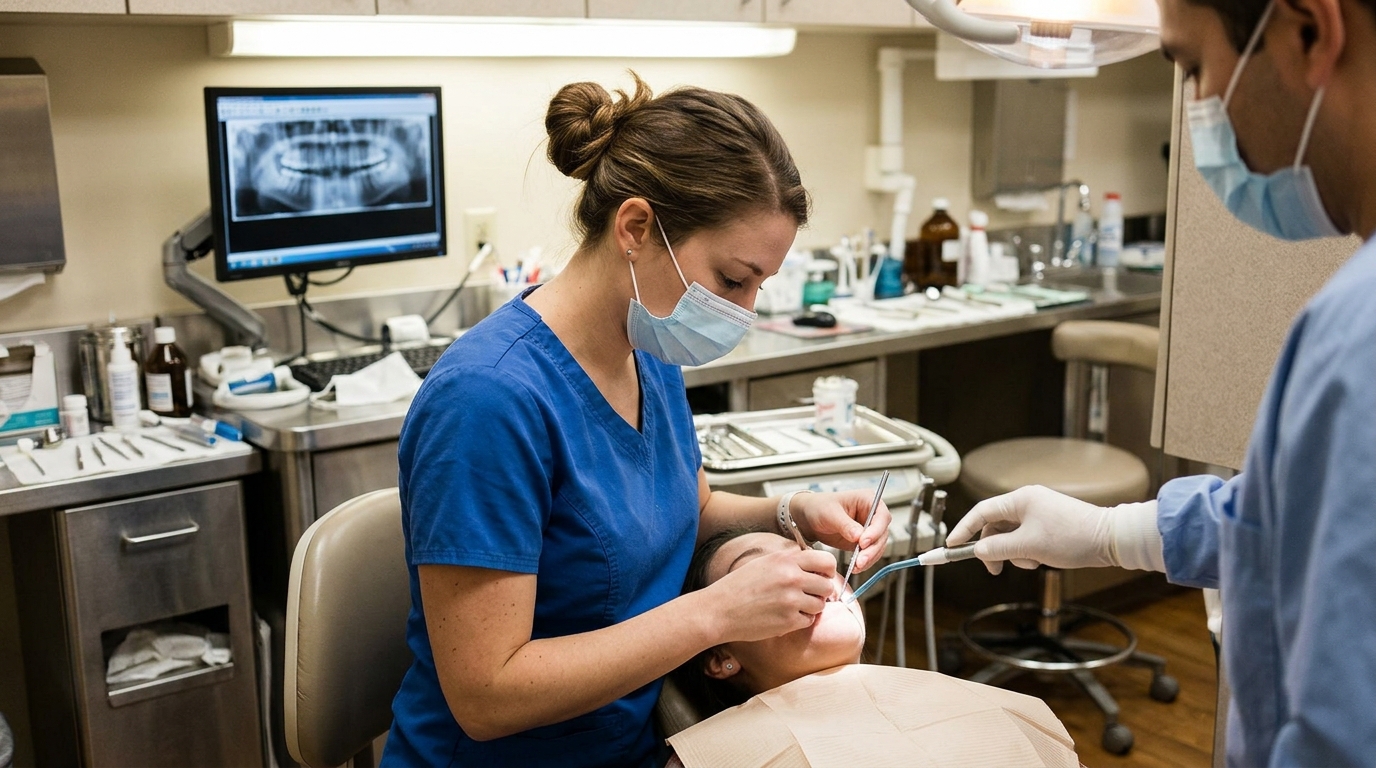
1:00 p.m.–3:00 p.m. — Dental procedure. Anesthesia again: you monitor, take full-mouth dental radiographs, scale with the ultrasonic scaler, polish, and chart each tooth for the veterinarian to review before extractions.
3:00 p.m.–4:30 p.m. — Appointments and discharges. You fill and label prescriptions in the pharmacy, walk two owners through discharge instructions — how to give a liquid antibiotic, what a normal incision looks like — and return client calls about lab results the veterinarian has approved.
4:30 p.m.–5:00 p.m. — Euthanasia appointment. You place the catheter, stay in the comfort room with the family and handle aftercare paperwork. Helping euthanize sick, injured or unwanted animals is a recognized emotional demand of the work (U.S. Bureau of Labor Statistics, 2025).
5:00 p.m.–5:45 p.m. — Evening treatments and handoff. Final inpatient medications, ward disinfection, crash-cart restock, and a verbal handover to the overnight technician using the treatment sheets you updated all day.
Core Responsibilities Beyond the Clock
- Weekly: controlled substance reconciliation. Count the safe against the written log with a veterinarian and file a signed, balanced record.
- Weekly: equipment checks. Leak-test each anesthesia machine and document the result on the maintenance log, so a failed circuit is caught before a patient is on it.
- Monthly: inventory and expiry sweep. Count vaccines, fluids and sutures, pull expired stock, submit a reorder list to the practice manager.
- Monthly or quarterly: autoclave spore testing, with the result filed as proof of sterilization.
- Quarterly: radiation safety review. Exchange dosimetry badges and confirm lead aprons pass an integrity check.
- Annually or biennially: continuing education for credential renewal. Complete the CE hours your state board requires and submit certificates with your renewal — hour counts and deadlines are set by each state, not nationally (National Association of Veterinary Technicians in America).
- Seasonally: heartworm test clinics in spring; holiday toxicity preparation for chocolate, lily and foreign-body cases.
- Ongoing: training assistants. Sign off new hires on restraint, catheter placement and radiograph positioning, producing a completed skills checklist.
- Rotating: evening, weekend and holiday coverage across the technician team (U.S. Bureau of Labor Statistics, 2025).
Who Tends to Thrive in This Role
People who stay calm with their hands busy and their eyes on a monitor. The 10:00 a.m. spay is the test: capnography and blood pressure, vaporizer adjustments, vitals logged every five minutes while the surgeon works. The same vigilance returns at 1:00 p.m., scaling one tooth while charting another. If repetitive, sustained attention feels satisfying rather than tedious, anesthesia work will suit you.
People who are physically steady around animals. Restraining a frightened cat at 8:30 a.m. and positioning a sedated retriever on the x-ray table just before noon are both body work, and both carry real risk — techs are bitten, scratched and kicked while restraining scared or aggressive animals (U.S. Bureau of Labor Statistics, 2025). You need to read body language fast and call for a second pair of hands early.
People who can switch registers. At 3:15 p.m. you are teaching an owner to syringe an antibiotic; at 4:30 p.m. you are in the comfort room during a euthanasia; at 5:00 p.m. you are back on treatments. Workers may also witness abused animals (U.S. Bureau of Labor Statistics, 2025), so a plan for decompressing is practical rather than optional.
The reward is just as concrete: the limping retriever leaves with a correct treatment plan partly because your radiographs were positioned well, and the spay you extubated at 11:35 a.m. went home because you caught a falling blood pressure early.
How to Get Started
- Get hands-on exposure first (1–3 months). Volunteer at a shelter or work as a veterinary assistant, so you learn whether restraint, cleaning and euthanasia appointments are work you can sustain before paying tuition.
- Enroll in an AVMA-accredited veterinary technology program (2–4 years). Technicians typically need a 2-year associate degree and technologists usually a 4-year bachelor's (U.S. Bureau of Labor Statistics, 2025). NAVTA defines a veterinary technician as someone educated in an AVMA-accredited program who passed the national exam and holds current credentials (NAVTA, 2020).
- Complete the clinical or externship hours built into the degree, where you log supervised catheter placements, anesthesia cases and lab work.
- Pass the Veterinary Technician National Examination (study 2–3 months; testing windows set by the exam body). Most states require the VTNE, owned and administered by the American Association of Veterinary State Boards. The AAVSB limits how many attempts a candidate may make, so prepare for the first sitting.
- Apply to your state board for your credential (several weeks to a few months). Depending on the state you become a Registered (RVT), Licensed (LVT) or Certified Veterinary Technician (CVT); the AAVSB administers the exam but does not itself license, certify or register technicians. Check your state board for application steps and fees.
- Take your first clinical job and onboard (6–12 months). Veterinary services employ the largest share of the occupation (U.S. Bureau of Labor Statistics, 2025), though shelters, universities, research facilities and emergency hospitals hire too. Check current pay for your state in the BLS Occupational Outlook Handbook and on CareerOneStop; pay is usually hourly, with differentials common for overnight, weekend and holiday shifts.
- Consider a specialty credential (typically several years of focused practice). A Veterinary Technician Specialist meets base credentialing requirements, spends a defined share of working time in the specialty and passes a Specialist Academy exam (NAVTA). CareerOneStop's Certification Finder lists academies including the Academy of Internal Medicine for Veterinary Technicians and the Academy of Veterinary Dental Technicians.
Frequently asked questions
Do I need a license to work as a veterinary technician?
In most of the US, yes. Each state regulates the role differently — some register technicians (RVT), some license them (LVT), some certify them (CVT) — and most states use the VTNE (NAVTA). The exam is administered by the American Association of Veterinary State Boards, but the AAVSB does not issue the credential; your state board does. Check its website before enrolling in any program.
What is the difference between a veterinary assistant and a veterinary technician?
A veterinary technician has completed an AVMA-accredited veterinary technology program, passed the VTNE and holds a current state credential (NAVTA, 2020). Assistants generally do not. What each may legally do — particularly anesthesia induction, dental extractions and radiography — is set by state practice acts, so the line between the roles shifts depending on where you work.
How is pay structured for veterinary technicians?
Pay is usually hourly, often with differentials for overnight, weekend, emergency and holiday coverage, plus occasional on-call stipends. Specialty credentials and referral settings tend to be paid differently from general practice. The Bureau of Labor Statistics publishes current median hourly and annual wages for the occupation in its Occupational Outlook Handbook, and CareerOneStop shows wages by state and metro area.
Is the job market for vet techs growing?
The Bureau of Labor Statistics publishes a projected employment growth rate for veterinary technologists and technicians for 2025–35, plus estimated average annual openings and the current number of jobs held. Veterinary services employ the largest share of these workers. Look up the current figures in the Occupational Outlook Handbook rather than secondhand numbers, since projections are revised.
What hours do veterinary technicians usually work?
It depends on the setting. General practices often run daytime shifts with a rotating Saturday; emergency and specialty hospitals run overnights and 12-hour blocks; shelters and universities vary. The Bureau of Labor Statistics notes technologists and technicians may have to work evenings, weekends or holidays (2025). Ask about the on-call rotation and hospitalized patients per technician before accepting an offer.
Sources
- U.S. Bureau of Labor Statistics — Veterinary Technologists and Technicians : Occupational Outlook Handbook (2025)
- U.S. Bureau of Labor Statistics — Veterinary Technologists and Technicians : Occupational Outlook Handbook
Your coach for this guide
Desmond covers workplace culture and the unwritten rules that shape who gets ahead. He likes talking to people mid-career, after the certainty has worn off and the real questions start.