 Work Quest Hub
Warehouse Worker Interview Questions and How to Answer Them
From safety scenarios to pick-accuracy questions, here is what hiring managers listen for on the floor and how to build answers from real shift examples.

By Priya NatarajanNov 15, 2026 · 8 min read
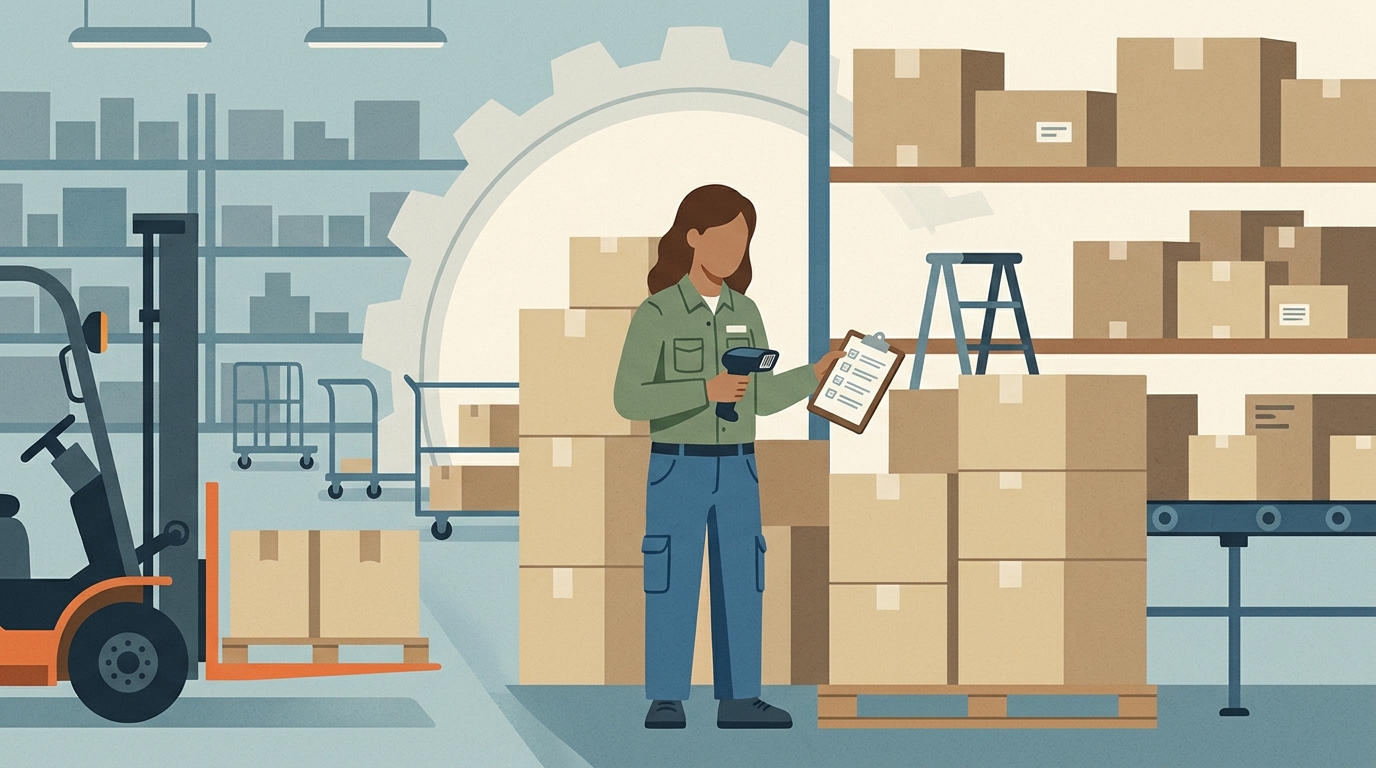
Warehouse interviews are short, practical and heavy on scenarios: how you lift, what you do when a count does not match the paperwork, and what happened the last time you saw something unsafe. Interviewers screen for safety judgment, honesty about equipment, and attendance across nights and weekends.
Below are the questions that come up most, sample answers in situation-task-action-result order, a script for the hardest one, and what to bring on the day.
What This Interview Evaluates
Three things decide most warehouse hiring calls.
Safety judgment under pressure. The work means moving freight, stock and materials to and from storage areas, loading docks, delivery vehicles and containers, by hand or using equipment (U.S. Bureau of Labor Statistics, 2025). Powered industrial trucks ranked sixth on OSHA's most frequently cited violations list in 2024, with 2,248 citations issued (OSHA citation data, 2024). Supervisors listen for whether you slow down and escalate when something looks wrong — and whether you have actually done it.
Accuracy with counts and instructions. Stockers and order fillers receive, unpack and track merchandise, record what enters and leaves, and inspect for damaged goods (U.S. Bureau of Labor Statistics, 2025). O*NET lists reading work orders or taking oral instructions to set assignments, and recording units handled on daily production sheets or work tickets. Expect a question about a count that disagrees with the paperwork.
Durability and availability. The job is manual work for long stretches under strict safety rules, often across nights, weekends and holidays (Glassdoor). Interviewers want to hear what keeps you steady at hour nine.
Entry-level education for this occupation is listed as no formal credential with short-term on-the-job training (U.S. Bureau of Labor Statistics, 2025), so shift stories and honesty about equipment carry more weight than qualifications.
Common Questions and Sample Answers
Describe how you would lift a heavy box.
Sample answer
Situation: at my last site I broke down inbound pallets of cases up to 50 pounds with no lift assist on that lane. Task: clear the pallet without hurting my back. Action: I checked the label weight, tested the corner, set my feet shoulder-width, squatted with my back straight, pulled the box to my chest, lifted with my legs, and turned with my feet instead of twisting. Anything heavier or awkward, I called a second person or used a jack. Result: two years on that line with no reportable strain injury.
Tell me about a time you observed, or were involved in, a safety-related situation.
Sample answer
Situation: a coworker left a stack of empty pallets leaning on a rack upright in a main aisle. Task: it was not my zone, but it sat in the path of the electric pallet jacks. Action: I moved the pallets to the drop point, then told the shift lead at break instead of waiting for the end-of-shift huddle. Result: the lead added a marked pallet drop to the aisle map, and that aisle stopped appearing on the weekly walk-through list.
When would you use a forklift instead of a pallet jack?
Sample answer
Situation: on receiving we had both available. Task: pick the right tool per pull. Action: I used a pallet jack for ground-level moves over short distances on flat, clear floor, and a forklift when the load had to come off or go into a rack position, exceeded the jack's rating, or travelled the length of the building. Result: no racking damage on my shift. I also know manual pallet jacks fall outside the OSHA forklift standard, while electric walk-behind and rider jacks need the same training and evaluation as a forklift.
What do you do when your count does not match the paperwork?
Sample answer
Situation: a pallet of inbound cartons scanned as 48; I counted 44. Task: resolve it before the stock hit the shelf. Action: I recounted, checked for shrink-wrapped doubles, noted the discrepancy on the work ticket, photographed the seal, and took it to the receiving lead before signing. Result: the shortage traced back to the supplier, and because the ticket was annotated at the dock the credit went through with no later inventory adjustment.
How do you stay focused through a long shift?
Sample answer
Situation: a ten-hour night shift on an outbound line. Task: hold pick accuracy at the end, not just the start. Action: I set hourly targets, scanned every location barcode instead of going by memory after the fourth hour, drank water at each break, and switched my lifting side when one shoulder tired. Result: my error rate in the last two hours matched the first two, and the lead asked me to train two seasonal hires.
How do you secure a load so it does not shift?
Sample answer
Situation: a mixed pallet of boxed goods and one drum going on a long trailer run. Task: stop it shifting in transit. Action: I set the drum over the pallet center, blocked it with the cases, added corner board and strapping, and shrink-wrapped down to the pallet deck so the base could not slide. I noted the bracing on the shipping document. Result: the receiving site reported no damage, and we reused the build pattern for that customer.
Can you work nights, weekends and holidays?
Sample answer
Situation: my previous site ran six-day weeks through peak. Task: hold my attendance through it. Action: I set my sleep schedule around nights, arranged transport that did not depend on bus timetables, and traded shifts in advance rather than calling out. Result: I finished peak with no unplanned absences. I am available for nights and weekends here, and I would like to know the holiday rotation so I can plan around it.
Answering the Hardest Question
Interviewers ask this because the expensive mistakes in a warehouse usually come from someone who saw a rule broken and said nothing. They want to know whether you escalate without starting a floor argument.
"What would you do if you saw an experienced coworker skip a safety step?"
Sample answer
I had this on an outbound dock. A driver on a rider pallet jack was reversing through a blind corner without sounding the horn, and he had been there far longer than me. My task was to stop it recurring without making an enemy on my own shift. First I said it to him directly at the next pause — that I could not see him coming from the staging lane and did not want to be the one he hit. He shrugged it off. So the same shift I told the supervisor what I saw, the time and the aisle, and left the judgment to him. The supervisor put a convex mirror on that corner and re-covered horn use at the next stand-up. After that, no near-miss reports came from that aisle, and the driver and I still worked fine together. I would rather have an awkward conversation than an incident report.
Day-Of Checklist
- Bring photo ID and, if you have one, your employer-issued forklift training certificate — compliant records list the operator's name, the training date, the evaluation date, and who trained and evaluated you.
- Write down each machine you have been trained and evaluated on — sit-down counterbalance, reach truck, electric rider jack, order picker — plus the month of your last evaluation, since evaluations are required at least once every three years under 29 CFR 1910.178(l).
- List the equipment and scanning software named in the posting, and prepare one story for each.
- Prepare two safety stories in situation-task-action-result order: a near-miss you prevented and one you reported.
- Rehearse your lifting answer, including the case weight you routinely handle and the point at which you call for a second person.
- Write out your availability by day and shift, including earliest start and holiday cover.
- Wear closed-toe boots and clothes you can walk a dock in; many warehouse interviews end in a floor tour or short demonstration.
- Prepare three questions: shift rotation, how new hires are trained and evaluated on powered equipment, and how pick or move rates are measured.
Frequently asked questions
Do I need a forklift certification before I apply?
Not always. OSHA requires that only trained and evaluated operators run a powered industrial truck, and federal law bars anyone under 18 from operating a forklift — but employers can train you in-house, and the certification comes from the employer, not an OSHA license. OSHA does not certify or endorse trainers or course providers. Say plainly what you have run and offer to be re-evaluated.
When should I bring up pay?
Let the interviewer raise it, or ask near the end. Warehouse pay is usually hourly with overtime, often with a shift differential for nights and weekends, and temp-to-hire roles through staffing agencies may be structured differently from direct hire. Rates vary by employer, state and metro area — check the posting and Bureau of Labor Statistics occupational wage data for your area first.
Will there be a physical test or a walk of the floor?
Often yes. Many sites finish with a tour so you can see the dock, the racking and the noise level, and some ask for a short demonstration: lifting a case, moving a pallet jack, or reading a work order. Wear closed-toe boots and clothing you can move in. If asked to operate powered equipment you have not been evaluated on, say so.
Is it a panel interview?
Usually not. Expect one or two people: a shift supervisor or lead, sometimes with an HR or staffing coordinator. The supervisor asks the scenario questions and cares about safety and accuracy; the coordinator covers availability, start dates and screening steps, which vary by employer and state. Direct your equipment and safety answers to the supervisor.
Sources
- U.S. Bureau of Labor Statistics — Hand Laborers and Material Movers : Occupational Outlook Handbook (2025)
- U.S. Bureau of Labor Statistics — Occupation Finder : Occupational Outlook Handbook (2025)
Your coach for this guide
Priya shapes the publication's coverage of job transitions, writing often about the messy middle between leaving one role and starting another. She's drawn to the quiet negotiations people have with themselves before a resignation letter gets written.