 Work Quest Hub
Electrician Resume: Skills, Format, and Examples That Get Interviews
How to put license status, apprenticeship hours, code knowledge and testing tools on one page a contractor can scan in under a minute.

By Yuki Tanaka-ReevesNov 15, 2026 · 9 min read
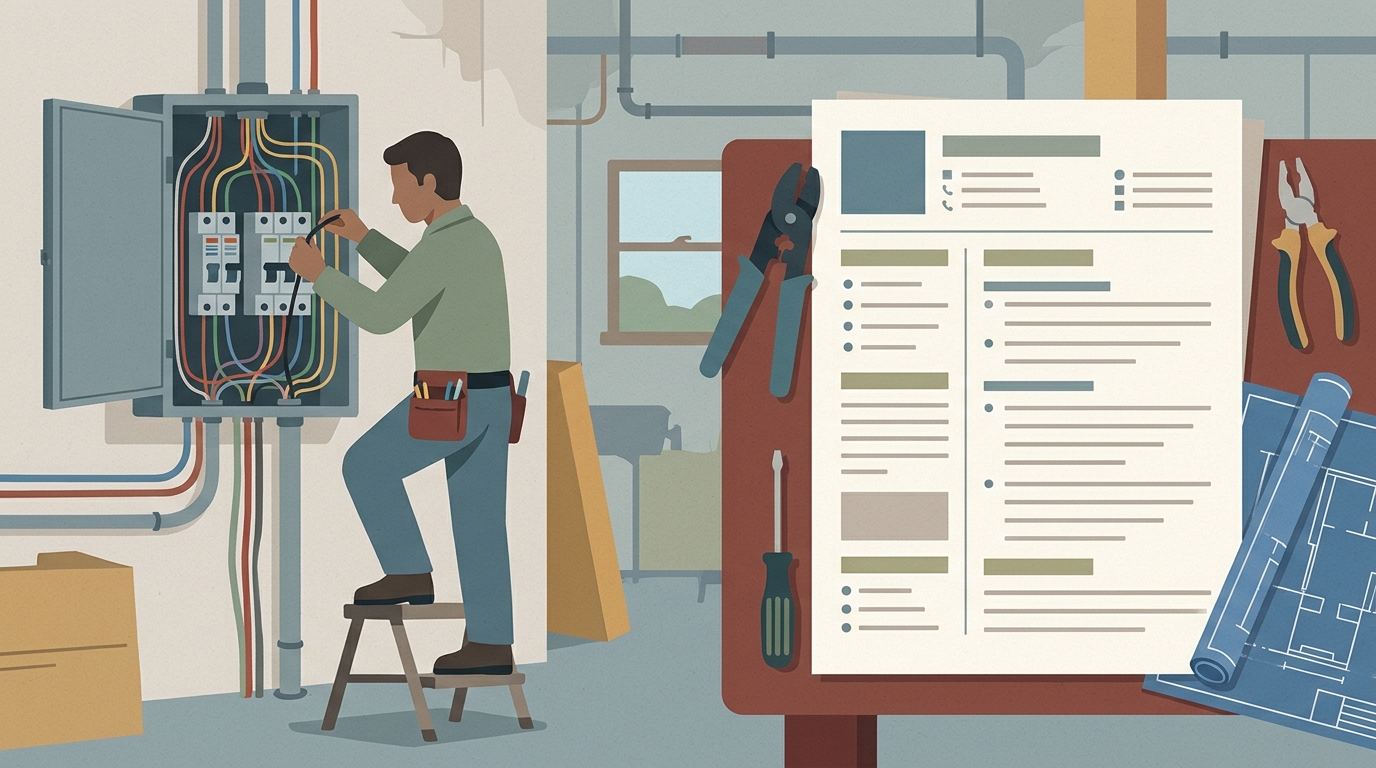
An electrician's resume is read first for licensing and code competence, then for hands-on scope: what systems you installed, what you troubleshot, and what instruments you used to do it. Put your license type and issuing state, your apprenticeship hours or journey status, and your test equipment where a hiring manager sees them without scrolling.
The rest is scope and numbers — panel sizes, service upgrades, conduit footage, inspection outcomes — written as bullets that start with a verb and end with a result.
What Hiring Managers Look For
Two questions get answered in the first ten seconds: can you legally perform the work in this jurisdiction, and will someone have to stand over you.
Licensing answers the first. Most states require electricians to pass a test and be licensed, with questions drawn from the National Electrical Code and state and local electrical codes (U.S. Bureau of Labor Statistics, 2025). Requirements differ by state and sometimes by city or county, so write the license name, the issuing state and the status — active, reciprocal, in application — rather than just "licensed electrician." After an apprenticeship, electricians are considered journey workers who may work on their own, subject to local or state licensing rules (U.S. Bureau of Labor Statistics, 2025); if that applies to you, say it plainly.
Scope answers the second. Reviewers look for the standard task set: reading blueprints and technical diagrams, installing and maintaining wiring, control and lighting systems, inspecting components, identifying problems with testing devices, and directing or training other workers (U.S. Bureau of Labor Statistics, 2025). Name service sizes, occupancy types and system types.
Specialties separate near-identical candidates. Electricians may hold additional certifications in areas such as solar photovoltaic, electrical generating or lighting systems (U.S. Bureau of Labor Statistics, 2025), and ONET lists 29 national certifications tied to the occupation, including Electrical Plans Examiner from the International Code Council (ONET OnLine, U.S. Department of Labor). Since 66 percent of electricians work for electrical contractors and other wiring installation contractors (U.S. Bureau of Labor Statistics, 2025), write for a service manager, not an HR generalist. Bring numbers: panels replaced, circuits pulled, feet of conduit, inspection results.
Skills to Include
Split the section so a reviewer scans hard skills in one block and sees the soft ones proved in bullets. The qualities named for the occupation include color vision, critical thinking, customer service, physical stamina, physical strength and troubleshooting (U.S. Bureau of Labor Statistics, 2025) — several of those belong in bullets, not a list.
Technical skills, 8 to 10 maximum
- NEC and local code compliance — state the code cycle you worked under
- Blueprint and technical diagram reading — reference a project type nearby
- Conduit bending and raceway layout — name bender sizes in your tools line
- Wire pulling through conduit, pipe and tubing — quantify runs or footage in a bullet
- Service, panel and feeder work — give amperage in the experience section
- Control and lighting system installation — separate commercial from residential
- Troubleshooting with ammeters, voltmeters, thermal scanners and cable testers — one named tools line
- Oscilloscopes and test lamps — include only if genuinely used on the job
- Solar photovoltaic or lighting specialty — list the certificate, not a claim
- AutoCAD markups and as-builts — tools line, backed by one bullet
Interpersonal skills, 3 to 4 maximum
- Customer service — proved inside a service-call bullet with an outcome
- Directing and training apprentices — give the number of helpers led
- Critical thinking under live conditions — shown in a fault-isolation bullet
- Trade coordination — named in a rough-in or scheduling bullet
How to Structure Each Section
- Header. Four lines maximum: name, phone, email, and the city and state where you can work. Add your license designation after your name — "Jordan Vasquez, Journeyman Electrician (TX)" — because licensing and reciprocity differ by state.
- Credentials block. Three lines directly under the header, before any summary, never in paragraph form: license type, issuing state and status; apprenticeship completion or hours logged; specialty certifications such as solar photovoltaic or lighting systems (U.S. Bureau of Labor Statistics, 2025).
- Summary. Three lines, no pronouns. Name your years in the trade, your two strongest system types (service upgrades, lighting controls, motor circuits) and the sector you want — residential service, commercial new construction, industrial maintenance.
- Experience. Reverse chronological, with employer type, city and state, and month-and-year dates. Under each job, cover blueprint reading, installs, inspection, fault identification with testing devices and directing other workers (U.S. Bureau of Labor Statistics, 2025), and give every entry at least one amperage, count or footage.
- Apprenticeship and training. Give it its own entry with sponsor type, years and hours. List the technical instruction you completed — electrical theory, blueprint reading, mathematics, code requirements, and safety and first-aid practices (U.S. Bureau of Labor Statistics, 2025) — on one comma-separated line.
- Tools and testing equipment. One comma-separated line, no bullets. Name instruments individually — ammeter, voltmeter, thermal scanner, cable tester, conduit bender — rather than "hand and power tools," and add AutoCAD if you produce or mark up drawings (O*NET OnLine, U.S. Department of Labor, 2026).
- Certifications and education. Last block, one line per item with issuing body and year. Include the high school diploma or equivalent, the standard entry requirement for the trade (U.S. Bureau of Labor Statistics, 2025), then national certifications such as Electrical Plans Examiner from the International Code Council (O*NET OnLine, U.S. Department of Labor).
Before and After Bullets
Each pair below uses a fictional employer. Rewrite your own the same way: verb first, tool or system named, number or outcome at the end.
Service calls
Before
Handled residential service calls and fixed electrical problems for customers.
After
Diagnosed and cleared faults on 8 to 12 residential service calls per week for a regional wiring contractor, isolating opens and shorts with a clamp ammeter and cable tester and closing 90 percent of calls on the first visit.
Panel and service upgrades
Before
Worked on panel replacements and service upgrades on older homes.
After
Replaced 40 residential panels and upgraded 18 services from 100A to 200A over two seasons, passing every utility and AHJ inspection on first submission.
Conduit and wire pulling
Before
Installed conduit and pulled wire on commercial job sites.
After
Bent and set roughly 3,400 feet of EMT and pulled feeders through conduit on a four-story office fit-out, working from scaffolds and lifts to hold a 6-week rough-in schedule.
Lighting and controls
Before
Installed lighting systems and controls in commercial buildings.
After
Installed and commissioned 220 LED fixtures with occupancy and daylight controls across a warehouse retrofit, verifying circuits with a voltmeter and correcting 11 miswired sensor legs before turnover.
Supervising apprentices
Before
Helped train new apprentices and oversaw their work on site.
After
Directed 3 apprentices through conduit layout and device trim on a 42-unit apartment build, reviewing each unit against the prints before inspection and logging zero rework items.
Code and documentation
Before
Made sure all work met electrical code requirements.
After
Corrected 27 pre-inspection code deficiencies across two tenant improvement jobs, referencing the governing National Electrical Code cycle and local amendments, and documented each fix in daily reports.
Final Checklist
- Confirm your license type, issuing state and current status appear in the top four lines of page one.
- Count your bullets: every one must contain a number, an amperage, a footage, a count or a named inspection outcome.
- Search the document for "responsible for" and "duties included" and replace each with an action verb.
- List at least four test instruments by name — ammeter, voltmeter, thermal scanner, cable tester — in a single tools line.
- Name the National Electrical Code and the state or local amendments you worked under in at least one bullet.
- State apprenticeship hours or completion year, and add journey worker status if you hold it.
- Pull three tools or system types directly from the job posting and confirm each appears on your resume.
- Check that every job entry shows employer type, city, state and month-and-year dates, and that each certification line shows issuing body and year.
Frequently asked questions
How long should an electrician resume be?
One page if you have under ten years in the trade, two if you carry a long list of license endorsements, specialty certifications or large projects. Contractors scan for license, scope and tools, so a second page earns its place only when it adds project detail — amperages, occupancy types, system types — rather than repeating the same residential service bullets.
I'm still an apprentice. What goes on the page?
Lead with hours. Most electricians train through a 4- or 5-year apprenticeship with about 2,000 paid on-the-job hours a year plus technical instruction (U.S. Bureau of Labor Statistics, 2025), so state your year, hours logged and sponsor type. List completed classroom subjects such as electrical theory, blueprint reading, mathematics, code requirements and safety practices (U.S. Bureau of Labor Statistics, 2025).
I'm coming from the military or general construction. How do I reframe my experience?
Translate the work into the trade's task language: wiring, control and lighting systems, inspection, fault identification with testing devices, and code compliance. Workers with electrical experience from the military or the construction industry may qualify for a shortened apprenticeship based on experience and testing (U.S. Bureau of Labor Statistics, 2025), so name the hours you believe transfer and any exam you have scheduled.
Should I put salary expectations on my resume?
No. Keep the page to credentials, scope and tools, and raise compensation when the employer does. Pay structures differ widely by employer and jurisdiction — hourly versus salaried, per diem, overtime rules, local agreement terms — so check your area first. The U.S. Bureau of Labor Statistics publishes wage data for electricians, most recently for May 2025.
Sources
- U.S. Bureau of Labor Statistics — Electricians : Occupational Outlook Handbook (2025)
- O*NET OnLine (U.S. Dept. of Labor) — Job Duties Custom List 47-2111.00 — Electricians
Your coach for this guide
Yuki covers early-career life, internships, and the strange first years of figuring out what work is for. She writes with the fresh impatience of someone still sorting out her own path.