 Work Quest Hub
Is Becoming a Veterinarian Right for You?
A look at the surgery, euthanasia conversations, bite risk and licensing exams behind the work, so you can judge the fit before applying to vet school.

By Priya NatarajanNov 15, 2026 · 9 min read
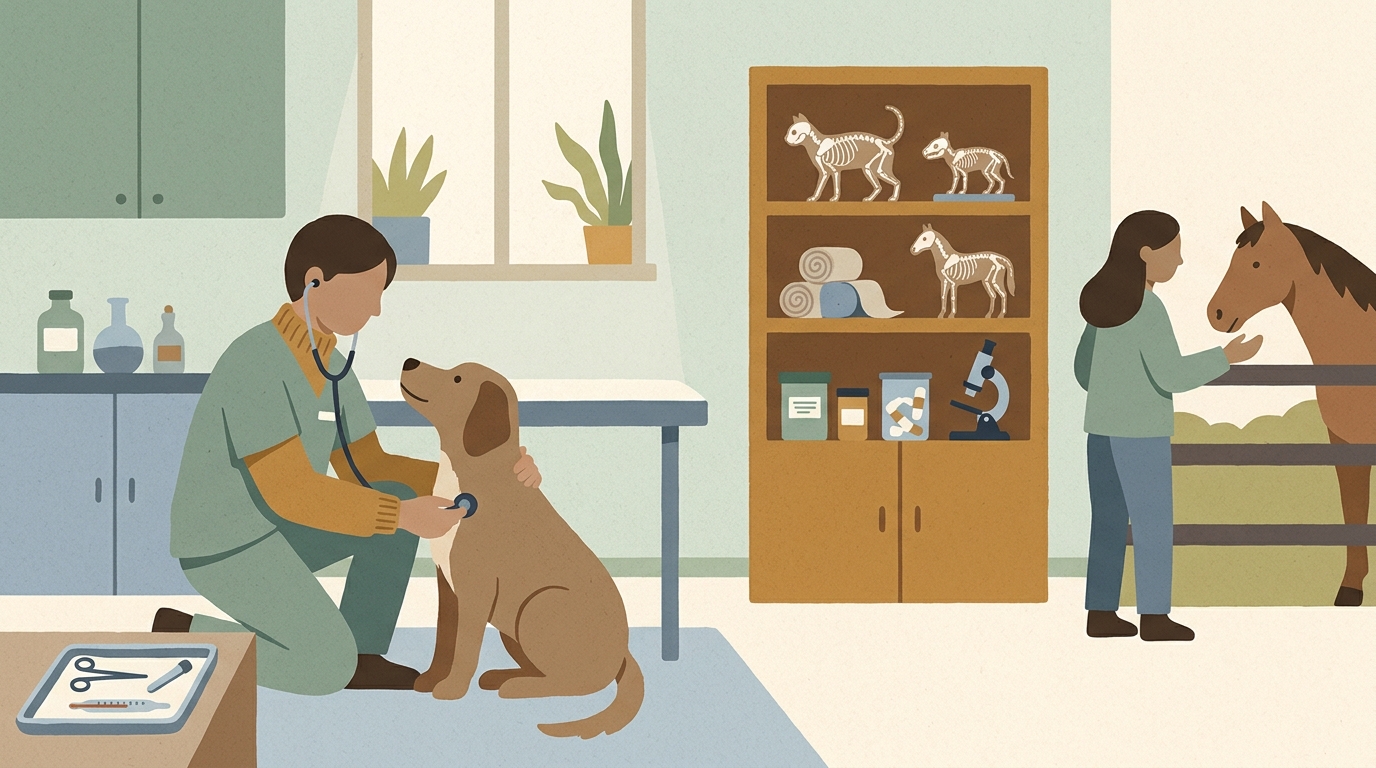
Veterinary medicine suits people who want clinical problem-solving plus constant human contact, and who can carry hard conversations home without being flattened by them. The work is a doctorate-level path: a four-year Doctor of Veterinary Medicine (DVM or VMD) from an accredited college, then a qualifying national licensing exam and, in most states, a state exam too (U.S. Bureau of Labor Statistics, 2025).
If you picture a day of cuddling puppies, the job will surprise you. Expect surgery, radiographs, zoonotic-disease questions, euthanasia appointments, and clients who cannot afford the plan you recommend.
What This Career Actually Involves
The shape of a general companion-animal day is roughly this, though it shifts with practice type and caseload. About half to 60% of it happens in the exam room: taking a history from the owner, running a nose-to-tail physical, checking ears with an otoscope, updating vaccine and parasite-prevention plans, and walking a client through a treatment estimate while they hold the leash.
Another fifth or so is procedural time in the surgical suite — spays and neuters, mass removals, dental extractions and cleanings, laceration repair — with anesthesia induction and monitoring either done by you or supervised by you. The U.S. Bureau of Labor Statistics (2025-08) lists examining animals, performing surgery, prescribing medication and euthanizing animals as core duties of the job.
A further slice is diagnostics: positioning patients for radiographic or ultrasound equipment, reading blood smears and cytology slides under a microscope, spinning samples in a centrifuge, interpreting chemistry panels. O*NET (2026) names operating diagnostic equipment such as radiographic or ultrasound machines as a specific task. The remainder is records and communication — SOAP notes in practice-management software, prescription refills, callbacks on lab results, referral letters to specialists.
O*NET (2026) also lists counseling clients about the death of a pet or a euthanasia decision, and educating the public about diseases spread from animals to humans, as named tasks. In mixed or large-animal practice the truck becomes the clinic: chute-side exams, herd health visits, and long drives between calls.
Hours stretch. Most veterinarians work full time, often more than 40 hours a week, and some work nights or weekends and respond to emergencies outside scheduled hours (U.S. Bureau of Labor Statistics, 2025).
Traits and Skills That Predict Success
- Manual dexterity under time pressure — you will place catheters in dehydrated kittens, tie suture inside a body cavity, and intubate a patient already under anesthesia. The U.S. Bureau of Labor Statistics (2025) names manual dexterity as an important quality for the role.
- Stress tolerance and self-control — a hit-by-car patient arrives while a scheduled appointment is already waiting in the lobby; O*NET (2026) ranks both among the top work styles for veterinarians.
- Compassion paired with composure — you will counsel a client through a euthanasia decision, then walk into the next exam room and run a routine puppy visit (O*NET, 2026).
- Plain-language communication — you have to explain a chronic kidney diagnosis, three treatment options and their costs to someone with no medical background, and get a decision before the appointment ends.
- Decision-making with incomplete information — your patient cannot describe symptoms, and the owner may decline the bloodwork that would answer the question. The U.S. Bureau of Labor Statistics (2025) lists decision-making and problem-solving skills among core qualities.
- Attention to detail — drug doses are calculated per kilogram, and a decimal error in a tiny cat is a different event than in a large dog. O*NET (2026) lists attention to detail and cautiousness among top work styles.
- Physical steadiness around frightened animals — you will restrain and muzzle patients, and the U.S. Bureau of Labor Statistics (2025) notes the risk of being bitten, kicked and scratched, plus infection risk when handling diseased animals.
- Perseverance through long training — O*NET (2026) places veterinarians in Job Zone Five, "Extensive Preparation Needed," with a specific vocational preparation range of 8.0 and above, a zone where occupations often require graduate school.
This Career vs. a Common Alternative
The job most often confused with this one is veterinary technologist or technician. Both work in clinics, both handle patients, and both are projected to grow much faster than the average for all occupations from 2025 to 2035 (U.S. Bureau of Labor Statistics, 2025). The difference is who diagnoses, who cuts, and how long the runway is.
| Factor | Veterinarian | Veterinary technologist / technician |
|---|---|---|
| Entry credential | DVM or VMD from an accredited college of veterinary medicine, generally 4 years (BLS, 2025) | Associate's degree for technicians, about 2 years, or a bachelor's for technologists, about 4 years (BLS, 2025-08) |
| Licensing exam | NAVLE: 360 multiple-choice questions, 200 to 800 scale, 425 to pass (ICVA); most states add a state exam (BLS, 2025) | A credentialing exam, with registration, licensure or certification depending on the state (BLS, 2025-08) |
| Pay structure | Salary, sometimes with a production component; lowest 10 percent under $73,920 and top 10 percent over $215,700 in May 2025 (BLS) | Hourly in most clinics; median pay of $22.78 per hour in May 2025 (BLS) |
| Daily task split | Majority of the day in client-facing exams and diagnosis, roughly a fifth in surgery and procedures, the rest records and callbacks | Medical tests that help diagnose injuries and illnesses, nursing care, sample handling and radiograph positioning (BLS, 2025-08) |
| Legal authority | Prescribes medication, performs surgery, performs euthanasia (BLS, 2025-08) | Works under veterinary supervision; does not diagnose or prescribe |
| Where the work is | About 91,100 veterinarian jobs in 2025, 83% in veterinary services and 7% self-employed (BLS) | Private clinics, laboratories and animal hospitals, with many working evenings, weekends or holidays (BLS, 2025-08) |
If the pull is hands-on animal nursing and you want to be working sooner, the 2-year associate's route for technicians gets you there faster than the 4-year DVM plus licensing (U.S. Bureau of Labor Statistics, 2025-08). If what you want is the diagnostic call and the scalpel, there is no shortcut — the DVM or VMD is the only door, and time spent as a technician does not shorten it.
Signs This Career Fits You
Answer each of these yes or no. A run of yeses is a better signal than any general love of animals.
- You have spent a full shift in a clinic, kennel, shelter or barn and came back the next day without dreading it.
- You have held a struggling animal still while someone else worked, and did not let go.
- You have been scratched or bitten and kept working rather than quitting the task.
- You have told someone news they did not want to hear — a cost, a diagnosis, a refusal — and stayed in the room afterward.
- You can point to a stretch of months where you studied hard material without anyone pushing you.
- You have been corrected on a detail by a supervisor and changed your process rather than defending it.
- You have calculated doses, dilutions or measurements where an error mattered, and double-checked the math as a habit.
- You have handled blood, pus, abscesses or necrotic tissue without needing to leave the room.
- You have worked a weekend, holiday or overnight shift and found the schedule tolerable rather than intolerable.
- You have explained something technical to a friend or a customer and watched them actually understand it.
Frequently asked questions
How long does it take to become a veterinarian?
The DVM or VMD degree generally takes 4 years at an accredited college of veterinary medicine, with most programs structured as 3 years of classroom, laboratory and clinical work plus a final year of clinical rotations (U.S. Bureau of Labor Statistics, 2025). That sits on top of whatever undergraduate prerequisite coursework your target schools require, so the total varies by applicant. Licensing comes after graduation.
What exam do I have to pass to get licensed?
All states require completing an accredited veterinary program and passing a qualifying national exam, and most states also require a state licensing exam (U.S. Bureau of Labor Statistics, 2025). The national exam is the NAVLE: 360 clinically relevant multiple-choice questions, scored on a 200 to 800 scale, with 425 as the minimum passing scaled score (International Council for Veterinary Assessment). Check your state's veterinary medical board for its own exam and application rules, which differ from state to state.
Can I sit the NAVLE if I trained outside the United States?
Eligibility requires being a graduate or final-year student of a veterinary school accredited by the AVMA Council on Education, or being enrolled in or certified through the ECFVG or PAVE programs for international graduates (per ICVA policy). Accreditation itself is granted for a period of up to seven years when a college has no deficiencies (American Veterinary Medical Association, 2026-07), so confirm a school's current status before you commit. Verify eligibility rules with the ICVA and with the board of the state where you intend to practice.
How much do veterinarians earn?
Pay is usually a salary, sometimes with a production component tied to the revenue you generate, and it varies by species focus, practice type and region. The U.S. Bureau of Labor Statistics reported that in May 2025 the lowest 10 percent of veterinarians earned less than $73,920 and the highest 10 percent earned more than $215,700. For current figures, check the BLS Occupational Outlook Handbook, which publishes state and industry breakdowns.
Is the job market for veterinarians growing?
The U.S. Bureau of Labor Statistics projects employment of veterinarians to grow much faster than the average for all occupations from 2025 to 2035, with most projected openings each year coming from workers transferring to other occupations or leaving the labor force. Veterinarians held about 91,100 jobs in 2025, 83% of them in veterinary services and 7% self-employed (BLS). A strong outlook is not a guarantee of any particular job offer, and openings cluster differently by region and species specialty.
What are the physical risks of the job?
Working with frightened or injured animals carries a real risk of being bitten, kicked and scratched, along with infection risk when handling diseased animals (U.S. Bureau of Labor Statistics, 2025). Clinics manage this with muzzles, restraint protocols, sedation and personal protective equipment. Rabies pre-exposure vaccination is a common requirement for veterinary students and clinic staff — ask any school or employer about its specific policy before you enroll or start.
Sources
- U.S. Bureau of Labor Statistics — Veterinarians : Occupational Outlook Handbook (2025-08)
- O*NET OnLine — 29-1131.00 - Veterinarians (2026)
Your coach for this guide
Priya shapes the publication's coverage of job transitions, writing often about the messy middle between leaving one role and starting another. She's drawn to the quiet negotiations people have with themselves before a resignation letter gets written.