 Work Quest Hub
How to Become a Dental Assistant: A Step-by-Step Guide
What the chairside job actually involves, which states make you test before you touch a patient, and the order to tackle school, CPR and the CDA exam.

By Desmond OkaforNov 15, 2026 · 9 min read
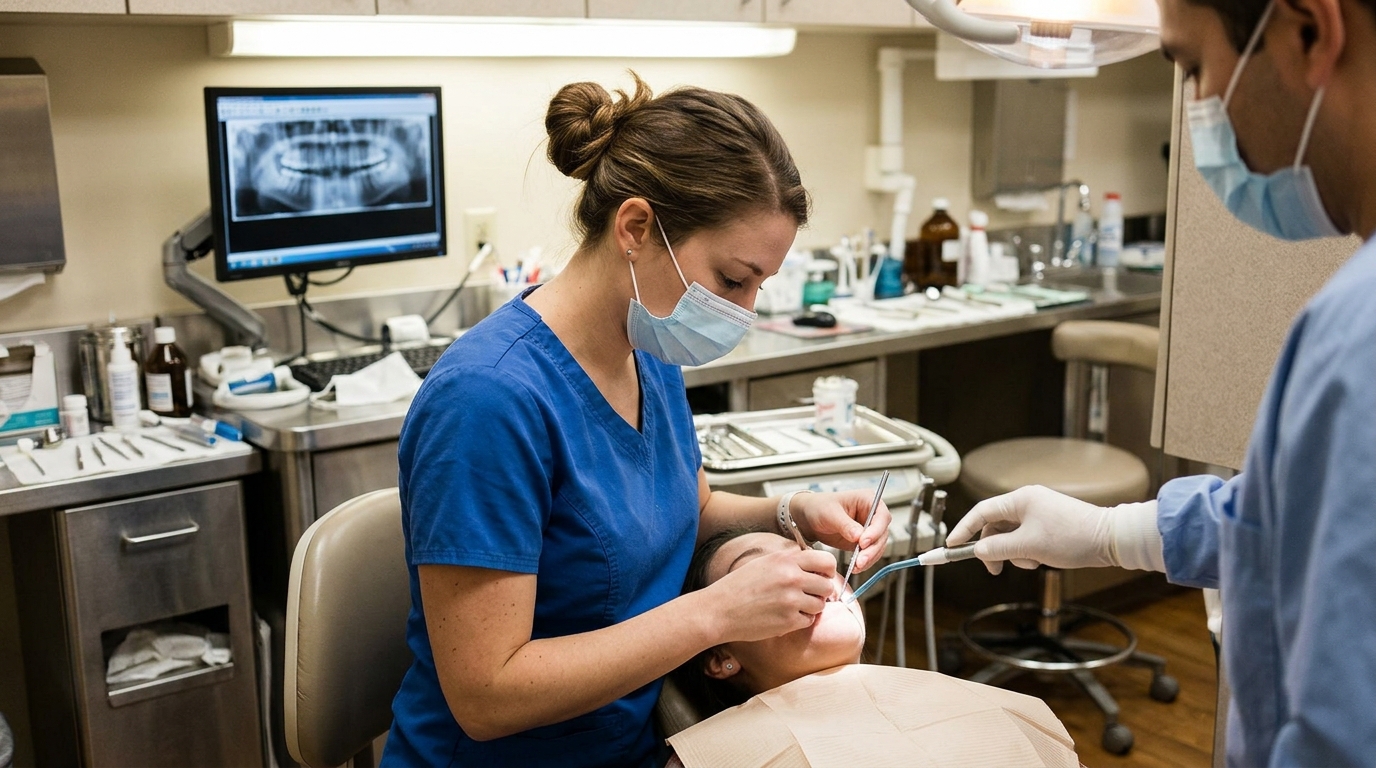
Dental assisting is hands-on, chairside work: passing instruments, running the high-volume evacuator, taking intraoral radiographs, mixing alginate for impressions, and turning over the operatory and autoclave between patients. The U.S. Bureau of Labor Statistics lists a high school diploma as the typical entry-level education (2025) and notes that training programs lead to a certificate or diploma, with on-the-job training also part of the picture (2025).
The route you take depends heavily on your state. BLS notes that some states require graduation from an accredited program and a passing exam score, while other states have no formal educational requirement and let assistants learn on the job (2025). Check your state dental board before you spend a dollar on tuition.
Step-by-Step Path to Entry
These steps run in order. The scheduling estimates are planning guidance, not regulatory deadlines — confirm actual dates with your state board, your school and DANB.
- Finish high school or earn a GED. BLS lists a high school diploma as the typical entry-level education for dental assistants (2025), and DANB requires a diploma or equivalent on its non-program pathway (2026). If you still need the GED, book the four subject tests and treat it as the first calendar item.
- Read your own state's rules — one afternoon. BLS states that some jurisdictions require graduation from an accredited program and an exam, while others have no formal educational requirement (2025). Open your state dental board's website, find the page for dental auxiliaries, and write down exactly which credential lets you take radiographs. This single hour determines everything that follows.
- Choose your training route — allow two to four weeks to apply. Either enrol in a dental assisting program accredited by the Commission on Dental Accreditation (CODA), which BLS describes as leading to a certificate or diploma (2025), or line up a trainee position in a state that permits on-the-job training (BLS, 2025). O*NET's Job Zone entry for dental assistants describes the general level of preparation expected and is worth reading before you commit.
- Complete a hands-on CPR, BLS or ACLS course from a DANB-accepted provider — usually a single day. Every DANB CDA eligibility pathway requires a current hands-on card; online-only courses are not accepted (DANB, 2026). Keep the expiry date in your calendar, because a lapsed card blocks your exam application.
- Log the chairside hours your pathway demands. Pathway I is graduation from a CODA-accredited dental assisting or dental hygiene program. Pathway II is a high school diploma or equivalent plus at least 3,500 hours of approved dental-assisting work experience. Pathway III covers former DANB CDAs and specified dental-school, foreign dental-degree and accepted post-baccalaureate candidates (DANB, 2026). Count your hours as you go — practices rarely reconstruct them later.
- Apply for and sit the DANB CDA combined exam. You pay a non-refundable application fee in addition to the exam fee (exam-prep publishers citing DANB, 2026), and the combined exam has separate components that must all be completed within DANB's stated deadline (DANB, 2026). Book each component as soon as your eligibility is confirmed rather than clustering them at the end of the window. The fee differs for active military candidates (2026).
- Add state-required expanded-function credentials — allow a short course plus an exam for each. BLS notes that states typically do not license entry-level assistants, but some require licensing, registration or certification for expanded duties such as coronal polishing or radiography (2025). In many practices, the radiography credential is what makes you employable on day one.
- Set your renewal reminders. DANB CDA certification runs on a fixed renewal cycle with continuing education required each cycle (2026). Put the renewal date and the CE deadline in your calendar the week you pass.
Entry Requirements at a Glance
- High school diploma or GED. This is the typical entry-level education BLS lists for dental assistants (2025) and the minimum DANB accepts on its experience-based pathway (2026).
- One of three DANB eligibility pathways for the CDA exam: graduation from a CODA-accredited dental assisting or dental hygiene program; or a diploma plus at least 3,500 hours of approved dental-assisting work experience; or the specified former-CDA, dental-school and foreign-dental-degree categories (DANB, 2026).
- Current hands-on CPR, BLS or ACLS certification from a DANB-accepted provider. Required on every pathway, with no online-only substitute (DANB, 2026).
- A passing score on the DANB CDA combined exam, with every component completed inside DANB's stated time limit (2026).
- Payment of both the CDA exam fee and the separate non-refundable application fee (DANB and exam-prep publishers, 2026). Active military candidates pay a different exam fee (2026).
- Your state's credential, where one exists. A count published in 2026 by a licensing-map publisher distinguishes the states and jurisdictions requiring a formal credential from the smaller group that require or recognise the DANB CDA specifically — so confirm your own state rather than assuming.
- A separate radiography credential if your state requires one before you expose intraoral or panoramic images (BLS, 2025).
- Employer-set health and background checks. Dental practices commonly ask for proof of hepatitis B vaccination, a TB screen and a criminal background check, and state boards may set a minimum age for registration. These vary by employer and by state — ask the practice and the board for their exact thresholds before you apply.
- Physical capacity for chairside work: standing or perching beside the chair through long restorative appointments, steady fine-motor control when passing instruments and placing suction tips, and comfortable handling of lead aprons, handpieces and sterilisation trays.
Comparing Entry Routes
All three routes lead to the same chairside job and the same wage data. BLS publishes a median annual wage for dental assistants (2025) and a May 2025 wage distribution showing what the lowest 10 percent earned below and the highest 10 percent earned above — look up both figures on the BLS Occupational Outlook Handbook page before you compare offers, since they are updated annually.
| Route | Time to entry | Approximate cost | Pay and outlook reference |
|---|---|---|---|
| CODA-accredited program (DANB Pathway I) | Short-duration certificate or diploma program (BLS, 2025); 0 additional work hours needed for CDA eligibility | Program tuition, published per school, plus the DANB CDA exam fee and the separate non-refundable application fee (DANB and exam-prep publishers, 2026) | BLS median annual wage and May 2025 wage distribution for dental assistants; BLS projects employment growth for 2025–35 and an average number of annual openings over that decade |
| On-the-job training (DANB Pathway II) | At least 3,500 hours of approved dental-assisting work experience before you can sit the CDA exam (DANB, 2026) | No tuition; you earn while you log hours, then pay the same CDA exam fee plus the application fee (DANB and exam-prep publishers, 2026) | Same BLS median annual wage and May 2025 distribution; permitted only where the state sets no formal educational requirement (BLS, 2025) |
| Military or prior-dental-education entry (DANB Pathway III) | Set by the qualifying credential you already hold — former DANB CDAs, specified dental-school students and graduates, and accepted foreign dental degree holders (DANB, 2026) | Active military candidates pay a different CDA exam fee from traditional candidates (2026), plus the same application fee | Same BLS median annual wage and May 2025 distribution; state expanded-function credentials still apply (BLS, 2025) |
The practical difference is up-front money versus time: Pathway I asks for tuition but zero logged work hours, while Pathway II asks for zero tuition but at least 3,500 hours at the chair. In a state that requires graduation from an accredited program and a passing exam, Pathway II is not available to you at all (BLS, 2025).
Frequently asked questions
How much does it cost to get certified as a dental assistant?
Two fees are unavoidable if you pursue the DANB Certified Dental Assistant credential: the CDA combined exam fee and a separate, non-refundable application fee (DANB and exam-prep publishers, 2026). Active military candidates pay a different exam fee from traditional candidates (2026). Current amounts are published on DANB's CDA page — BLS itself directs readers seeking certification information to that third-party certifying body (2025), so check there rather than relying on a figure quoted elsewhere.
Can I work as a dental assistant without going to school?
In some states, yes. BLS states that some states have no formal educational requirement and assistants learn through on-the-job training, while others require graduation from an accredited program plus a passing exam score (2025). If you take the no-school route and later want the CDA credential, DANB's Pathway II requires a high school diploma or equivalent plus at least 3,500 hours of approved dental-assisting work experience (2026).
Do I need a license in every state?
No. BLS notes that states typically do not require licenses for entry-level dental assistants, but some require a license, registration or certification for expanded duties such as coronal polishing or radiography (2025). A 2026 licensing-map publication separates the jurisdictions that require some formal credential from the smaller number that require or recognise the DANB CDA specifically. Your state dental board's auxiliary page is the only authority that settles it for you.
Does my certification transfer if I move to another state?
The DANB CDA is a national credential, but it does not automatically grant you the right to practise in a new state. Some states require or recognise the CDA, others set their own registration or exam, and some require nothing at entry level (BLS, 2025; licensing-map publication, 2026). Before you move, check the new state board's rules for radiography and expanded functions, since those are the duties most often credentialed separately.
How long is the CDA certification valid, and what do I have to do to keep it?
DANB runs CDA certification on a fixed renewal cycle with continuing education required each cycle (2026). You also need to keep a current hands-on CPR, BLS or ACLS card from a DANB-accepted provider, since that requirement applies across every eligibility pathway (2026). Check DANB's renewal page for the current cycle length and CE hour total, and diary both deadlines when you first pass.
Is there steady demand for dental assistants?
BLS publishes a projected employment growth rate for dental assistants over 2025–35 and an average number of job openings per year across that decade (2025). Those openings come from both new positions and replacement needs as assistants retire or move into hygiene or practice management. Look up the current figures on the BLS Occupational Outlook Handbook entry, and check your state's projections too, since demand is concentrated where practices are opening.
Sources
- U.S. Bureau of Labor Statistics — Dental Assistants : Occupational Outlook Handbook (2025)
- National Center for O*NET Development — 31-9091.00 - Dental Assistants - O*NET OnLine
Your coach for this guide
Desmond covers workplace culture and the unwritten rules that shape who gets ahead. He likes talking to people mid-career, after the certainty has worn off and the real questions start.