 Work Quest Hub
A Day in the Life of an HVAC Technician
From the 7 a.m. truck-stock check to the last no-cool call, here is how a service technician's route, tools, customers and paperwork fit into one shift.

By Priya NatarajanNov 15, 2026 · 9 min read
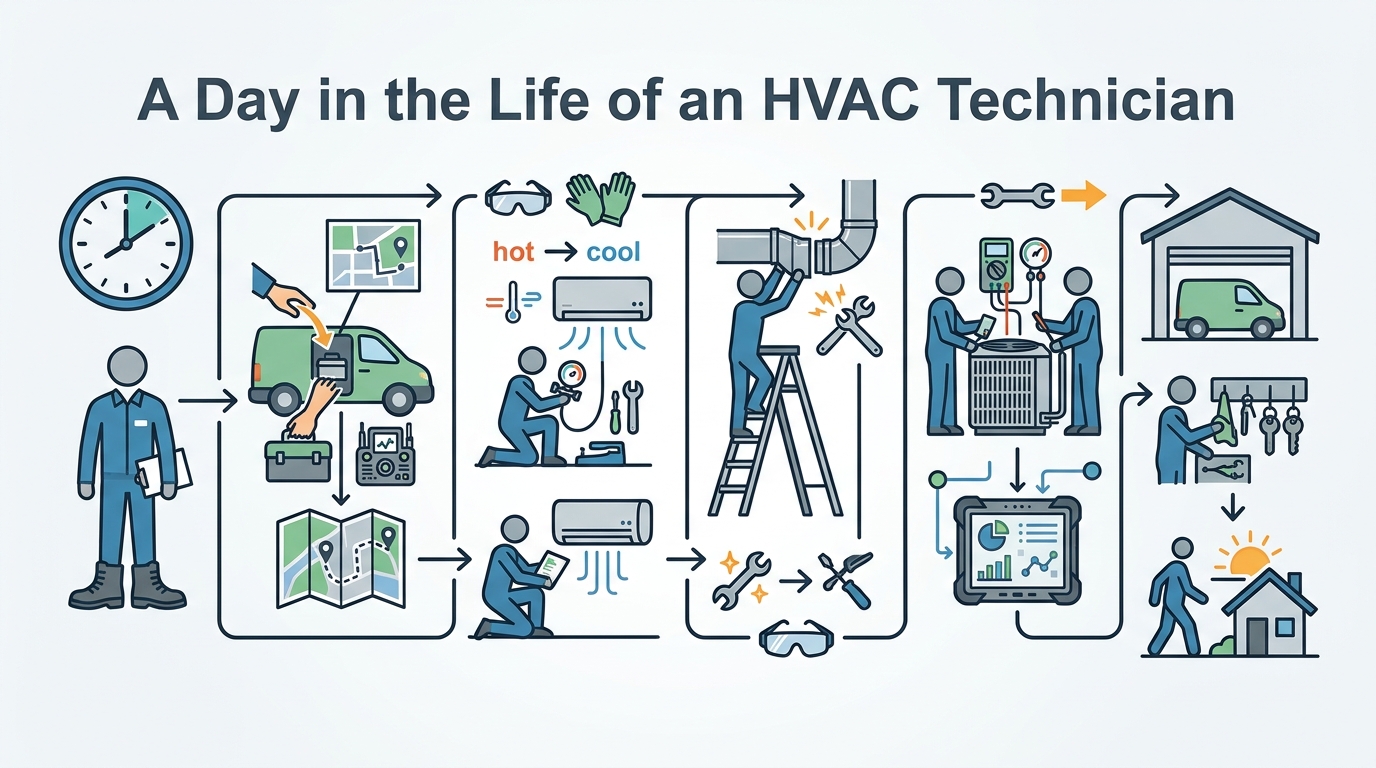
An HVAC technician spends most of the day on the move: driving a stocked service van between homes and buildings, diagnosing faults with electrical test equipment, explaining the problem to whoever owns the system, and writing it up before the next call. The U.S. Bureau of Labor Statistics notes that technicians frequently have a set number of daily maintenance calls, and that the majority work full time.
It is hands-on, often dirty work — O*NET OnLine reports that 68% of respondents are exposed to contaminants every day and 88% wear common protective equipment daily. It is also a job where you usually know by the end of a call whether you fixed it.
Hour-by-Hour: A Typical Shift
This is a composite day — a residential and light-commercial service route built from tasks common across the trade, not a profile of a real person. An install crew, a night-shift supermarket refrigeration tech and a maintenance-only route tech would each run a different clock.
- 6:45 a.m.–7:10 a.m. — Clock in and take the route. You open the day's dispatched work orders in the field service app and message the dispatcher about an overnight add-on. O*NET lists scheduling work with customers and initiating work orders among the occupation's core tasks.
- 7:10 a.m.–7:45 a.m. — Stock the van. You restock capacitors, contactors, filters and fuses from shelf stock, check the refrigerant recovery machine and digital manifold gauges, and put on safety glasses, gloves and boots — gear O*NET reports 88% of respondents wear every day. You text a teammate to swap a part neither of you has.
- 8:00 a.m.–9:15 a.m. — First no-cool call. You interview the homeowner about when the unit quit and what noise it made — discussing malfunctions with system users is a listed core task — then test circuits for continuity with a multimeter, find a failed run capacitor, replace it, and record model and serial numbers on the invoice before taking payment.
- 9:30 a.m.–11:00 a.m. — Scheduled maintenance. At a second address you clean the condenser coil, change the filter, clean the flame sensor and run a combustion analyzer on the furnace. You walk the homeowner through the readings and flag a weak blower motor, logging every measurement — the U.S. Bureau of Labor Statistics stresses that technicians must carefully maintain records of all work performed.
- 11:00 a.m.–11:40 a.m. — Supply house and lunch. You order the blower motor at the counter with the parts rep, pick up nitrogen and brazing rod, and eat in the van while confirming afternoon arrival windows by text.
- 11:55 a.m.–1:30 p.m. — Rooftop unit at a small commercial site. You carry tools up a fixed ladder, meet the property manager, change belts, check charge and recover refrigerant with recovery equipment — work that requires EPA Section 608 certification under U.S. Environmental Protection Agency rules.
- 1:45 p.m.–3:15 p.m. — Hard diagnostic. An intermittent fault sends you back to basics: electronic leak detector, pressure readings, wiring diagram taped to the blower door. You call the field supervisor on speaker, then build a repair-or-replace estimate in the app and email it to the customer.
- 3:30 p.m.–4:45 p.m. — Attic furnace inspection. You crawl joists in confined heat with a work light, test the inducer motor and photograph a cracked flue connection for the file. This is the part of the day that uses the physical stamina the U.S. Bureau of Labor Statistics ties to the job — many hours walking, standing, kneeling and climbing.
- 5:00 p.m.–5:40 p.m. — Close out. You finish open work orders, record refrigerant added or recovered, order parts for tomorrow, restock from the shop and check the on-call board before clocking out.
Core Responsibilities Beyond the Clock
- Weekly van inventory reconciliation. Count shelf stock against the parts used on the week's work orders and submit a replenishment list, so Monday's first no-cool call does not become a return trip.
- Weekly or biweekly toolbox safety meeting. Attend a crew session on ladders, lockout/tagout or electrical safety and sign the attendance sheet. The U.S. Bureau of Labor Statistics reports HVACR technicians have one of the highest rates of injuries and illnesses of all occupations.
- Monthly on-call rotation. Most service departments rotate after-hours coverage, so one week in a cycle you carry the phone overnight and on weekends, producing emergency work orders.
- Monthly callback and warranty review. Revisit jobs that returned, document root cause, and file warranty claims on failed parts with the manufacturer.
- Seasonal changeover campaigns. Spring and fall bring maintenance-agreement blitzes — a fixed list of tune-ups to clear in a few weeks, each ending in a completed inspection report in the customer file. The first heat wave and first hard freeze bring long days and evening calls.
- Annual equipment checks. Gauges, recovery machines, combustion analyzers and cylinders get checked or calibrated, and the van gets a documented safety inspection.
- Certification upkeep every two years. NATE certification is valid for two years, after which technicians must meet ongoing education and practice requirements to renew (Lincoln Technical Institute). EPA Section 608 Technician Certification does not expire (U.S. Environmental Protection Agency).
Who Tends to Thrive in This Role
People who are comfortable talking to strangers all day do well here. The 8:00 a.m. no-cool call starts with interviewing a homeowner about symptoms, and the 9:30 a.m. maintenance ends with explaining combustion readings to someone who did not ask for a lecture on flame sensors. O*NET reports that 98% of respondents have face-to-face discussions with individuals and within teams every day — and the supervisor call at 1:45 p.m. shows some of those conversations are with your own crew.
Methodical troubleshooting beats guesswork. Testing circuits for continuity on the morning capacitor failure and running a leak search on the afternoon intermittent fault both reward someone who follows a sequence instead of swapping parts. The same trait shows up on paper: serial numbers recorded at 8:00 a.m., every reading logged at 9:30 a.m., refrigerant recovered noted at the rooftop unit. The U.S. Bureau of Labor Statistics lists detail orientation precisely because those records have to hold up later.
Clock discipline is non-negotiable. A 90-minute diagnostic that runs to two hours pushes the 3:30 p.m. attic inspection into the evening, which is why the Bureau ties time-management skills to the set number of daily calls. Physical tolerance matters too — the ladder climb to the rooftop unit and the crawl across attic joists in summer heat are the demanding end of the job. The reward is specific: by 9:15 a.m. a hot house is cooling again because you found one failed part and replaced it. Being coachable helps early, since the Bureau notes new technicians typically begin alongside experienced ones.
How to Get Started
- Finish high school or a GED, taking shop and math if offered (ongoing). CareerOneStop lists the occupation's experience requirement as no work experience, so this is a genuine entry point.
- Complete a postsecondary HVAC certificate or associate's degree (6 months to 2 years). CareerOneStop lists a postsecondary certificate as the typical education requirement, and O*NET places the occupation in Job Zone Three, covering vocational school training, related on-the-job experience or an associate's degree. Community and technical colleges in your state are the usual providers.
- Or apply to a registered apprenticeship instead (typically 3 to 5 years, paid). The U.S. Department of Labor has approved apprenticeship titles for this occupation, including Heating & Air Conditioning Mechanic & Installer and Refrigeration Mechanic, listed on Apprenticeship.gov.
- Earn EPA Section 608 Technician Certification (weeks of study, one exam sitting). The U.S. Environmental Protection Agency requires passing an EPA-approved test through an EPA-approved certifying organization before you handle refrigerants; the credential does not expire. Pick the type — I, II, III or Universal — matching your equipment.
- Get hired as a helper or apprentice and ride along (1 to 2 years). O*NET notes employees in this Job Zone usually need one or two years of on-the-job experience plus informal training with experienced workers.
- Check state and local licensing (weeks to months, varies). HVAC and contractor licensing is set at state level and sometimes by city or county, so requirements differ sharply between states. Contact your state's contractor licensing board for exam, experience-hour and application details.
- Add NATE certification once you have field time (a few months of study). It requires a core exam on fundamental HVAC concepts plus a specialized exam, and is valid for two years before renewal requirements apply (Lincoln Technical Institute).
Frequently asked questions
How much do HVAC technicians get paid?
Pay is usually an hourly wage, with overtime for long days and after-hours work, on-call pay, and at some companies commission on sold equipment or maintenance agreements. Apprentices earn less than experienced technicians, and rates vary by state, metro area and employer type. O*NET OnLine publishes median wages for the occupation for 2025, and the U.S. Bureau of Labor Statistics publishes wage data by state — check both for current figures.
Do I need a license to work on HVAC systems?
Federally, the U.S. Environmental Protection Agency requires Section 608 Technician Certification, earned by passing an EPA-approved test through an EPA-approved certifying organization, before you handle refrigerants. Beyond that, HVAC and contractor licensing in the United States is set by individual states and sometimes by cities or counties, and rules differ widely. Ask your state's contractor licensing board what applies to employees versus contractors where you plan to work.
Is HVAC a dangerous job?
It carries real risk. The U.S. Bureau of Labor Statistics reports HVACR technicians have one of the highest rates of injuries and illnesses of all occupations, and O*NET reports 68% of respondents are exposed to contaminants every day. Electrical work, ladders, roofs, confined attics, pressurized refrigerant and extreme work-area temperatures are all part of it, which is why protective equipment and safety training are standard in most service departments.
Can I become an HVAC technician without going to trade school?
Often, yes. A registered apprenticeship is the main alternative — the U.S. Department of Labor has approved apprenticeship titles for the occupation, including Heating & Air Conditioning Mechanic & Installer and Refrigeration Mechanic, listed on Apprenticeship.gov. Some companies also hire helpers with no experience and train them in-house. CareerOneStop lists more than one year of on-the-job training as typical for the occupation.
Sources
- U.S. Bureau of Labor Statistics — Heating, Air Conditioning, and Refrigeration Mechanics and Installers : Occupational Outlook Handbook
- O*NET OnLine / National Center for O*NET Development — 49-9021.00 - Heating, Air Conditioning, and Refrigeration Mechanics and Installers
Your coach for this guide
Priya shapes the publication's coverage of job transitions, writing often about the messy middle between leaving one role and starting another. She's drawn to the quiet negotiations people have with themselves before a resignation letter gets written.