 Work Quest Hub
Accountant Pay Explained: Average Salary, Range, and Benefits
What accountants earn depends on industry, licensure, employer type and location — here is how the pay is built and where to check the current figures.

By Priya NatarajanNov 15, 2026 · 7 min read
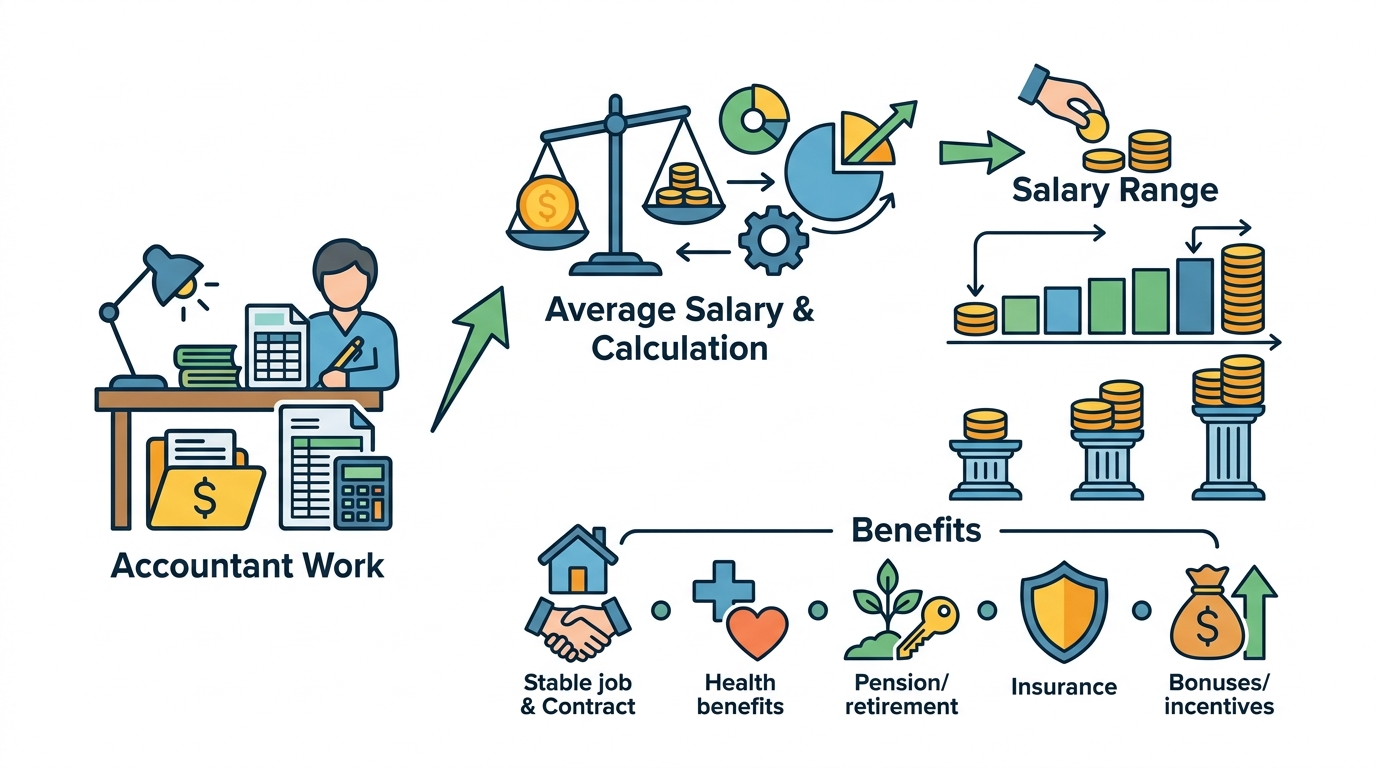
The U.S. Bureau of Labor Statistics publishes four benchmark numbers for accountants and auditors as of May 2025: a median annual wage, a median hourly wage, the amount the lowest-paid 10 percent earned less than, and the amount the highest-paid 10 percent earned more than. Look those up first, because industry, licensure, seniority and state all move you within that span.
This guide explains how accountant pay is structured, which levers actually move it, and which published tables to read so you are working from current figures rather than someone's estimate.
National Average Salary
The authoritative national numbers come from the U.S. Bureau of Labor Statistics, which publishes a median annual wage and a median hourly wage for accountants and auditors as of May 2025. The median is the midpoint: half earned more, half earned less. BLS publishes both ends of the distribution for the same month — the figure the lowest-paid 10 percent earned less than, and the figure the highest-paid 10 percent earned more than. Read all four together and you have the national range rather than one headline number.
Two comparison figures sit in the same May 2025 release and are worth pulling at once: the median annual wage for all occupations, and the median for the broader "financial specialists" group accountants belong to. That tells you how the occupation sits against both the general labour market and neighbouring finance roles.
To see current values, open the BLS Occupational Outlook Handbook profile for accountants and auditors, or the Occupational Employment and Wage Statistics (OEWS) page for the same occupation. Both are free, both state their data month, and both update annually. The figures are national and do not describe any one employer's offer. BLS also reports the total number of accountant and auditor jobs, projected employment change and growth for 2025–35, and average annual openings — useful context, because a large occupation with steady openings tends to produce a wide pay spread.
Salary by Experience Level
BLS publishes wages for the occupation as a whole rather than by years of experience, so use the percentile range as your ladder: new entrants cluster toward the 10th percentile, long-tenured and licensed accountants toward the 90th. The progression is documented — entry-level public accountants may advance to senior positions, then supervisor, manager and partner as responsibility grows (U.S. Bureau of Labor Statistics, 2025).
| Stage | What it involves | Where it sits in the range |
|---|---|---|
| Entry level (0–2 years) | Staff accountant or junior auditor; a bachelor's degree is the typical entry-level education (BLS, 2025) | Toward the 10th-percentile end of the May 2025 BLS range |
| Senior (roughly 3–5 years) | Owning engagements or close cycles; often when CPA licensure lands | Around the national median annual wage (BLS, May 2025) |
| Supervisor or manager | Managing staff, clients and deadlines | Above the median, below the 90th percentile |
| Director, controller or partner (10+ years) | Firm ownership, or running an in-house finance function | Toward the 90th-percentile figure (BLS, May 2025) |
Check the live percentile figures on the BLS OEWS page before benchmarking an offer against this ladder.
Salary by State or Metro
Pay is not uniform across the country, and published state data is the only reliable way to see your own market. BLS OEWS produces wage estimates for accountants and auditors in all 50 states, the District of Columbia and hundreds of metropolitan and nonmetropolitan areas — including high-cost markets such as New York, California and Massachusetts and lower-cost ones such as Mississippi, Arkansas and West Virginia. Pull the figure for your state and your metro, since the two can differ sharply within one state.
| Where to look | What it gives you |
|---|---|
| BLS OEWS state estimates (May 2025) | Median and mean annual wage for the occupation in each state and D.C. |
| BLS OEWS metropolitan estimates | Wages for individual metro areas |
| BLS OEWS nonmetropolitan estimates | Wages outside metro areas, for rural employers |
| BLS OEWS state employment levels | How many accountant jobs exist in each state |
| Your state labor market information office | State-produced wage and outlook data |
| CareerOneStop | Occupation, certification and local wage lookups (BLS, 2025) |
Note the data month whenever you compare locations, and remember a higher state figure can be offset by housing and tax differences.
What Affects Pay
- CPA licensure. Any accountant who files a report with the Securities and Exchange Commission must be a licensed Certified Public Accountant (U.S. Bureau of Labor Statistics, 2025), which restricts a tier of higher-responsibility roles to licence holders. Employers may pay the costs associated with the CPA exam, so ask about reimbursement before paying out of pocket.
- The 150-hour requirement. All states require CPA candidates to complete 150 semester hours of college coursework — 30 hours more than a usual 4-year bachelor's degree (BLS, 2025). Weigh that extra year of study against the roles it opens.
- Industry. BLS publishes separate May 2025 medians for accounting, tax preparation, bookkeeping and payroll services; finance and insurance; management of companies and enterprises; manufacturing; and government excluding state and local education and hospitals. Compare them side by side rather than estimating.
- Employer type. A regional public firm, a corporate finance department and a government agency price the same title differently. Government roles typically use published pay schedules; firms more often use grade structures.
- Busy season and overtime. Whether deadline hours are paid, banked as time off, or absorbed into a salary depends on your employer and on how your role is classified under federal and state wage law. Confirm it in writing.
- Benefits beyond salary. Exam fees, review courses, licence renewal, CPE hours, bonuses and retirement matching vary by employer and are often where two similar base salaries diverge in value.
How to Increase Your Earnings
- Finish the 150 semester hours. Every state requires 150 hours for CPA licensure, 30 more than a typical bachelor's degree (BLS, 2025). Plan the extra 30 while you are still a student if you can.
- Sit the CPA exam, and ask who pays. The licence is a hard requirement for anyone filing reports with the SEC (BLS, 2025), and employers may cover exam costs — which removes a real expense from your side.
- Choose your industry deliberately. Pull the May 2025 BLS medians for public accounting, finance and insurance, management of companies, manufacturing and government, and compare the five before your next move. These published differences are the clearest lever you have.
- Follow the advancement path. Entry-level public accountants advance to senior, then supervisor, manager and partner as responsibility grows (BLS, 2025). Each step moves you toward the 90th-percentile end of the national range.
- Add a specialty credential. Information on accounting and auditing certifications is available from CareerOneStop (BLS, 2025). Pick one matching the work you want — internal audit, forensic, management accounting.
- Re-benchmark yearly. OEWS updates annually; check the national median, your state figure and your industry figure before every review.
Frequently asked questions
Where do I find the current national median for accountants?
Use the U.S. Bureau of Labor Statistics Occupational Outlook Handbook profile for accountants and auditors, or the Occupational Employment and Wage Statistics (OEWS) tables. The most recent wage reference period is May 2025, and both give the median annual wage, the median hourly wage and the 10th and 90th percentile figures.
Does becoming a CPA change what I can be paid?
It changes what work you are allowed to do. Any accountant filing a report with the Securities and Exchange Commission must be a licensed CPA (BLS, 2025), which restricts a tier of roles to licence holders. Licensure requires 150 semester hours in every state — 30 beyond a standard bachelor's degree.
Which industries pay accountants differently?
BLS publishes separate May 2025 medians for five employing industries: accounting, tax preparation, bookkeeping and payroll services; finance and insurance; management of companies and enterprises; manufacturing; and government excluding state and local education and hospitals.
Is the job market for accountants expected to hold up?
BLS publishes a projected employment change and growth rate for accountants and auditors covering 2025–35, plus average annual job openings and the current number of jobs. Read all three in the Occupational Outlook Handbook.
Sources
- U.S. Bureau of Labor Statistics — Accountants and Auditors : Occupational Outlook Handbook (2025-05)
Your coach for this guide
Priya shapes the publication's coverage of job transitions, writing often about the messy middle between leaving one role and starting another. She's drawn to the quiet negotiations people have with themselves before a resignation letter gets written.