 Work Quest Hub
Bookkeeping vs. Accounting: Which Career Change Is Right for You
A side-by-side look at pay, schedules, credentials and entry timelines for two finance roles that sound similar but ask very different things of you.
By Desmond OkaforNov 15, 2026 · 9 min read
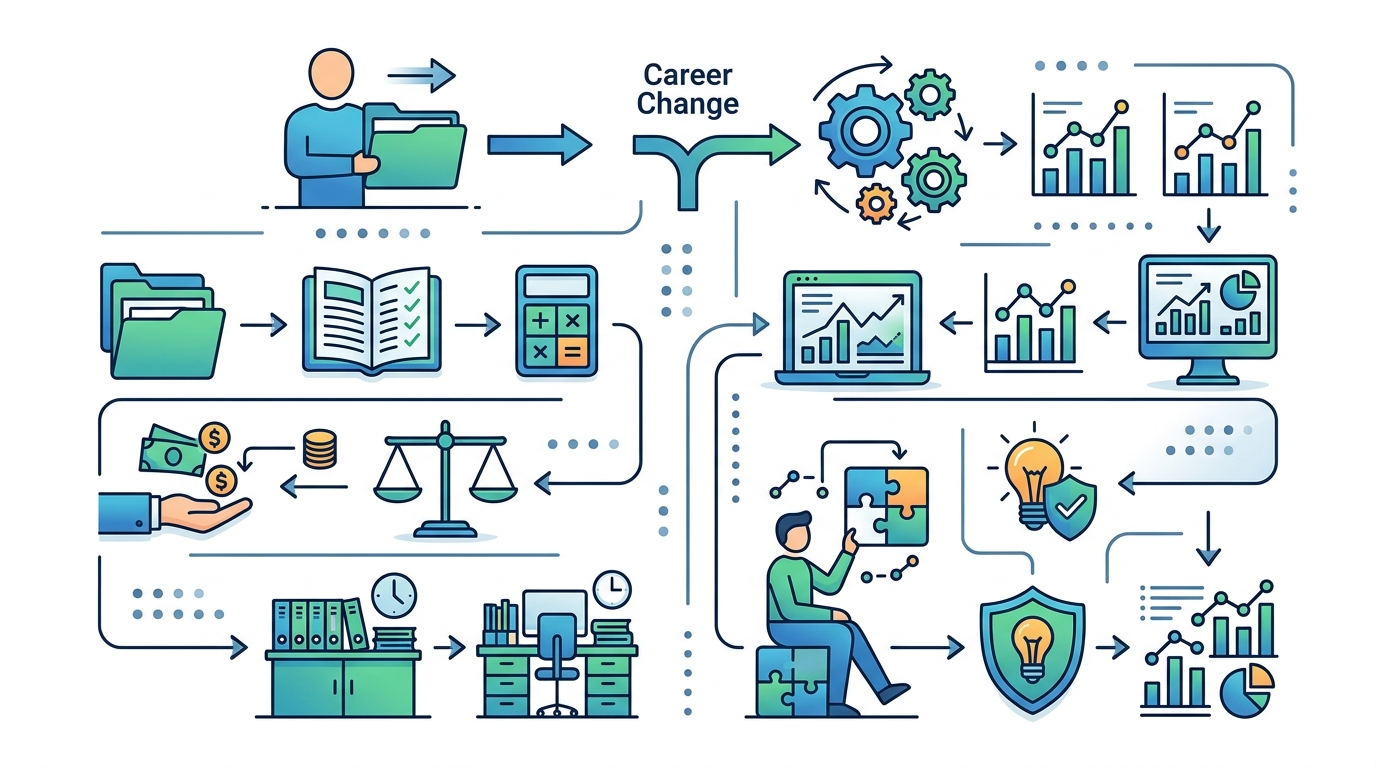
Bookkeeping and accounting both involve recording and interpreting financial data, but they differ sharply on entry requirements and pay. Bookkeeping, accounting and auditing clerks typically enter with "some college, no degree" and had a median annual wage of $50,670 in May 2025 (U.S. Bureau of Labor Statistics, 2025-05); accountants and auditors typically need at least a bachelor's degree in accounting or a related field and had a median of $83,680 (U.S. Bureau of Labor Statistics, 2025-05).
The other difference that matters when you are switching while employed is direction of travel. Clerk employment is projected to change by -6% from 2025 to 2035, while accountant and auditor employment is projected to grow 5%, described as faster than average (U.S. Bureau of Labor Statistics, 2025).
Bookkeeping vs. Accounting at a Glance
| Dimension | Bookkeeping clerks | Accountants and auditors |
|---|---|---|
| Median annual pay | $50,670, May 2025 (U.S. Bureau of Labor Statistics) | $83,680, about $40.23 an hour, May 2025 (U.S. Bureau of Labor Statistics) |
| Pay benchmark | Near the $50,980 median for all occupations, May 2025 (U.S. Bureau of Labor Statistics) | Near the $82,660 median for business and financial occupations, May 2025 (U.S. Bureau of Labor Statistics) |
| Typical schedule | Most clerks work full time (U.S. Bureau of Labor Statistics, 2025) | Most accountants and auditors work full time (U.S. Bureau of Labor Statistics, 2025) |
| Entry education | Some college, no degree (U.S. Bureau of Labor Statistics, 2025) | At least a bachelor's degree in accounting or a related field (U.S. Bureau of Labor Statistics, 2025) |
| Entry timeline for a career changer | 3-9 months of study and job search (writer's estimate, reasoned from the "some college, no degree" entry standard — no degree stands between you and an application) | 2-4 years if you must finish a bachelor's (writer's estimate, reasoned from the degree requirement), plus a year or more for the CPA exam process (Gleim CPA Review) |
| Physical demands | Desk-based keyboard and screen work, full time (U.S. Bureau of Labor Statistics, 2025) | Desk-based, plus travel to client or branch sites for audit fieldwork, full time (U.S. Bureau of Labor Statistics, 2025) |
| Size of the field | About 1.5 million jobs in 2025 (U.S. Bureau of Labor Statistics) | 1,595,200 jobs in 2025 (U.S. Bureau of Labor Statistics) |
| Ten-year outlook | -6%, 2025-35 (U.S. Bureau of Labor Statistics, 2025) | +5%, faster than average, 2025-35 (U.S. Bureau of Labor Statistics, 2025) |
| Upward path | Senior bookkeeper, then AIPB Certified Bookkeeper after passing the four-part national certification exam and signing the Code of Ethics (American Institute of Professional Bookkeepers, 2024-11) | Staff accountant to senior to manager, with CPA licensure through four Uniform CPA Examination sections (Gleim CPA Review) |
One caution on the outlook numbers. A -6% projection does not mean no hiring: the clerk field still held about 1.5 million jobs in 2025 (U.S. Bureau of Labor Statistics), and replacement openings continue. It does mean competition is likelier to tighten over the decade than loosen.
Day-to-Day Differences
Take a Tuesday in the first week of a month, the busiest stretch for both roles.
A bookkeeper opens the ledger file — QuickBooks, Xero or Sage — and clears the bank feed: matching downloaded bank and card transactions to recorded entries, coding the unmatched ones, flagging anything with no receipt. That is often the first 90 minutes. Next comes accounts payable: entering supplier invoices, checking them against purchase orders or delivery notes, and preparing a payment run for someone with signing authority. After lunch it is accounts receivable — issuing customer invoices, applying payments received, chasing invoices past 30 days. If a payroll period lands that week, an hour or two goes to checking timesheets, entering hours and running the payroll module. The day usually ends with one or two balance-sheet reconciliations saved as reports. The work is transaction-level, deadline-driven and largely self-contained, and most clerks do it full time (U.S. Bureau of Labor Statistics, 2025).
An accountant's Tuesday starts further downstream. Two or three hours often go to month-end close: posting accruals and prepayments, reviewing depreciation schedules, agreeing intercompany balances, and reviewing the reconciliations a bookkeeper prepared rather than preparing them. Mid-morning might be a variance review — comparing actuals to budget line by line and writing a short explanation for each variance over a set threshold, which means calling the department head who owns that spend. In public accounting the afternoon looks different again: an auditor may spend four hours of fieldwork at a client site selecting samples, testing controls and documenting the testing in audit software, while a tax accountant works through depreciation and deferred tax positions. Judgement calls recur in the accountant's day — whether a cost should be capitalised, whether a receivable needs a provision — where the bookkeeper's day turns on accurate capture and reconciliation. Most accountants and auditors also work full time (U.S. Bureau of Labor Statistics, 2025), with longer hours around close dates, audit deadlines and filing season.
If you prefer finishing a defined list of transactions and knowing the ledger balanced, the bookkeeping Tuesday fits. If you prefer writing the explanation of why a number moved and defending it to a manager or client, the accounting Tuesday does.
Pay, Hours, and Entry Requirements Compared
| Factor | Bookkeeping clerk | Accountant or auditor |
|---|---|---|
| Median annual pay | $50,670 (U.S. Bureau of Labor Statistics, May 2025) | $83,680, about $40.23 an hour (U.S. Bureau of Labor Statistics, May 2025) |
| Typical weekly hours | Most work full time, so roughly 40 hours (U.S. Bureau of Labor Statistics, 2025); the hour count is the writer's estimate from that full-time standard | Most work full time, so roughly 40 hours (U.S. Bureau of Labor Statistics, 2025), with longer weeks at month-end close, audit deadlines and tax season; hour count and peaks are the writer's estimate |
| Required education | Some college, no degree (U.S. Bureau of Labor Statistics, 2025) | At least a bachelor's degree in accounting or a related field (U.S. Bureau of Labor Statistics, 2025) |
| Named credential | AIPB Certified Bookkeeper: apply, pass the four-part national certification exam, sign the Code of Ethics (American Institute of Professional Bookkeepers, 2024-11) | CPA licence: pass four Uniform CPA Examination sections — AUD, FAR and REG plus one discipline from BAR, ISC or TCP (Gleim CPA Review) |
| Experience tied to the credential | 2 years' full-time or 3,000 hours' part-time or freelance bookkeeping experience, before or after the exam, with 3 years from the exam-pass date to complete it (American Institute of Professional Bookkeepers, 2024-11) | 150 semester hours plus 1 year of experience in many jurisdictions (Gleim CPA Review) |
| Exam structure | Four-part national certification exam (American Institute of Professional Bookkeepers, 2024-11) | Sixteen hours across four sections, developed and administered by the AICPA with NASBA at Prometric test centres (AICPA/NASBA) |
| Average time to entry | 3-9 months of study and job search before a first paid role; writer's estimate, reasoned from the "some college, no degree" entry standard | 2-4 years to finish a bachelor's (writer's estimate from the degree requirement), plus a year or more for the CPA exam process (Gleim CPA Review) |
On training costs: fees for bookkeeping certificate programmes and CPA review courses differ by provider and by state, and community college tuition is set per credit hour by each institution. Ask each provider for a written total that includes exam and application fees before you enrol, and check your state board's fee schedule separately.
On licensure rules: each of the 55 U.S. jurisdictions — the 50 states plus D.C., Guam, Puerto Rico, the Virgin Islands and the Mariana Islands — sets its own CPA licensing requirements, and you apply in the jurisdiction where you want the licence (Gleim CPA Review). The AICPA and NASBA have approved model legislation adding new pathways beyond the traditional 150-hour requirement (Gleim CPA Review), so confirm the current rule with your own state board.
Questions to Ask Yourself Before Choosing
Answer each with a yes, a no, or a number from your own situation, and write the answers down.
- Can you fund two to four years of part-time bachelor's study while staying in your current job? If no, the clerk route — entry at "some college, no degree" (U.S. Bureau of Labor Statistics, 2025) — is the realistic start.
- How many college credits do you already hold, and how many would transfer toward an accounting bachelor's? Request an official transcript evaluation and get the number in writing.
- Would a first-year income near the $50,670 clerk median (U.S. Bureau of Labor Statistics, May 2025) cover your fixed monthly costs? Total your rent or mortgage, insurance, debt payments and childcare, then compare.
- Is the distance between that clerk median and the $83,680 accountant median (U.S. Bureau of Labor Statistics, May 2025) worth the study time, or do you need higher pay within 12 months?
- Can you commit to a sixteen-hour examination across four sections at a Prometric test centre, plus the study behind it, over a year or more (AICPA/NASBA; Gleim CPA Review)? If no, non-CPA accounting roles remain open.
- Can you reach 2 years' full-time or 3,000 hours' part-time bookkeeping experience within 3 years of passing the AIPB exam (American Institute of Professional Bookkeepers, 2024-11)? Divide 3,000 by the paid hours you could log each week.
- Have you downloaded your own state board's current CPA education and experience sheet, given that all 55 jurisdictions set their own rules (Gleim CPA Review), and noted the date you checked it?
Frequently asked questions
Is bookkeeping or accounting better paid?
Accounting, by a clear margin. The median annual wage was $83,680 for accountants and auditors and $50,670 for bookkeeping, accounting and auditing clerks, both May 2025 (U.S. Bureau of Labor Statistics). The clerk median sits close to the $50,980 median for all occupations in the same month.
Can I become a bookkeeper without a degree?
Typical entry-level education for bookkeeping, accounting and auditing clerks is listed as some college, no degree (U.S. Bureau of Labor Statistics, 2025). Accountants and auditors typically need at least a bachelor's degree in accounting or a related field, so the degree question separates the two paths more than any other requirement.
How long does it take to switch from bookkeeping to accounting?
Plan on finishing a bachelor's degree first, since that is the typical entry requirement for accountants and auditors (U.S. Bureau of Labor Statistics, 2025). If you then pursue CPA licensure, the exam process can take a year or more, and many jurisdictions add 150 semester hours plus 1 year of experience (Gleim CPA Review).
Sources
- U.S. Bureau of Labor Statistics — Bookkeeping, Accounting, and Auditing Clerks : Occupational Outlook Handbook (2025-05)
- U.S. Bureau of Labor Statistics — Office and Administrative Support Occupations : Occupational Outlook Handbook (2025)
Your coach for this guide
Desmond covers workplace culture and the unwritten rules that shape who gets ahead. He likes talking to people mid-career, after the certainty has worn off and the real questions start.