 Work Quest Hub
Customer Service Representative: Day Shift vs. Night Shift
A composite look at both schedules in a 24-hour contact center, from the 8 a.m. queue surge to the 3 a.m. billing-system maintenance window.

By Desmond OkaforNov 15, 2026 · 8 min read
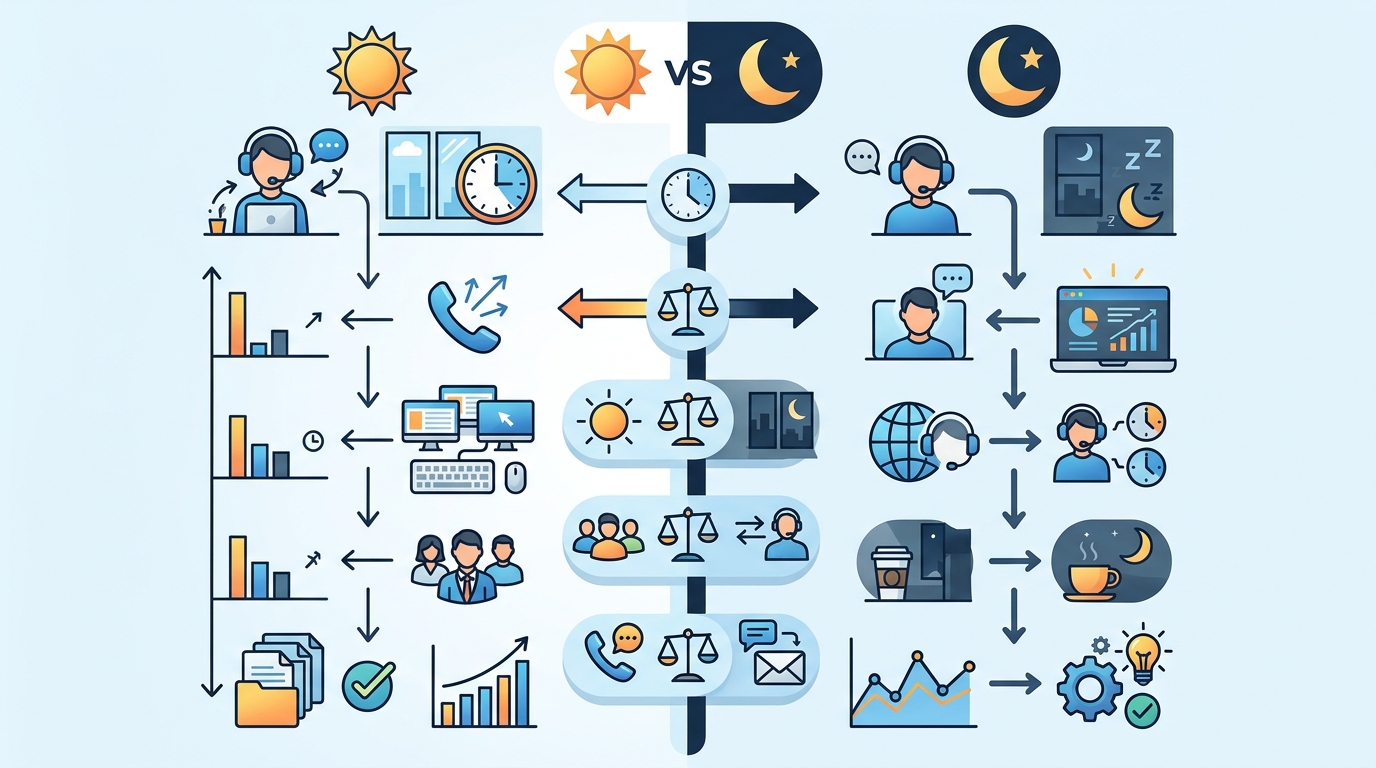
Day shift and night shift customer service work use the same tools and cover the same ticket queue, but they feel different hour by hour. Days mean a packed floor, a supervisor within earshot, and back-to-back calls through the mid-morning peak; nights mean a thinner roster, long quiet stretches between calls, and more email and after-hours escalation work.
The Bureau of Labor Statistics notes that representatives often work evenings, weekends, and holidays, and that call centers open 24 hours a day may require shifts early in the morning or late at night (U.S. Bureau of Labor Statistics, 2025). Which shift you can request, and what it pays, depends on your employer, your state, and whether the site runs round the clock at all.
Day Shift vs. Night Shift at a Glance
The comparison below is a composite of 24-hour contact center work, not one specific employer. Staffing and schedules vary widely by employer, state, and whether the account is retail, utility, healthcare, or financial services.
| Dimension | Day shift (roughly 8 a.m.-4:30 p.m.) | Night shift (roughly 11 p.m.-7:15 a.m.) |
|---|---|---|
| Staffing on the floor | Full roster, several team leads, a QA analyst, and a workforce management coordinator watching the real-time queue board | A smaller roster, often one supervisor for the whole room, with specialist teams such as fraud or technical tier two unavailable until morning |
| Pace and call volume | Near-continuous calls through the 10 a.m.-noon peak, with the handle-time tracker visible on a wallboard | Steady until about 1 a.m., then long gaps between calls from 2 a.m. to 4 a.m., then a climb from 5 a.m. onward |
| Typical tasks | Order taking, calculating charges and processing billing, returns, and account reviews (U.S. Bureau of Labor Statistics, 2025) | The same call types plus email backlog clearing, outage scripts during maintenance windows, and documentation cleanup |
| Pay structure | Hourly base rate, sometimes with a monthly quality or attendance incentive | Same hourly base, commonly with a shift differential added per hour; the BLS publishes a median hourly wage for the occupation in its Occupational Employment and Wage Statistics data, which is the place to check current rates |
| Interruptions and coaching | Live supervisor monitoring, side-by-side coaching, and scheduled QA call reviews; BLS notes supervisors monitor representatives for quality assurance (U.S. Bureau of Labor Statistics, 2025) | Fewer live interruptions; coaching feedback usually arrives as a recorded-call scorecard read at the start of the next shift |
| Noise and environment | A large shared room that can be noisy with other representatives talking (U.S. Bureau of Labor Statistics, 2025) | Quieter room, cafeteria usually closed, lighting and building access often reduced |
A Typical Day Shift Hour by Hour
A composite day, built from common contact center routines rather than one real person's schedule.
- 7:45 a.m.-8:00 a.m. Badge in, log into the softphone and the CRM, and read the overnight handoff notes left by the night team lead.
- 8:00 a.m.-9:30 a.m. Queue opens. Back-to-back calls on billing disputes and order status, each one looked up in the order management system and closed with a contact note, since recording details of contacts is a core duty (U.S. Bureau of Labor Statistics, 2025).
- 9:30 a.m.-10:00 a.m. A refund exceeds your authorization limit, so you place the caller on hold and raise it with the team lead at the pod desk.
- 10:00 a.m.-10:15 a.m. Scheduled break, logged in the workforce management tool so adherence does not slip.
- 10:15 a.m.-12:00 p.m. Peak volume. Average handle time scrolls on the wallboard, and an angry caller on a double-billed account tests the composure that ONET lists as the key work style of self-control for this occupation (ONET OnLine, U.S. Department of Labor).
- 12:00 p.m.-12:30 p.m. Lunch.
- 12:30 p.m.-2:00 p.m. Channel switch to the email and chat queue; email is a daily tool for most representatives (O*NET OnLine, U.S. Department of Labor). You type near-continuously, which is where the repetitive-motion strain of the job shows up.
- 2:00 p.m.-2:30 p.m. QA coaching with your supervisor, reviewing a recorded call against the scorecard.
- 2:30 p.m.-4:00 p.m. Returns and exchanges: issuing return authorizations, calculating prorated charges, updating accounts.
- 4:00 p.m.-4:30 p.m. Clear after-call work, flag two unresolved tickets in the handoff document for the evening team, and log out.
A Typical Night Shift Hour by Hour
Also a composite, covering an overnight shift at a site that runs 24 hours (U.S. Bureau of Labor Statistics, 2025).
- 10:45 p.m.-11:00 p.m. Badge in through the single staffed entrance. Difference one: safety protocol. Many sites restrict parking to a lit lot and ask overnight staff to leave in pairs or request a security walk-out, which no one does at 4:30 p.m.
- 11:00 p.m.-12:30 a.m. Calls from later US time zones: order changes, password resets, payment arrangements, each logged in the CRM.
- 12:30 a.m.-1:30 a.m. Difference two: staffing. One supervisor covers the whole floor, and the fraud and tier-two technical teams are offline until morning, so you decide more cases yourself and leave a detailed note instead of a warm transfer.
- 1:30 a.m.-2:00 a.m. Meal break. The cafeteria is closed, so it is whatever you brought plus the vending machines.
- 2:00 a.m.-3:00 a.m. Difference three: the quiet period. Calls drop to a trickle. You clear the overnight email queue, tidy after-call notes, and work through an assigned e-learning module — the on-the-job training route the BLS describes for this occupation (U.S. Bureau of Labor Statistics, 2025).
- 3:00 a.m.-4:00 a.m. Scheduled billing-system maintenance window. You read the outage script, tell callers when the system returns, and post updates in the incident chat channel.
- 4:00 a.m.-5:00 a.m. Early-rising East Coast callers and overnight outage reports start arriving.
- 5:00 a.m.-6:30 a.m. Volume climbs steadily; you work the queue while preparing handoff items.
- 6:30 a.m.-7:15 a.m. Verbal briefing to the incoming day team lead plus a written shift log listing open escalations, then log out of the softphone.
Which Schedule Fits Which Person
Pick based on the tasks above, not on whether you consider yourself a morning person.
Day shift suits you if the 10:15 a.m.-noon block reads as energizing rather than exhausting: continuous calls, a visible handle-time tracker, and a noisy shared room, which the BLS describes as typical office conditions for the role (U.S. Bureau of Labor Statistics, 2025). It also suits you if you want the 2:00 p.m. QA coaching session and a team lead two desks away when a refund exceeds your limit. New representatives often do better on days for exactly that reason — the help is in the room.
Night shift suits you if the 12:30 a.m. scenario appeals: tier two is offline, and you would rather document a decision and move on than wait for approval. It also suits you if the 2:00 a.m.-3:00 a.m. quiet hour is useful to you — people studying, certifying, or clearing an e-learning backlog get that hour on nights and never get it on days. Expect the trade-offs: a closed cafeteria, a thin supervisory bench, and the 3:00 a.m. maintenance window where you repeat the same outage script dozens of times.
Both shifts share the hardest part. Dealing with unpleasant, angry, or discourteous people is a daily feature of the work context (O*NET OnLine, U.S. Department of Labor), and the typing and headset posture make repetitive motion a real physical cost. Both shifts also share the satisfying part: finding the duplicate charge in the billing system, reversing it on the call, and closing the ticket without an escalation.
Frequently asked questions
Do night shifts always pay more?
No. A shift differential is an employer policy, not a legal entitlement, and it varies by company and state. Some sites add a flat hourly amount for overnight hours, some pay a percentage, and some pay the same rate around the clock. Ask for the differential in writing before you transfer, and check the Bureau of Labor Statistics Occupational Employment and Wage Statistics data for current median hourly wages for the occupation (U.S. Bureau of Labor Statistics, 2025).
How hard is it to move from nights to days?
It depends on how your site allocates schedules. Many contact centers run periodic shift bids where seniority or quality scores decide who picks first, so a strong QA scorecard from your recorded-call reviews matters. Others fill day openings only when someone leaves. Ask workforce management how bids are run and how often before you accept an overnight schedule.
Will I have to work weekends and holidays either way?
Often, yes. The BLS notes that representatives frequently work during busy periods including evenings, weekends, and holidays (U.S. Bureau of Labor Statistics, 2025). Overnight schedules tend to include weekend coverage because the queue never closes. Confirm the exact rotation pattern — for example four ten-hour nights, or five eight-hour shifts with two non-consecutive days off — during the interview.
What do I need to start on either shift?
Entry typically requires a high school diploma or equivalent plus on-the-job training in the employer's systems, which can run from a few days to about a year depending on the account (U.S. Bureau of Labor Statistics, 2025; O*NET OnLine, U.S. Department of Labor). Most employers run that training on day hours even for overnight hires, so expect a temporary daytime schedule during onboarding.
Sources
- U.S. Bureau of Labor Statistics — Customer Service Representatives : Occupational Outlook Handbook (2025)
- O*NET OnLine (U.S. Dept. of Labor) — 43-4051.00 - Customer Service Representatives
Your coach for this guide
Desmond covers workplace culture and the unwritten rules that shape who gets ahead. He likes talking to people mid-career, after the certainty has worn off and the real questions start.