 Work Quest Hub
Dental Hygienist Cover Letter Example (And How to Write Your Own)
See how a hygienist frames licensure, instrument experience and patient-education results on one page, then swap in your own clinics, schedule and skills.

By Lena KowalczykNov 15, 2026 · 7 min read

A dental hygienist cover letter works best when it answers the three things a hiring dentist or office manager checks first: are you licensed in their state, which instruments and imaging equipment you have used chairside, and how you handle a full recall schedule. One page is enough, and most of it should be concrete clinical detail rather than a restatement of your resume.
Below is a complete sample letter for a fictional applicant, plus a line-by-line guide to swapping in your own background.
What Makes a Strong Cover Letter Here
Offices of dentists are the largest employer of dental hygienists (U.S. Bureau of Labor Statistics, 2025), which means your letter is usually read by a practice owner or office manager between patients, not by a recruiting team. Write for a two-minute read.
Four things earn their attention:
- Licensure, stated plainly. Every state requires dental hygienists to be licensed, and in most states that means an accredited program plus written and clinical examinations (U.S. Bureau of Labor Statistics, 2025). Say which state you hold a license in, whether it is active, and if you are in the process of applying elsewhere. Many jobs also require CPR certification (U.S. Bureau of Labor Statistics, 2025) — name yours and its expiry month.
- Equipment you have actually used. Hygienists work with hand, power and ultrasonic instruments, air-polishing devices and x-ray machines, and in some settings lasers (U.S. Bureau of Labor Statistics, 2025). Match your list to the posting's list.
- Case mix. Periodontal maintenance, pediatric recall, sealant and fluoride application, scaling and root planing, radiographic series — say which you do weekly.
- Schedule fit. Many hygienists work part time and some work for more than one dentist (U.S. Bureau of Labor Statistics, 2025), so spell out the days and hours you can commit to.
Full Example Letter
Sample: experienced hygienist applying to a four-day general practice
Maya Okonjo, RDH — letter to Cedar Hollow Family Dentistry (a fictional practice)
Dear Dr. Lindqvist,
I am applying for the full-time dental hygienist position at Cedar Hollow Family Dentistry. I hold an active Ohio dental hygiene license and current CPR certification, renewed this past March, and I am available for the four-day Tuesday-to-Friday schedule listed in your posting.
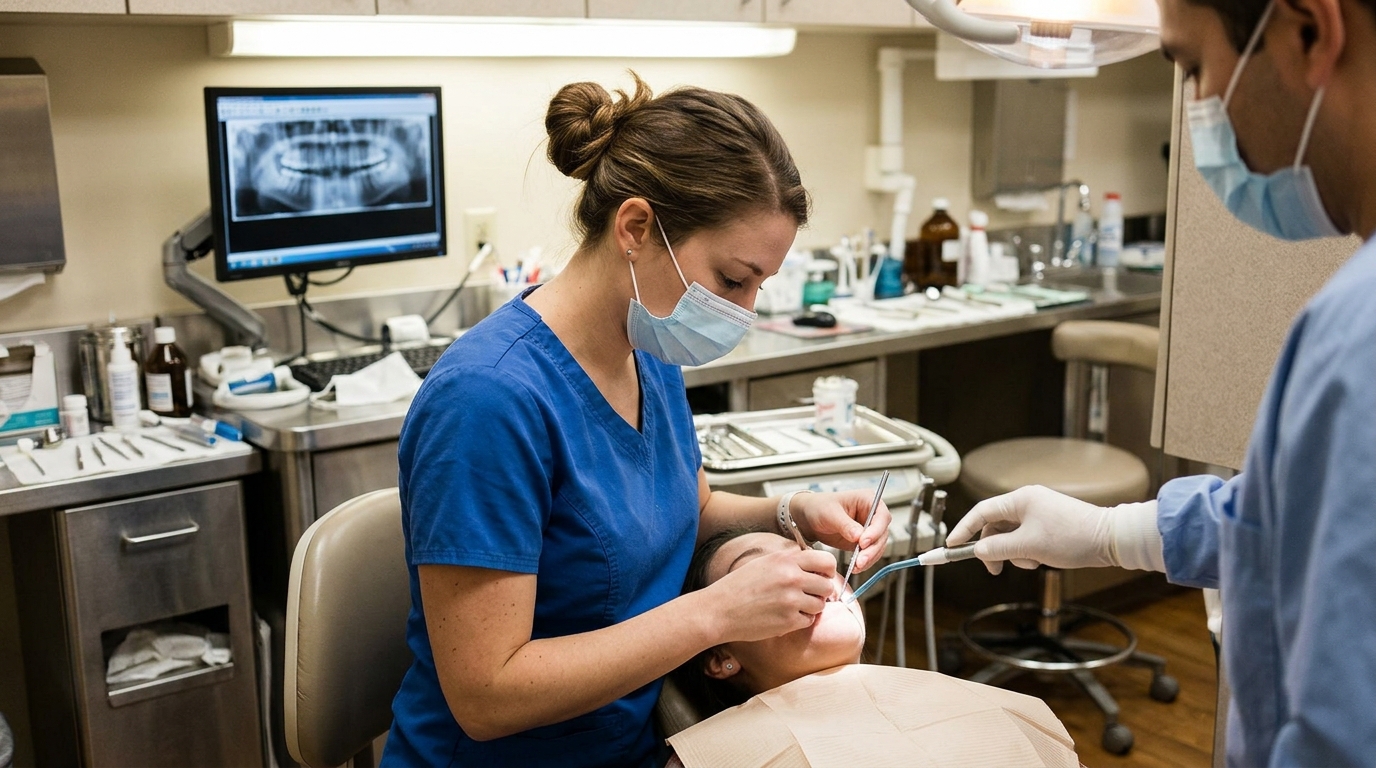
Your posting asks for comfort with ultrasonic scaling and digital radiography. At Willow Point Dental Group, a six-operatory general practice, I treat an average of nine patients a day, roughly a third of them periodontal maintenance cases. I scale with a combination of ultrasonic and hand instrumentation, take full-mouth and bitewing series on digital sensors, and chart six-point probing depths at every maintenance visit so the dentist can see progression before the exam begins.
Two results I would bring with me. First, I rebuilt our periodontal recall script and three-month follow-up call sequence; completed maintenance appointments rose from 61 to 84 a month over two quarters. Second, I introduced an intraoral camera walkthrough at the start of each hygiene appointment, which cut the time the dentist spends re-explaining findings to about three minutes per operatory and made sealant and fluoride acceptance conversations far easier with parents of our pediatric patients.
Your posting also mentions that the practice is moving to block scheduling for new-patient exams. I ran that transition at Willow Point last year, including the chart audit that identified 140 patients overdue for radiographs, and I would be glad to share how we sequenced it.
My license verification, National Board results and two references from treating dentists are available on request. I would welcome a working interview and can bring my own loupes and instruments.
Sincerely, Maya Okonjo, RDH
How to Customize It
- Opening line — "I hold an active Ohio dental hygiene license and current CPR certification, renewed this past March." Swap in your own licensing state and renewal month. If you are applying across state lines, write that you have applied to that state's board rather than implying you are already licensed there; requirements differ by state, and you can confirm yours through your state's Board of Dental Examiners or CareerOneStop's licensing information (U.S. Bureau of Labor Statistics, 2025).
- Availability line — "available for the four-day Tuesday-to-Friday schedule." Replace with the exact days and hours the posting names. If you already work for another dentist part time, say which days are free rather than writing "flexible."
- Setting sentence — "a six-operatory general practice." Substitute your practice type and size: pediatric, periodontal, public health clinic, corporate group, or a solo office with two chairs.
- Volume figure — "nine patients a day, roughly a third of them periodontal maintenance." Use your real daily count and case mix. If you are new to practice, use your clinical program numbers instead: patients treated, scaling and root planing quadrants completed, radiographic series taken.
- Instrument list — "ultrasonic and hand instrumentation ... digital sensors." Rewrite it from the posting's own wording, adding only what you have used: air-polishing, power polishing, laser therapy where your state permits it, or restorative duties if you practice in a state that allows additional-training roles such as dental therapists (U.S. Bureau of Labor Statistics, 2025).
- Results paragraph — the recall rebuild and the intraoral camera walkthrough. Replace with two outcomes of your own that have a number attached: appointments recovered, no-show rate, overdue radiograph audits, or sealant acceptance among pediatric recall patients.
- Posting-specific paragraph — "your practice is moving to block scheduling." Pick one detail from the actual advertisement — new software, expanded perio program, Saturday hours, a second location — and say what you have done that touches it.
- Closing — "a working interview ... my own loupes and instruments." Keep it only if true, and add continuing education you have completed, since hygienists must meet continuing education requirements to maintain licensure (U.S. Bureau of Labor Statistics, 2025).
Frequently asked questions
How long should a dental hygienist cover letter be?
One page, and usually three to four short paragraphs — around 250 to 350 words. Practice owners typically read it between patients. Front-load licensure, availability and the instruments you use, then give one or two measurable results. If the posting asks only for a resume, send a four-sentence email version covering license state, CPR status, days available and case mix.
Should the letter repeat what is on my resume?
No. Your resume lists employers, dates, credentials and skills. The letter should explain two or three things the resume cannot: why you are leaving a practice, how you handle a heavy periodontal recall load, what you did about overdue radiographs, or how you adapted when the office changed imaging systems. Pick evidence that matches the posting's requirements rather than summarizing your whole history.
Who should I address it to?
Address the treating dentist by name whenever the practice website or posting gives one — most hygiene hiring is done by the owner or the office manager. If no name appears, call the front desk and ask who reviews hygiene applications. Use "Dear Hiring Dentist" only as a last resort, and never "To Whom It May Concern."
What if I just graduated and have no practice experience?
Use your clinical program as your work history. Dental hygiene programs include laboratory, clinical and classroom instruction in subjects such as anatomy, medical ethics and periodontics (U.S. Bureau of Labor Statistics, 2025), so cite patient counts from clinic, instrument types you were checked off on, and board examination status. State your license position clearly, then name your available days — part-time hygiene work is common (U.S. Bureau of Labor Statistics, 2025).
Sources
- U.S. Bureau of Labor Statistics — Dental Hygienists : Occupational Outlook Handbook (2025)
Your coach for this guide
Lena builds long-form conversations with workers across industries, chasing the specific texture of a job rather than its title. She's most interested in the gap between what a role is called and what it actually asks of someone.