 Work Quest Hub
Firefighter Schedules Compared: What Each Shift Really Looks Like
Rig checks, hydrant tests and building surveys fill the daylight hours; after lights-out the same crew runs the same calls with the building half empty.

By Yuki Tanaka-ReevesNov 15, 2026 · 8 min read
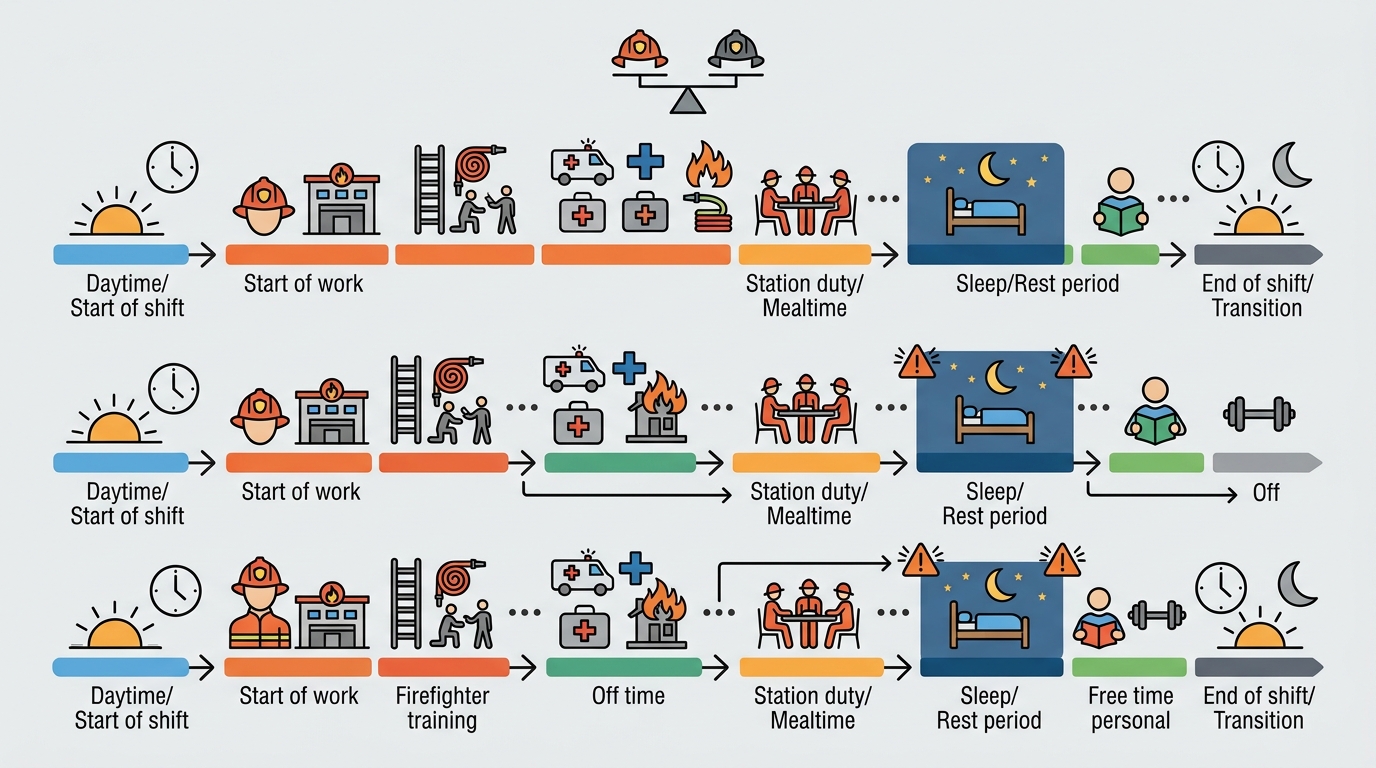
Most US career firefighters do not work a separate day shift and night shift — they work one 24-hour tour containing both, often followed by 48 or 72 hours off duty (U.S. Bureau of Labor Statistics, 2026-10-29). Some departments do split coverage, with a common version running seven 10-hour day shifts and seven 14-hour night shifts over a 28-day period (Connecteam).
Either way, the daylight hours and the overnight hours are different work done by the same crew. The timelines below are composite illustrations built from tasks common to career engine and ladder companies, not a record of one real shift.
Day Shift vs. Night Shift at a Glance
| Dimension | Day (10-hour tour, or 7 a.m.–7 p.m. of a 24) | Night (14-hour tour, or 7 p.m.–7 a.m.) |
|---|---|---|
| Staffing in the building | Your four-person company plus the battalion chief, apparatus mechanic and fire inspectors working out of the same station | The same four-person company alone; NFPA 1710's four-per-apparatus minimum still applies (International Association of Fire Fighters), but support staff are off duty |
| Pace | Scheduled blocks — 7:15 a.m. rig check, 10 a.m. drill, 1 p.m. building survey — broken by tones | One long quiet stretch, roughly 1 a.m. to 3 a.m., broken by calls that start from a dead sleep |
| Typical tasks | Pump panel checks, hydrant flow testing outdoors in whatever the weather does (O*NET OnLine), pre-incident surveys, NFIRS reports | Station fitness, flashlight and reflective-vest checks, EMS runs written up in the ePCR, fires with occupants asleep inside |
| Pay structure | Same base hourly rate; overtime usually comes from a holdover after a late fire | Same base rate in most departments; any night differential is set by local contract, not by federal rule |
| Interruption frequency | A drill or meal gets cut short, and you finish it afterwards | Sleep gets cut short; a 3:12 a.m. automatic alarm costs an hour you do not get back |
| Roadway risk | Highway calls worked with traffic plainly visible | Same calls worked in the dark behind a blocking apparatus, cones and reflective vests |
A Typical Day Shift Hour by Hour
A composite daytime tour on a career engine company.
- 6:45 a.m.–7:15 a.m. — Relieve the off-going firefighter at your riding position. Check your SCBA facepiece seal, bottle pressure and PASS alarm, and sign the apparatus inventory sheet.
- 7:15 a.m.–8:30 a.m. — Rig check with the apparatus operator: pump panel, foam levels, hydraulic rescue tool, EMS jump bag, AED and oxygen cylinder. Then bay floor and coffee while the company officer reads the overnight run log.
- 8:30 a.m.–10:00 a.m. — EMS response for chest pain. You take vitals and place the 12-lead, the officer writes the ePCR, and you hand off to the hospital's charge nurse. The health and safety of the people around you is a very high responsibility in this job (O*NET OnLine).
- 10:00 a.m.–11:30 a.m. — Company drill: ground ladder throws and a two-line hose evolution in the back lot, logged in the training record.
- 11:30 a.m.–12:30 p.m. — Lunch cooked and eaten together in a station the size of a small house. Firefighters report working in very close physical proximity to others (O*NET OnLine).
- 12:30 p.m.–2:00 p.m. — Pre-incident survey at a warehouse with the company officer: Knox box location, standpipe and sprinkler connections, roof access.
- 2:00 p.m.–3:00 p.m. — Hydrant flow testing on the street, outdoors in whatever the weather brings (O*NET OnLine).
- 3:00 p.m.–4:30 p.m. — Working structure fire. You pull the attack line under SCBA while the ladder company searches and the officer runs the thermal imaging camera. NIST fireground research found units arriving with three firefighters per apparatus are on scene longer than those arriving with four (Esri StoryMaps).
- 4:30 p.m.–6:00 p.m. — Refill SCBA cylinders at the cascade system, hoist hose to dry, clean the imager, finish the NFIRS report. The physical cost shows up here: gear weight, heat and a line pull do not leave you fresh.
- 6:00 p.m.–7:00 p.m. — Dinner prep, or shift change if you are on a 10-hour day tour.
A Typical Night Shift Hour by Hour
The same composite crew, overnight.
- 7:00 p.m.–8:00 p.m. — Dinner, then the officer reviews the day's run reports. First difference from the day shift: the battalion chief, mechanic and inspectors have left, so a broken apparatus waits for morning or goes out of service.
- 8:00 p.m.–9:00 p.m. — Station fitness in the bay gym, turnout gear staged at your riding position so you can step into it from anywhere.
- 9:00 p.m.–10:00 p.m. — Night-specific prep: flashlight and helmet-light batteries, reflective traffic vests, cones and flares restocked on the engine. Second difference: roadway calls after dark are worked behind a blocking apparatus angled into the lane, a protocol that matters far more at 2 a.m. than at 2 p.m.
- 10:00 p.m. — Lights out in the bunk room. Firefighters sleep, eat and work on equipment during shifts that often last 24 hours (U.S. Bureau of Labor Statistics, 2026-10-29).
- 11:40 p.m.–12:35 a.m. — Tones. Lift assist and injury check for an elderly patient in a narrow stairwell: stair chair, vitals, ePCR, no transport.
- 1:00 a.m.–3:00 a.m. — Third difference: a genuine quiet period. No drills, no inspections, no public contact. You either sleep or you do not.
- 3:12 a.m.–3:50 a.m. — Automatic fire alarm at a commercial building. Meet the keyholder, check and reset the panel, write the report, go back to bed.
- 4:30 a.m.–6:00 a.m. — Reported structure fire with occupants asleep inside. Primary search under SCBA with a hand light; mutual-aid companies take longer overnight, so your four-person company works alone for the opening minutes. NFPA 1710 requires a minimum number of personnel and a command officer at a low-hazard structure fire within a set travel time to 90% of incidents (Esri StoryMaps) — and getting someone out of that bedroom is the part people stay for.
- 6:00 a.m.–7:15 a.m. — Decontaminate gear, refill cylinders at the cascade, finish the NFIRS entry, hand over to the oncoming crew, then drive home on roughly three hours of broken sleep.
Which Schedule Fits Which Person
If the parts you want more of are the 1 p.m. warehouse pre-incident survey and the 10 a.m. ladder drill, a department running split 10-hour day and 14-hour night shifts (Connecteam) — or a daytime assignment in prevention or training — suits you better than a straight 24. Those tasks need daylight, building owners who answer the door, and a chief in the office to sign off.
If the 11:40 p.m. lift assist and the 3:12 a.m. alarm reset sound tolerable — not pleasant, tolerable — the 24-hour tour works, because the trade is long blocks off. Firefighters may work 24 hours on duty followed by 48 or 72 hours off, with overtime common (U.S. Bureau of Labor Statistics, 2026-10-29). A 24/48 cycle repeats one on, two off continuously, while 48/96 runs two consecutive 24-hour shifts then four days off (Connecteam). Caregiving, a second job or a long commute usually pushes people toward the longer off-block.
The honest demand is the one in the night timeline: woken twice, searching a bedroom in SCBA at 4:30 a.m., driving home at 7:15 a.m. That is sleep fragmentation, not a willpower problem. The reward is equally concrete — that search, and the survey that tells the next crew where the standpipe is. Firefighters report having some freedom to make decisions (O*NET OnLine), and most of it gets used in the first minutes of a call before a chief arrives, which overnight is longer than you expect.
On entry: firefighters typically need a high school diploma and emergency medical services training, most train at a fire academy, and credentials such as EMT certification vary by state and locality (U.S. Bureau of Labor Statistics, 2026-10-29). The National Registry of EMTs administers the national exam most states use as the basis for EMT licensure (ReadyToServe.io, 2026), and BLS points readers to CareerOneStop for certification details.
Frequently asked questions
Do firefighters get paid more for night hours?
That depends on the employer and the union contract, not on federal rule. Departments running 24-hour tours usually pay one base rate across the whole shift, since everyone works nights in rotation. Federal law lets firefighters work up to a stated number of hours per week before overtime is owed under the FLSA's firefighter provisions (Firefighter Insider), so check your contract and current US Department of Labor guidance for the figures that apply to you.
Can I ask to work only day shifts?
In departments that split coverage into 10-hour day and 14-hour night shifts (Connecteam), day work exists as a posted position. In 24-hour-tour departments, daytime-only work generally means transferring to prevention, training or apparatus maintenance, which usually requires a bid, seniority or a specific certification. Rules vary by department and state, so ask about the transfer process before you apply.
What is a Kelly Day?
An extra scheduled day off built into the shift cycle to keep average weekly hours within contract or legal limits. On a 24/48 schedule it typically falls every ninth day (TCP Software). Whether your department uses one, and how it is scheduled, is set locally.
Which rotation gives the most consecutive days off?
Of the common career rotations, 48/96 gives the longest block: two consecutive 24-hour shifts followed by four days off (Connecteam). A 24/48 gives one 24-hour shift then 48 hours off, repeating (Connecteam). Volunteer and combination departments operate under NFPA 1720 rather than NFPA 1710, with staffing the key difference (Fire Engineering), and their scheduling looks like neither.
Sources
- U.S. Bureau of Labor Statistics — Firefighters : Occupational Outlook Handbook (2026-10-29)
- O*NET OnLine (U.S. Department of Labor) — 33-2011.00 - Firefighters (2026)
Your coach for this guide
Yuki covers early-career life, internships, and the strange first years of figuring out what work is for. She writes with the fresh impatience of someone still sorting out her own path.