 Work Quest Hub
How a Nurse Practitioner's Day Changes After Five Years on the Job
Panel size, chart-closing speed and who signs off on your plan all shift between year one and year five — here is what that looks like hour by hour.

By Marcus BellweatherNov 15, 2026 · 9 min read
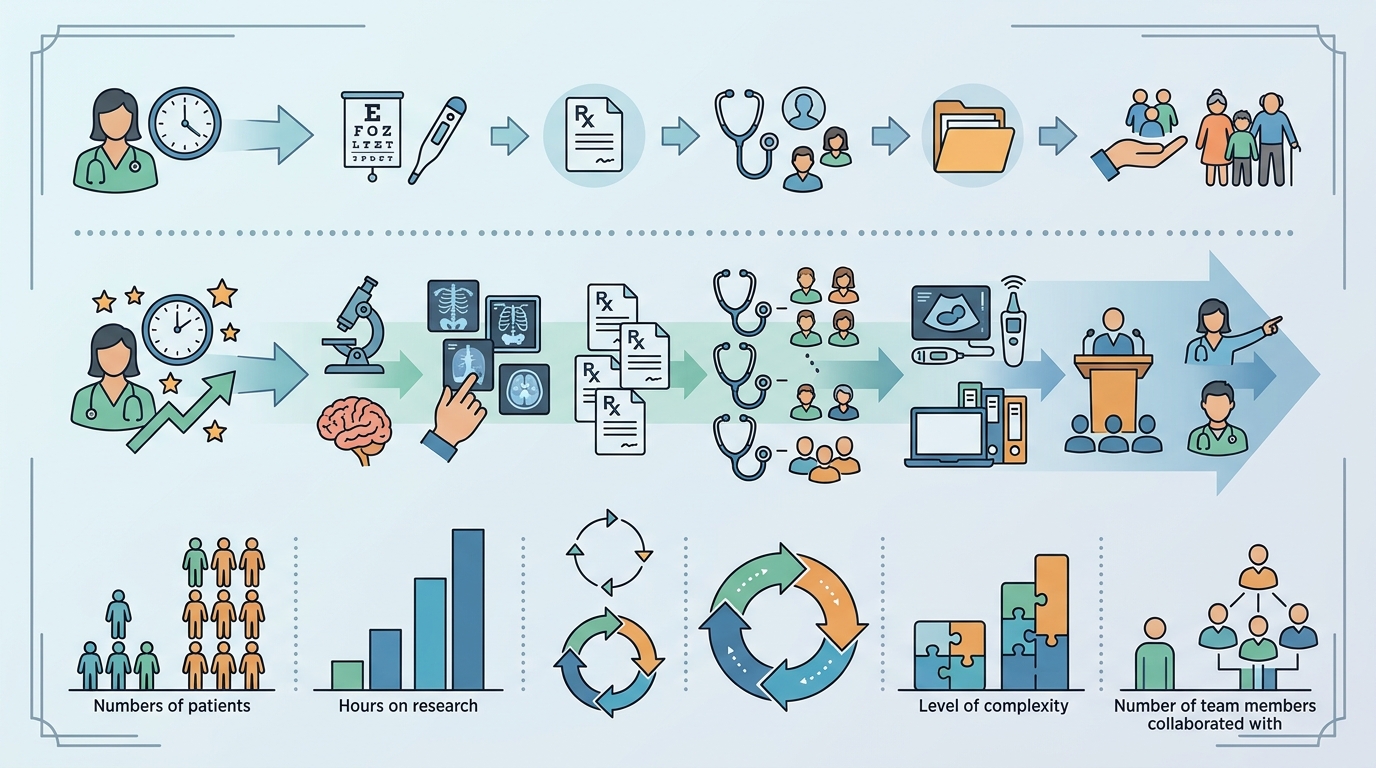
In year one, a nurse practitioner's day is shaped by other people: a lengthened template schedule, a collaborating physician or preceptor reviewing plans, and an inbox that keeps you at the desk after clinic ends. By year five the task list looks similar, but you carry a fuller panel, make most treatment decisions without checking first, and spend part of the day precepting students or onboarding new hires.
How far your autonomy goes is partly a legal question, not just an experience one. Scope of practice is set state by state, and the American Association of Nurse Practitioners (2026) classifies only some states as Full Practice.
What Changes With Experience
The table compares a first-year NP with one about five years in, in the same outpatient clinic. State law and employer policy change the supervision and prescribing rows in particular.
| Dimension | Entry-level (year 1) | Experienced (around year 5) |
|---|---|---|
| Schedule and panel | Lengthened template with longer visit slots; complex new patients routed to a physician | Standard slots plus same-day add-ons, a named patient panel, and chronic-disease patients other clinicians refer on |
| Supervision | Daily preceptor or collaborating-physician check-ins; plans discussed before the patient leaves; charts co-signed | Manages most visits alone; curbside consults with a physician colleague by choice, not requirement |
| Task types | Hypertension follow-ups, rapid strep swabs, wellness visits, prior authorizations in the payer portal | Insulin starts, thyroid nodule workups, direct hospital admissions, formulary and protocol committee work |
| Decision-making authority | Follows clinic protocols closely; escalates abnormal imaging, controlled-substance requests and admission decisions | Titrates insulin, declines inappropriate refills after a prescription drug monitoring program check, sends a patient straight to the emergency department |
| Prescribing scope | Where state law requires it, prescribing under written protocols — New York requires written practice protocols and a collaborating-physician agreement until a stated number of practice hours is complete (Sigma Nursing, 2026) | In Full Practice states, prescribing including controlled substances under the state board of nursing's exclusive licensure authority (AANP, 2026); VA-employed NPs hold full practice authority within their VA scope under 38 CFR 17.415, subject to the Controlled Substances Act |
| Teaching and admin | Receives orientation; attends quality meetings as a listener | Precepts FNP students, onboards new NP hires, reviews draft clinic protocols |
| Pay band | Usually lower in the national spread; CareerOneStop publishes the 25th-to-75th percentile band from federal wage data (2024) | Usually higher in that same spread, with productivity or RVU components more common; check the U.S. Bureau of Labor Statistics OEWS median annual wage for nurse practitioners (May 2025) |
A Day as an Entry-Level Nurse Practitioner
A composite day in a primary care clinic, built from tasks common to the role rather than one real person's shift.
7:30–7:50 a.m. Opens the EHR schedule, reviews the day's bookings with the medical assistant, and flags two visits — a new diabetic and a possible DVT — for the collaborating physician before clinic starts.
7:50–8:10 a.m. Morning huddle. Confirms which open slots can take add-ons and which stay clear for preceptor check-ins.
8:10–9:40 a.m. Three visits on a lengthened template: a hypertension follow-up, a sore throat with a rapid strep swab, and a Medicare annual wellness visit documented on the clinic's structured template.
9:40–10:00 a.m. Preceptor check-in. Presents all three cases, adjusts the antihypertensive plan after discussion, and gets the charts co-signed.
10:00–11:40 a.m. Two acute visits plus an abscess incision and drainage, performed with the supervising physician in the room for the first time.
11:40 a.m.–12:15 p.m. Works the EHR results inbox: calls a patient about a mildly elevated creatinine, sends an e-referral to nephrology, asks the clinic pharmacist about a dosing adjustment.
12:15–1:00 p.m. Lunch at the desk closing morning charts. This backlog is the most draining part of year one, and it shrinks only as the templates become second nature.
1:00–3:30 p.m. Afternoon block: a well-child visit checked against the published immunization schedule, a depression follow-up using a PHQ-9 in the EHR, and a sprained ankle with imaging ordered.
3:30–4:00 p.m. Completes a prior authorization in the payer portal with front-office staff, then reads the state board's billing rules — O*NET (U.S. Department of Labor, 2026) lists maintaining current knowledge of state legal regulations for NP practice, including reimbursement of services, as a core task.
4:00–5:30 p.m. Final visits. Catches an atypical shingles presentation the patient had blamed on a pulled muscle and treats it inside the antiviral window — the first call made entirely independently, and the most satisfying moment of the day.
5:30–6:30 p.m. Inbox and chart closure before logging out.
A Day as an Experienced Nurse Practitioner
The same composite clinic, five years on, with a full panel and a student assigned for the term.
7:15–7:35 a.m. Triages overnight patient portal messages alone: reassures a post-op patient, converts another to a same-day slot, returns a refill request to the medical assistant with instructions.
7:35–7:50 a.m. Leads the huddle. Decides which add-on slots to release and asks the MA to pre-load spirometry for an afternoon COPD visit.
7:50–9:40 a.m. Standard-template visits. Starts basal insulin on a patient whose A1c has not responded to oral agents, choosing the regimen and titration schedule without a consult.
9:40–10:05 a.m. Precepts an FNP student: watches a full cardiac exam, works the differential for exertional chest pain at the whiteboard, co-signs the student's note with written feedback.
10:05–11:45 a.m. Complex block: orders and interprets an ultrasound for a thyroid nodule, then arranges direct admission for a patient whose blood pressure and headache picture is not safe to send home, calling the hospitalist personally.
11:45 a.m.–12:30 p.m. Declines an early opioid refill after checking the state prescription drug monitoring program, documents the reasoning, and offers a taper plan plus a behavioral health referral. These conversations are the mentally heaviest part of the week.
12:30–1:00 p.m. Lunch mentoring a newly hired NP through the clinic's controlled-substance protocol and the co-signature rules that still apply to them.
1:00–3:45 p.m. Telehealth block and in-person follow-ups, including the COPD patient whose spirometry supports stepping down therapy.
3:45–4:15 p.m. Reviews a proposed update to the clinic's diabetes protocol against current state regulations on NP practice and reimbursement, and sends edits to the medical director.
4:15–5:30 p.m. Final visits, including a patient whose A1c has fallen steadily across a year of shared work — the payoff for carrying a stable panel rather than a rotating one.
5:30–5:50 p.m. Closes the remaining charts and signs the student's evaluation.
If you liked presenting cases at 9:40 a.m. in year one, you will like precepting at 10:05 a.m. in year five. If the refill conversation at 11:45 a.m. sounds unbearable, the experienced role is harder, not easier.
Skills and Credentials That Unlock the Next Level
These are the concrete markers that separate a first-year NP from one trusted with a full panel, students and protocol work.
- National certification in your population focus. The ANCC Family Nurse Practitioner exam (FNP-BC) has a stated number of questions and testing time; the AANP Certification Board's FNP-C exam is shorter (ANCC via Pocket Prep, 2025; UWorld Nursing). From January 1, 2026, ANCC requires candidates to pass within a set number of years of completing their FNP program — confirm the current window with ANCC before scheduling.
- A completed five-year certification cycle. AANPCB certification must be renewed every five years. The practice-hours route requires a minimum number of clinical practice hours plus minimum advanced practice continuing education contact hours inside that period. Track both from day one; reconstructing them in year five is painful.
- State licensure and scope milestones. Check your board of nursing for any practice-hour threshold before independent practice — New York requires written protocols and a collaborating-physician agreement until a stated number of hours is complete (Sigma Nursing, 2026), while states such as Alabama require a physician relationship for practice and prescriptive authority (NCSL). CareerOneStop's license finder lists state rules too, including a Louisiana requirement about how recently the APRN program was completed.
- A second specialty certification. O*NET (U.S. Department of Labor, 2022) lists multiple NP certification categories — FNP, PMHNP, AGACNP and PNP among them — each requiring a third-party exam, a qualifying degree, continuing education and experience. Adding one is the usual route into acute care, psychiatry or a hospital service line.
- Demonstrated procedural competence. Employers typically want a logged record of independently performed procedures — joint injections, incision and drainage, skin biopsies, IUD insertions — signed off by a supervising clinician before co-signature requirements are relaxed.
- Same-day documentation. Closing your charts before you leave, consistently across a quarter, is what makes a full-template schedule survivable and is often what a manager watches before widening your panel.
- Regulatory literacy. O*NET names keeping current with state legal regulations for NP practice, including reimbursement, as a core task — and it is what gets you onto protocol and billing committees. CareerOneStop also publishes the occupation's entry requirements if you are mapping the path from scratch.
Frequently asked questions
How long before I stop having my charts co-signed?
That depends on state law and employer policy, not on feeling ready. In Full Practice states as defined by the AANP (2026), the constraint is usually your employer's credentialing policy, often tied to a logged record of independently handled visits and procedures. Where a physician relationship is required for practice or prescribing — Alabama, for example (NCSL) — co-signature arrangements continue. New York ties independent practice to a stated number of practice hours; confirm the figure with the state board.
What usually triggers the move to a higher pay band?
Three things commonly do it: completing your first five-year AANPCB certification cycle, meeting the state practice-hour threshold that lifts a collaborative agreement requirement, and taking on precepting or panel ownership. Employers also shift experienced NPs onto productivity or RVU components. For current numbers, check the U.S. Bureau of Labor Statistics OEWS median annual wage for nurse practitioners (May 2025) and the 25th-to-75th percentile band CareerOneStop publishes from that data (2024).
Can I get more autonomy without moving states?
Sometimes. Under 38 CFR 17.415, NPs employed by the VA hold full practice authority within their VA employment scope regardless of state or local restrictions, subject to the Controlled Substances Act. Outside that, autonomy follows your state statute — NCSL tracks state-by-state rules on NP practice and prescriptive authority, and the AANP maintains the Full Practice classification. Check both before assuming a job change widens your scope.
Is the job market likely to support a move after five years?
The U.S. Bureau of Labor Statistics (2025) projects employment of nurse anesthetists, nurse midwives and nurse practitioners to grow much faster than average from 2025 to 2035, and O*NET classifies nurse practitioners as a Bright Outlook occupation with 75,000 or more job openings projected for 2024–2034. That guarantees no individual offer, but specialty certifications such as PMHNP or AGACNP tend to open options beyond your current clinic.
Sources
- U.S. Bureau of Labor Statistics — Nurse Anesthetists, Nurse Midwives, and Nurse Practitioners : Occupational Outlook Handbook (2025)
- CareerOneStop (BLS OEWS data) — Occupation Profile for Nurse Practitioners (2024)
Your coach for this guide
Marcus writes a running column on the economics of work, from gig platforms to apprenticeships. He's skeptical of easy career advice and prefers questions to conclusions.