 Work Quest Hub
How an HVAC Technician's Day Changes After Five Years on the Job
The gap between year one and year five shows up in truck stock, the calls dispatch sends you, and who signs off on a diagnosis before the customer pays.

By Priya NatarajanNov 15, 2026 · 9 min read
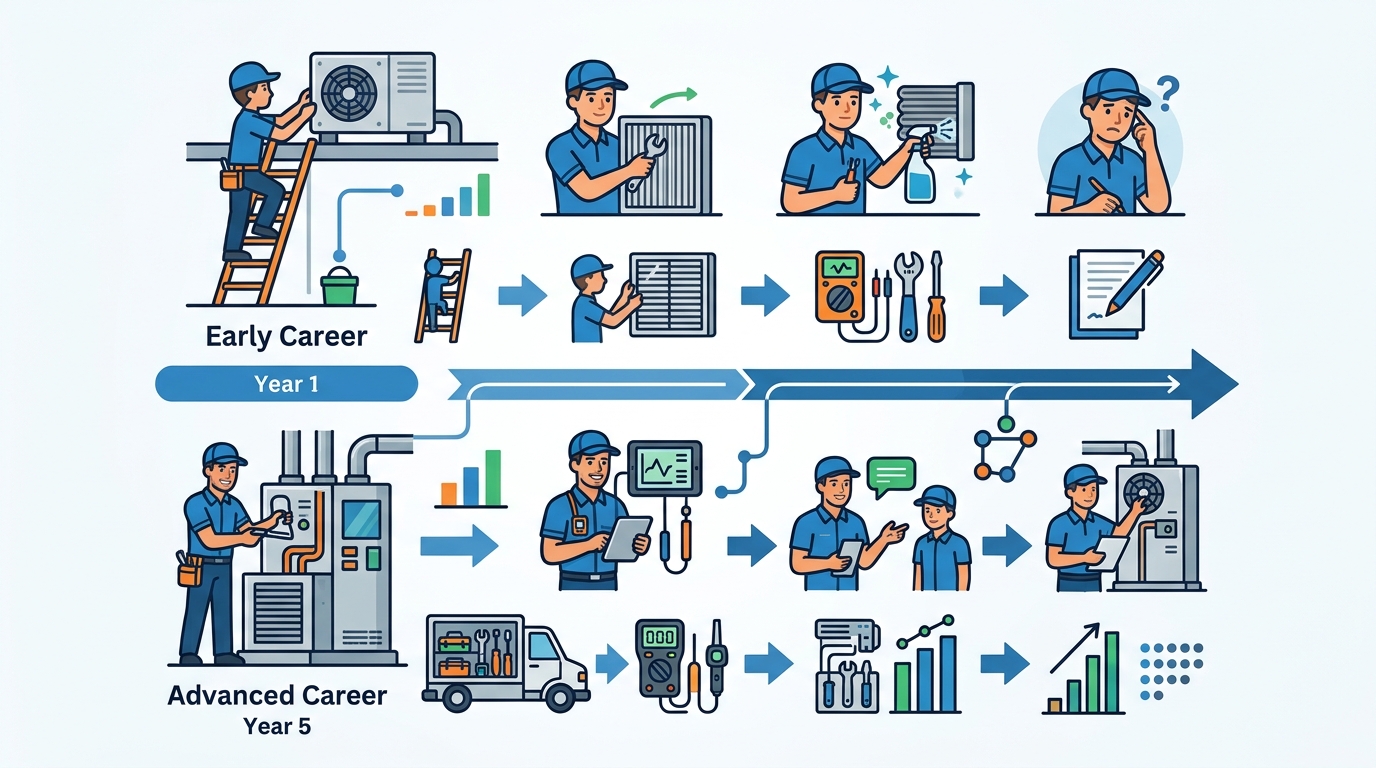
After five years, the biggest change for an HVAC technician is authority, not tools. Early on you work alongside experienced technicians and get your meter readings verified before a part is condemned (U.S. Bureau of Labor Statistics, 2025). By year five you run a truck alone, decide repair versus replacement in front of the customer, red-tag unsafe equipment, and coach an apprentice through a gas valve swap by phone.
The work shifts too: fewer filter changes and lineset-carrying, more refrigerant-circuit diagnostics, combustion analysis, and control faults nobody else on the board could solve.
What Changes With Experience
| Dimension | Entry-level (roughly year one) | Experienced (roughly year five on) |
|---|---|---|
| Supervision | New hires typically work alongside experienced technicians (U.S. Bureau of Labor Statistics, 2025); the lead re-checks capacitor and contactor readings before any part is replaced. | Runs a truck solo off the dispatch board; oversight is a spot-check of photos and readings attached to the work order, plus a callback review. |
| Autonomy | Works a maintenance checklist written by someone else, in the order dispatch assigned it. | Re-sequences the day's calls, decides which no-cool jumps the queue, and orders parts from the supply house directly. |
| Task types | Filter and belt changes, condenser coil cleaning, condensate drain clearing, carrying linesets and sheet metal on change-out days. | Refrigerant circuit diagnostics, compressor and reversing-valve failures, communicating-control faults, combustion analysis, light commercial rooftops. |
| Decision-making authority | Cannot condemn a compressor or red-tag a furnace without the lead confirming it. | Red-tags a cracked heat exchanger, tags off the gas, authorizes warranty parts, and writes the replacement quote on the spot. |
| Customer contact | Observes while the lead discusses symptoms with the homeowner — ONET lists discussing heating or cooling malfunctions with users as a core task (ONET OnLine, 2026). | Leads that conversation and presents repair-versus-replace options. |
| Pay structure | Hourly, often as an apprentice with paid on-the-job training plus technical instruction each year (U.S. Bureau of Labor Statistics, 2025). | Higher hourly band, on-call stipend, performance pay at many shops. For current figures see the Occupational Outlook Handbook (U.S. Bureau of Labor Statistics, May 2025). |
| Credentials | One EPA Section 608 type; typical entry-level education is a postsecondary nondegree award (U.S. Bureau of Labor Statistics, 2025). | Section 608 Universal, often NATE Core plus a specialty, and a state or local license where required (U.S. Bureau of Labor Statistics, 2025). |
A Day as an Entry-Level HVAC Technician
A composite cooling-season day in a residential and light commercial service shop, not a profile of a real person.
6:45 a.m.–7:15 a.m. Load the van against the parts list in the service management app; pull two 20x25 filters and a run capacitor. The lead checks what you pulled.
7:15 a.m.–7:45 a.m. Drive reading the work order on the tablet: "warm air upstairs, system 11 years old." The lead says which checks to run.
7:45 a.m.–9:30 a.m. Maintenance on a rooftop package unit: filters, blower wheel, condenser coil, then log temperature split and static pressure on the tablet checklist. The lead re-measures static pressure because your number looked low.
9:30 a.m.–10:15 a.m. No-cool call. Pull the disconnect and test the contactor coil and capacitor for continuity with a multimeter — ONET lists continuity testing with electrical test equipment as a core task (ONET OnLine, 2026). Photograph the readings and text them to the lead before replacing anything.
10:15 a.m.–11:00 a.m. Ask the homeowner when the noise started and whether the thermostat was changed, then stand by while the lead presents pricing.
11:00 a.m.–11:45 a.m. Attic coil inspection in roughly 120-degree air, checking a plugged secondary drain pan. Heat, crawlspaces and lifting condensers onto pads are the punishing part of year one.
11:45 a.m.–12:15 p.m. Lunch in the van; restock screws and schrader cores.
12:15 p.m.–2:30 p.m. Helper on a furnace change-out: carry the old unit out, run the vacuum pump, watch the micron gauge, hand up fittings while the lead brazes. Recovery is handled by a Section 608 certified technician — any person servicing, installing or disposing of stationary appliances must be certified, with a narrow exception for disposing of small appliances (U.S. Environmental Protection Agency).
2:30 p.m.–3:30 p.m. Nitrogen pressure test on the new lineset; the lead checks every joint before evacuation.
3:30 p.m.–4:30 p.m. Second maintenance stop: flush the condensate line, pour pan tablets, verify the float switch trips.
4:30 p.m.–5:00 p.m. Close out work orders in the service software and attach photos. The lead reads your notes before the invoice goes out.
5:30 p.m.–8:30 p.m. Classroom night. Apprenticeships usually last several years and include paid on-the-job training plus technical instruction each year (U.S. Bureau of Labor Statistics, 2025).
A Day as an Experienced HVAC Technician
Also a composite day, in the same kind of shop five years later.
6:30 a.m.–7:00 a.m. Dispatch board on your phone. You move a no-heat call at a daycare ahead of a maintenance stop on your own judgment, text dispatch the change, and text the apprentice which gas pressures to check on his first call.
7:00 a.m.–8:30 a.m. Commercial rooftop, no cooling on one circuit. Gauges on, superheat and subcooling measured, a shorted compressor confirmed with a megohmmeter. You decide on the spot to quote a compressor replacement rather than a full change-out — cabinet and coil are sound and the unit is six years old.
8:30 a.m.–9:15 a.m. Walk the building manager through the reading sheet, explain why the second circuit will fail next, and write both quotes in the field quoting tool.
9:15 a.m.–10:45 a.m. Residential no-heat. Combustion analyzer in the flue, rollout visible at the burner box, cracked heat exchanger confirmed. You shut off and tag the gas valve, red-tag the furnace, and explain it to the homeowner yourself. Nobody signs off on that but you.
10:45 a.m.–11:30 a.m. Phone call with the apprentice: a sequence-of-operation problem on a two-stage furnace. You walk him through isolating the pressure switch with a manometer instead of giving him the answer.
11:30 a.m.–12:00 p.m. Lunch; order the compressor and a hard-start kit from the supply house.
12:00 p.m.–2:00 p.m. Intermittent fault on a communicating system. Pull fault history from the thermostat, find a chafed low-voltage wire behind the air handler, repair and re-test. The satisfying part: a fault three technicians could not reproduce, fixed and verified in two hours.
2:00 p.m.–3:30 p.m. Ride-along quality check on the apprentice's maintenance. Re-measure his temperature split and show him how to document static pressure so the number means something to the next technician.
3:30 p.m.–4:30 p.m. Replacement consultation: measure the existing ductwork, run a room-by-room load calculation, present two equipment options.
4:30 p.m.–5:15 p.m. Close out work orders, file a warranty claim in the manufacturer's portal, and give the dispatcher your on-call availability.
8:40 p.m. On-call page: no heat, infant in the house. Replace an igniter from van stock and log the call before bed.
Skills and Credentials That Unlock the Next Level
- EPA Section 608, moving from one type to Universal. Federal rules under Section 608 of the Clean Air Act require certification for technicians who maintain, service, repair or dispose of equipment that could release ozone-depleting refrigerants or, since 2018, most substitutes (U.S. Environmental Protection Agency). There are four types covering different equipment (Lincoln Tech); passing all of them gives Universal and removes the limit on which calls dispatch can send you.
- NATE Core plus at least one specialty exam. Full NATE certification means passing a Core exam plus a specialty such as heat pumps or air conditioning, administered by North American Technician Excellence (Carrier). It is not a legal requirement to work in HVAC, unlike EPA 608 (SkillCat), but many shops tie it to a senior pay band.
- Documented field time, then the senior exam. A NATE exam-proctoring provider publishes recommended field experience before certain specialty exams (Certification & Safety), so track your hours by equipment type. After gaining experience you can test for the senior level technician NATE certification (Indeed).
- Keeping certification current. NATE certification must be renewed by retaking the specialty exam or completing continuing education hours before the expiration date (Trane).
- A state or local license where it applies. Some states and localities require HVACR technicians to be licensed (U.S. Bureau of Labor Statistics, 2025). Exam content and qualifying experience hours differ by state and sometimes by city — check your state's contractor licensing board directly.
- Completed apprenticeship or postsecondary program. Apprenticeships usually run several years with paid on-the-job training plus technical instruction each year (U.S. Bureau of Labor Statistics, 2025), and postsecondary HVACR programs at technical schools or community colleges lead to a certificate or associate degree (nuecareer.com).
- Measurable field skills to demonstrate. Charge a system to manufacturer superheat and subcooling spec without a second opinion; run a combustion analysis and adjust to the rating plate; measure total external static pressure and explain it to a customer; braze under flowing nitrogen so the joint passes a pressure test first time; diagnose a low-voltage control fault from the schematic rather than by swapping parts.
Frequently asked questions
How long before I run calls on my own?
It depends on the shop and your state's licensing rules. New hires typically start alongside experienced technicians, and the occupation's on-the-job training is classified as long-term (U.S. Bureau of Labor Statistics, 2025). Apprenticeships usually run several years with paid training plus yearly technical instruction (U.S. Bureau of Labor Statistics, 2025). Most shops release you to solo maintenance calls first, then simple no-cool diagnostics, then change-outs.
What actually triggers a promotion to senior technician?
Usually three things together: EPA Section 608 Universal certification, a clean callback record on calls you diagnosed alone, and the ability to present repair-versus-replace options without a lead present. Many employers add NATE Core plus a specialty exam (Carrier), and some add the senior level technician NATE certification once you have field experience (Indeed).
How big is the pay difference between year one and year five?
Pay is normally hourly, with peak-season overtime, an on-call stipend, and performance pay at many shops. Apprentices earn while training (U.S. Bureau of Labor Statistics, 2025). For current numbers, look up median pay for heating, air conditioning, and refrigeration mechanics and installers in the Occupational Outlook Handbook (U.S. Bureau of Labor Statistics, May 2025), then compare state and metro figures, which vary widely.
Do I need NATE certification to advance?
Not legally. NATE is not a requirement to work in HVAC, unlike EPA Section 608 certification (SkillCat). It is an employer and customer signal: full certification means a Core exam plus at least one specialty (Carrier), renewed by retaking the specialty exam or completing continuing education hours before expiry (Trane). Check whether your state or locality requires a license instead (U.S. Bureau of Labor Statistics, 2025).
Sources
- U.S. Bureau of Labor Statistics — Heating, Air Conditioning, and Refrigeration Mechanics and Installers: Occupational Outlook Handbook (2025)
- O*NET OnLine (U.S. Department of Labor) — 49-9021.00 - Heating, Air Conditioning, and Refrigeration Mechanics and Installers (2026)
Your coach for this guide
Priya shapes the publication's coverage of job transitions, writing often about the messy middle between leaving one role and starting another. She's drawn to the quiet negotiations people have with themselves before a resignation letter gets written.