 Work Quest Hub
How to Become a Registered Nurse: Education, Certifications, and Steps
The route runs through a board-approved nursing program, a state license application, and the NCLEX-RN — here is what each stage asks of you.

By Desmond OkaforNov 15, 2026 · 10 min read
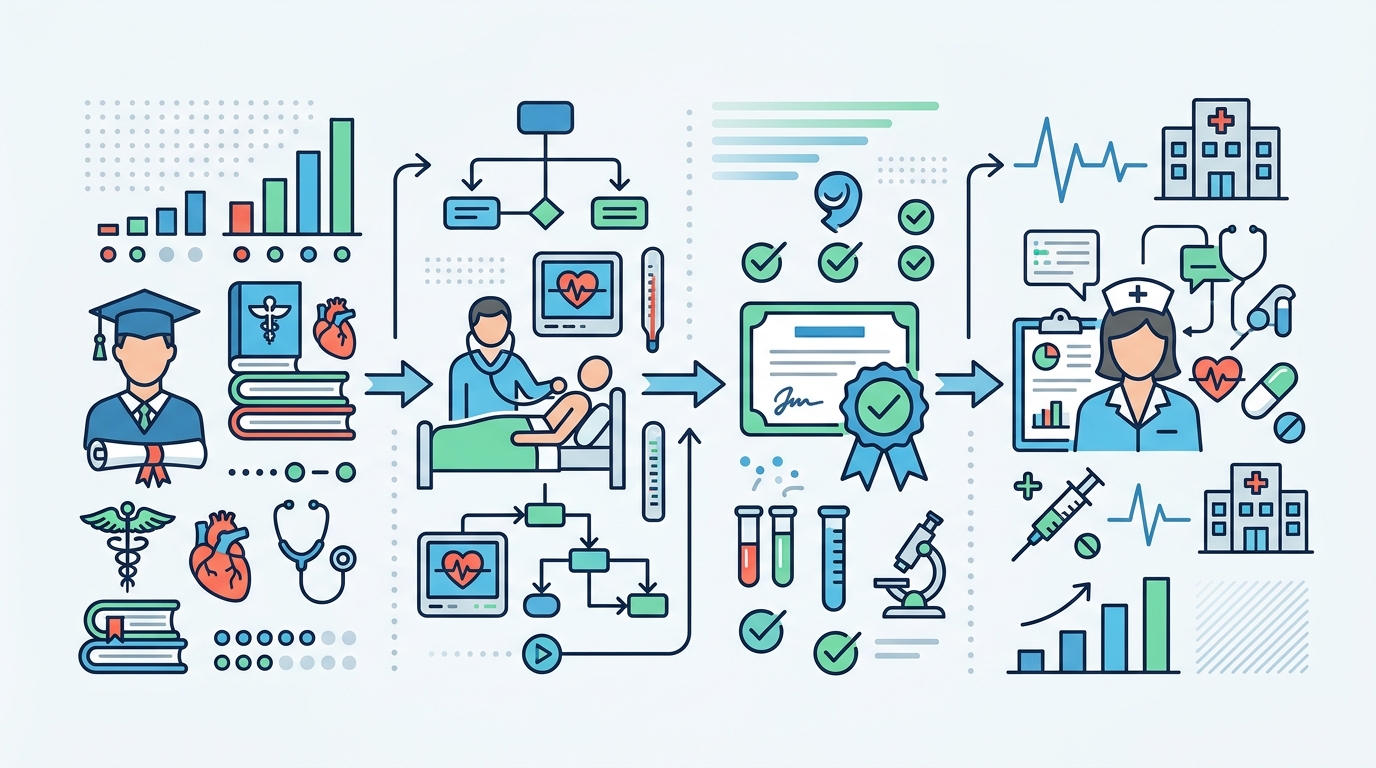
Becoming a registered nurse means completing an approved nursing program, applying to your state's nursing regulatory body, and passing the NCLEX-RN exam. The U.S. Bureau of Labor Statistics (2025) says RNs usually qualify through one of three education paths — a bachelor's degree in nursing, an associate's degree in nursing, or a diploma from an approved hospital program — and all three end in licensure.
Which path you choose affects how long you study and what kinds of employers will consider you, but none of them skips the exam. Requirements beyond the exam, such as a criminal background check, vary by state (U.S. Bureau of Labor Statistics, 2025).
What a Registered Nurse Actually Does
A shift is built around a patient assignment and a medication schedule. You assess each patient's condition at the start of the shift, record medical histories, symptoms and vital signs, and flag changes to the physician or advanced practice provider (U.S. Bureau of Labor Statistics, 2025; O*NET OnLine).
Medication administration takes up a large block of the day. You administer medicines and treatments on schedule and then monitor patients for reactions or side effects (ONET OnLine). When a drug is unfamiliar or a dose looks wrong for the patient's weight or kidney function, you check drug guide information retrieval software before it goes in (ONET OnLine).
You also operate and monitor medical equipment — infusion pumps, cardiac monitors, suction and oxygen delivery — and troubleshoot alarms (U.S. Bureau of Labor Statistics, 2025). Documentation runs alongside all of it: maintaining accurate, detailed reports and records is a listed core task, and the software you touch may include diagnostic and procedural coding tools and database applications such as Microsoft Access, alongside the electronic health record your employer uses (O*NET OnLine).
The rhythm differs by setting. Hospital inpatient units run 8- or 12-hour shifts with nights, weekends and holidays covered. Outpatient clinics, schools, correctional health and home health agencies tend to run daytime hours with a different mix of tasks — more triage calls, teaching and care coordination, fewer continuous monitors.
Is This Career a Fit for You
- Comfortable on your feet for a 12-hour shift. Hospital inpatient nursing is largely standing and walking, with charting done in short bursts between patients.
- Able to interrupt yourself and resume accurately. You will be pulled out of a medication pass by a call light or an alarm, then have to return to the right patient, the right drug and the right dose.
- Steady around bodily fluids, wounds and distress. Assessing conditions and administering treatments means hands-on contact that cannot be delegated away on most units.
- Precise with numbers and records. Vital signs, dosages and documentation are core tasks (O*NET OnLine), and errors in them have direct consequences for patients and for your license.
- Willing to be tested on your own. The NCLEX-RN is computerized adaptive testing: you must answer each item to move on, and you cannot skip questions or go back to change earlier answers (NCLEX.com).
- Tolerant of irregular hours early on. New graduates often start on nights, weekends or rotating shifts in hospitals and long-term care before day positions open.
- Prepared for several years of study before you earn as an RN. O*NET OnLine classifies registered nursing as Job Zone Four, meaning considerable preparation is needed.
- Open to continuing education. Employers may require CPR, basic life support (BLS) or advanced cardiac life support (ACLS) certification on top of licensure (U.S. Bureau of Labor Statistics, 2025).
Steps to Break In
- Confirm the entry requirements of programs near you. Nursing programs set their own prerequisite science courses and admission tests, and the program must be approved for its graduates to sit the licensing exam (U.S. Bureau of Labor Statistics, 2025). Call or check the catalog of two or three community colleges and universities, plus any hospital diploma program in your area, before you enroll in anything.
- Complete prerequisite coursework if you do not already have it. Anatomy and physiology, microbiology and similar courses are usually taken at a community college over one to two semesters, on the schedule the college publishes.
- Enroll in and finish an approved nursing program. Choose a bachelor of science in nursing (BSN), an associate's degree in nursing (ADN or ASN), or a diploma program run by a hospital or medical center — the three routes BLS (2025) identifies. Expect supervised clinical rotations as part of the program.
- Get your CPR or basic life support certification while you study. RN positions may require CPR, BLS or ACLS certification (U.S. Bureau of Labor Statistics, 2025). BLS courses are short and are commonly offered through hospitals and community training centers; many programs require one before clinicals.
- Register for the NCLEX-RN in two separate steps. Obtain a licensure or registration application from your state nursing regulatory body, and register separately with Pearson VUE, the testing vendor (NCLEX.com). Budget the registration fee — $350 in the United States effective Feb. 1, 2027 (NCLEX.com) — and allow for state-specific steps such as a criminal background check, which vary by state (U.S. Bureau of Labor Statistics, 2025).
- Sit and pass the NCLEX-RN. The exam can be anywhere from 85 to 150 items, with a maximum time limit of five hours regardless of how many items you receive (NCSBN).
- Apply to employers that hire new graduates. Hospitals with nurse residency or new-graduate programs, skilled nursing facilities, home health agencies and clinics are the usual first stops. BLS projects employment growth for registered nurses over 2025–35, with a projected average number of annual openings over the decade — check the current Occupational Outlook Handbook entry for the figures before you plan around them.
Education and Certification Options
All three education routes lead to the same licensing exam; what differs is length, cost and which employers shortlist you. RN-to-BSN programs exist precisely because many nurses start with an associate degree or diploma and finish the bachelor's later (U.S. Bureau of Labor Statistics, 2025).
| Path | Time to Complete | Approximate Cost | Where Required |
|---|---|---|---|
| Bachelor of science in nursing (BSN) | The longest of the three qualifying routes (U.S. Bureau of Labor Statistics, 2025); check the program's published length | Tuition set by the school and by in-state versus out-of-state status — verify with the college's cost page | Not required by every employer, but commonly preferred by hospital employers and magnet-designated systems |
| Associate's degree in nursing (ADN or ASN) | Shorter than a BSN (U.S. Bureau of Labor Statistics, 2025); community colleges publish the term-by-term plan | Community college tuition, usually the lowest of the three routes — check the district's published rate | Accepted for licensure in states whose board approves the program; some hospitals expect a later BSN |
| Hospital or medical center diploma program | Shorter than a BSN (U.S. Bureau of Labor Statistics, 2025); set by the sponsoring hospital | Set by the sponsoring hospital — ask for the full cost including clinical fees | Available in a limited number of states; confirm approval with your state board |
| RN-to-BSN bridge (after licensure) | Set by the program; usually part-time while working | Often partly covered by employer tuition assistance — ask the employer, not the school | Used by ADN, ASN and diploma RNs to meet employer degree preferences (U.S. Bureau of Labor Statistics, 2025) |
| NCLEX-RN registration | Scheduled after your board authorizes you | $350 in the United States effective Feb. 1, 2027; $570 CAD in Canada (NCLEX.com) | Required for licensure in every U.S. state (U.S. Bureau of Labor Statistics, 2025) |
| Specialty certification (ambulatory care, gerontology, pediatrics) | After you have the required practice hours | Set by the certifying association | Voluntary, offered through professional associations (U.S. Bureau of Labor Statistics, 2025) |
If you can afford the time, the BSN is the path that keeps the most hospital doors open. The trade-off is real: it is the longest and generally the most expensive route, and you earn nothing as an RN during it, whereas an ADN graduate can be licensed and working sooner and then complete an RN-to-BSN program with employer tuition help.
How Long It Takes
Total time is dominated by one variable — the length of the nursing program you choose — so anchor your plan to the program's published schedule, then add the fixed steps below.
- Month 0 — decision and applications. You compare approved programs and start prerequisites if needed. Prerequisite science courses typically run one to two semesters on the college's calendar.
- Prerequisites complete, program begins. Cumulative elapsed time: however long your prerequisites took, usually one academic year or less if you take them full-time.
- Graduation from an approved program. Cumulative time: prerequisites plus the program's published length — longest for a BSN, shorter for an ADN, ASN or hospital diploma (U.S. Bureau of Labor Statistics, 2025). Your BLS or CPR certification should already be in hand by this point.
- Licensure application and NCLEX registration. Add the weeks your state nursing regulatory body takes to process the application and the background check, which vary by state (U.S. Bureau of Labor Statistics, 2025), plus separate registration with Pearson VUE (NCLEX.com).
- Exam day and first offer. The NCLEX-RN itself takes a maximum of five hours (NCSBN). Employers that run new-graduate cohorts often hire before results arrive, contingent on licensure, so applications usually overlap with the final term of your program rather than starting after it.
The practical reconciliation: nothing in this sequence shortens the program itself. Choosing an ADN or diploma over a BSN is the only step that meaningfully reduces total time to a first RN job, and it pushes the bachelor's degree into an RN-to-BSN program later (U.S. Bureau of Labor Statistics, 2025).
Frequently asked questions
What happens if I fail the NCLEX-RN?
You re-register and retake it. Because you register twice — once with your state nursing regulatory body and once with Pearson VUE (NCLEX.com) — check both for the retake procedure and waiting period, which your board sets. You also pay the registration fee again; it is $350 in the United States effective Feb. 1, 2027 (NCLEX.com). Most candidates use the gap to work through practice items under timed, no-going-back conditions.
Can I move my RN license to another state?
Licensing is handled by each state's nursing regulatory body, and requirements beyond the exam vary by state (U.S. Bureau of Labor Statistics, 2025). Some states participate in multistate arrangements; others require a separate application. Contact the board in the state you are moving to before you accept a job there, and ask about processing times and background check rules.
How much do registered nurses earn?
Pay is usually an hourly rate with shift differentials for nights, weekends and holidays, plus overtime, and it varies widely by state, employer type and setting. The U.S. Bureau of Labor Statistics publishes a median annual wage for registered nurses and state-by-state figures; look up the current Occupational Outlook Handbook and Occupational Employment and Wage Statistics pages rather than relying on a number from a job board.
Does working as a CNA or LPN first help?
It gives you clinical exposure, a reference from a healthcare employer and a realistic sense of shift work before you commit to a nursing program. It does not substitute for the RN education requirement: you still need a BSN, ADN or ASN, or an approved diploma program, and the NCLEX-RN (U.S. Bureau of Labor Statistics, 2025). Some employers offer tuition assistance to existing staff — ask.
Do I need ACLS before my first job?
Not usually for a first application. RN positions may require CPR, basic life support or advanced cardiac life support certification (U.S. Bureau of Labor Statistics, 2025), but ACLS is typically tied to critical care, emergency or telemetry roles, and many hospitals provide it during orientation. BLS or CPR certification is the one to have before you apply.
Is specialty certification worth it early on?
Specialty certifications in areas such as ambulatory care, gerontology and pediatrics are voluntary and offered through professional associations (U.S. Bureau of Labor Statistics, 2025). Most require documented practice hours in the specialty, so they are not available to brand-new graduates. Focus first on licensure and completing your employer's orientation, then pick a certification that matches the unit you actually work on.
Sources
- U.S. Bureau of Labor Statistics — Registered Nurses : Occupational Outlook Handbook (2025)
- O*NET OnLine (U.S. Department of Labor) — 29-1141.00 - Registered Nurses
Your coach for this guide
Desmond covers workplace culture and the unwritten rules that shape who gets ahead. He likes talking to people mid-career, after the certainty has worn off and the real questions start.