 Work Quest Hub
How to Become an HVAC Technician: Education, Certifications, and Steps
From EPA Section 608 to state licensing and NATE exams, here is what the trade asks of you and the order in which to tackle each requirement.

By Lena KowalczykNov 15, 2026 · 10 min read
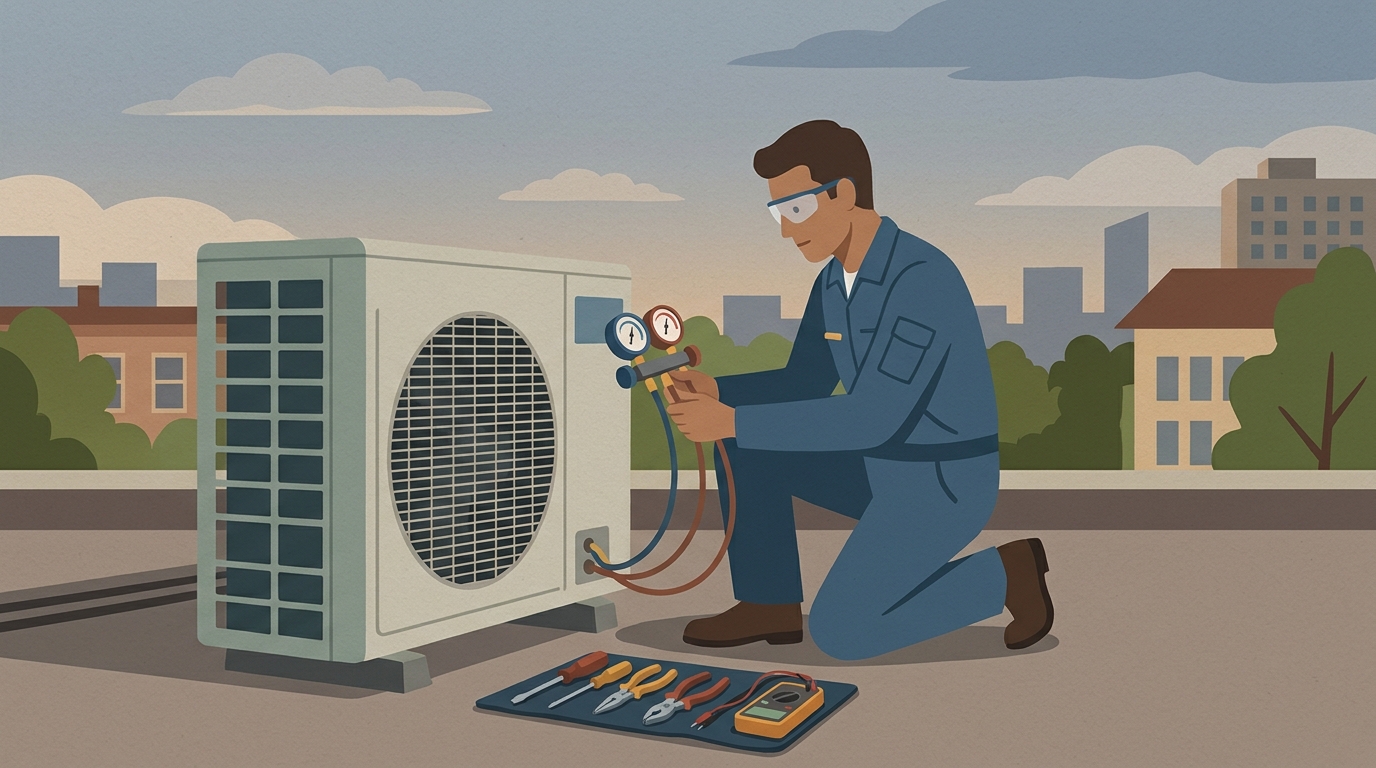
Becoming an HVAC technician means learning refrigeration, electrical and airflow work well enough to diagnose a failed system in a customer's house or a rooftop unit in July. Most people get there through a postsecondary HVACR training program or a paid apprenticeship, then add the federally required EPA Section 608 refrigerant certification and whatever license their state or locality demands.
The U.S. Bureau of Labor Statistics (2025) lists a postsecondary nondegree award as the typical entry-level education, with no prior work experience in a related occupation normally needed and on-the-job training expected after you are hired.
What an HVAC Technician Actually Does
A service day usually starts with a dispatch list on a phone or tablet. You drive to the first call, talk to the customer about what the system is doing — short cycling, no cold air, a smell, a noise — and then start testing rather than guessing. The U.S. Bureau of Labor Statistics (2025) describes the core duties as installing electrical components and wiring, inspecting and testing systems, discussing malfunctions with customers, repairing or replacing worn parts, and keeping records of the work.
In practice that looks like clipping a multimeter across a dual-run capacitor to see whether it still holds its rated microfarads, putting a manifold gauge set on the service ports to read suction and head pressure, checking superheat and subcooling against the manufacturer's chart, and pulling a vacuum with a micron gauge after a repair. Refrigerant never goes to the atmosphere: you recover it into a cylinder with a recovery machine, which is exactly the activity the EPA Section 608 rules cover.
Installation days are different work. You are setting a condenser on a pad, brazing line sets, running low-voltage thermostat wire, terminating line-voltage at a disconnect, sizing or sealing duct, and often doing a load calculation so the equipment matches the building — the math skills the BLS (2025) lists as an important quality for the job.
Paperwork closes every job: invoice, parts used, readings taken, refrigerant added or recovered, and a note for the next technician. Commercial and refrigeration work adds building automation front ends and rooftop units; residential service adds a lot of attics, crawl spaces and conversations on doorsteps.
Is This Career a Fit for You
- Willing to accept a genuinely hazardous trade. HVAC technicians have one of the highest rates of injuries and illnesses of all occupations, including burns, chemical hazards and muscle strains (U.S. Bureau of Labor Statistics, 2025). Torch work, electricity and refrigerant are all in a normal day.
- Comfortable in attics in August and on roofs in January. Equipment lives where the weather is worst, and peak demand for service arrives during heat waves and cold snaps.
- Physically strong and able to keep going. The BLS (2025) lists physical stamina and physical strength among the important qualities; compressors, condensers and sheet metal are heavy and rarely at waist height.
- Patient with electrical and mechanical troubleshooting. You will spend hours proving which component failed instead of swapping parts until something works.
- Able to do arithmetic under time pressure. Load calculations, superheat targets, airflow and electrical sizing all require math skills (BLS, 2025).
- Able to explain bad news to a customer. Customer-service skills are listed as an important quality (BLS, 2025), and a large share of residential calls end with a repair-versus-replace conversation.
- Comfortable with software, not just wrenches. Technology skills matter for computerized system components (BLS, 2025) — thermostats, control boards and dispatch apps.
- Prepared to keep studying after you are hired. Refrigerants, codes and controls change, and the EPA Section 608 exam is only the first test you sit.
Steps to Break In
- Check licensing in your state and locality first (one to two weeks). Some states and localities require HVAC technicians to be licensed, and the rules differ by place (U.S. Bureau of Labor Statistics, 2025). Call your state contractor licensing board and your city or county building department and ask what a technician, as opposed to a contractor, is allowed to do. This decides everything below it.
- Finish a high school diploma or equivalent (varies; plan on months if you need a GED). Some employers will hire candidates whose highest education is a high school diploma (BLS, 2025), and it is the floor for almost every training program and apprenticeship application.
- Choose a training route and apply (apply one to three months ahead of the start date). Either a postsecondary HVACR program at a community or technical college, which the BLS (2025) describes as the typical entry-level education for the occupation, or a registered apprenticeship that combines paid on-the-job training with technical instruction each year (BLS, 2025). Find apprenticeship sponsors through your state apprenticeship agency, the U.S. Department of Labor's registered apprenticeship listings, and local mechanical and sheet metal contractors. The apprenticeship pays you from day one, but intakes are competitive, cohorts may open only once a year, and you are tied to one sponsor's schedule.
- Pass the EPA Section 608 Technician Certification (one exam sitting). The EPA requires passing an EPA-approved test given by an EPA-approved certifying organization, specific to the equipment type — Type I, II, III or Universal — and the credential does not expire (U.S. Environmental Protection Agency). The BLS (2025) notes this is usually completed as part of a postsecondary HVACR program. Universal is the most useful to a job applicant. Apprentices are exempt while closely and continually supervised by a certified technician (EPA), so this can follow a hire rather than precede it.
- Apply for helper, installer or apprentice service technician roles (allow four to eight weeks of applying). Target residential service and replacement contractors, commercial mechanical contractors, refrigeration service companies, and in-house facilities departments at hospitals, school districts and universities. Expect on-the-job training after hire (BLS, 2025) — nobody hands a new hire a van and a diagnostic list on week one.
- Stack the NATE entry credentials in your first year. NATE's recommended pathway begins with the Ready-to-Work Certificate for people with zero to six months of HVAC experience, then the HVAC Support Technician Certificate at roughly six months to a year, before core NATE Certification (NATE pathway, reported by Faraday Careers). NATE publishes a per-exam price list (Faraday Careers).
- Sit core NATE certification once you have the experience. NATE recommends a minimum of two years in the HVAC industry before attempting it (LennoxPROs).
Education and Certification Options
| Path | Time to Complete | Approximate Cost | Where Required |
|---|---|---|---|
| High school diploma plus employer on-the-job training | Diploma or equivalent, then on-the-job training after hire (BLS, 2025) | No tuition; you are paid while training | Accepted by some employers as a new hire's highest education (BLS, 2025) |
| Postsecondary HVACR certificate or associate degree | Each college publishes its own program length — ask for it in writing before enrolling | Published tuition per credit or per program; request the current schedule from the school | The typical entry-level education for the occupation (BLS, 2025) |
| Registered apprenticeship | Paid on-the-job training plus technical instruction each year; the registered program states its term (BLS, 2025) | Paid work; sponsors commonly cover or subsidize classroom instruction, you buy hand tools | Common route into union and larger mechanical contractors |
| EPA Section 608 Technician Certification | One proctored exam per type; often taken inside an HVACR program (BLS, 2025) | Exam fee set by the EPA-approved certifying organization | Required by the EPA for refrigerant handling; does not expire (EPA) |
| NATE Ready-to-Work and Support Technician certificates | Ready-to-Work at zero to six months of experience; Support Technician at about six months to a year (NATE pathway, via Faraday Careers) | Per-exam fees from NATE's published price list (Faraday Careers) | Not a legal requirement; requested by many employers and manufacturers |
| Core NATE Certification | NATE recommends a minimum of two years of HVAC industry experience first (LennoxPROs) | Per-exam fee from NATE's published price list (Faraday Careers) | Employer-driven, not government-mandated |
| State or local HVAC license | Set by the issuing board | Application and examination fees set by the board | Required in some states and localities (BLS, 2025) |
If you want to be earning immediately, the apprenticeship is the stronger route because the on-the-job training is paid (BLS, 2025). Its real drawback: you are locked to one sponsor, intake is competitive and often annual, and if that sponsor does only commercial refrigeration or only residential replacements, your first years of experience are narrow. A college HVACR program costs tuition and pays nothing, but you control the start date and usually leave with the EPA Section 608 exam already behind you (BLS, 2025).
How Long It Takes
These milestones match the steps above. Cumulative time runs from the day you start, and the single biggest variable is the published length of the training program or apprenticeship term you choose.
- Weeks 1–2 — requirements confirmed. You have called your state licensing board and local building department and know whether a license applies to you (BLS, 2025), and you have a shortlist of HVACR programs and registered apprenticeship sponsors.
- Months 1–3 — enrolled or accepted. Applications are in and a start date is set. Apprenticeship intakes may push this out if the next cohort is months away.
- Program or apprenticeship start, then first paid HVAC work. Apprentices are earning from the first week, with technical instruction each year (BLS, 2025), and are exempt from Section 608 while closely and continually supervised by a certified technician (EPA). Students are typically hired after completing the program, with EPA Section 608 already passed (BLS, 2025), then receive on-the-job training from the employer (BLS, 2025).
- Six to twelve months of HVAC experience — entry credentials stacked. You are inside NATE's Ready-to-Work window at zero to six months and eligible for the HVAC Support Technician Certificate at roughly six months to a year (NATE pathway, via Faraday Careers). You are running simpler service calls with supervision.
- Two years of experience — core NATE eligible. This is the minimum industry experience NATE recommends before attempting core certification (LennoxPROs), and the point at which most employers will treat you as a full service technician rather than a helper.
Frequently asked questions
How much do HVAC technicians earn?
Pay is usually hourly, with overtime during peak heating and cooling seasons, on-call or standby pay, and in many residential companies a commission or spiff on equipment sales and add-ons. The U.S. Bureau of Labor Statistics publishes a median annual wage for heating, air conditioning and refrigeration mechanics and installers (2025) along with state and metro figures — check the Occupational Outlook Handbook and your state's labor department for current rates.
Can I get hired with only a high school diploma?
Sometimes. The U.S. Bureau of Labor Statistics (2025) notes that some employers will hire candidates whose highest education is a high school diploma, and that on-the-job training is typically required after hire. You will usually start as an installation helper rather than a service technician, and you still need EPA Section 608 certification before handling refrigerant on your own.
Does the EPA Section 608 certification expire or need renewing?
No. The U.S. Environmental Protection Agency states that Section 608 Technician Certification requires passing an EPA-approved test through an EPA-approved certifying organization, specific to the equipment type — Type I, II, III or Universal — and that the credential does not expire. Keep your card and your certificate; employers ask for proof at hire.
Do apprentices need EPA certification on day one?
Not if they are supervised. The U.S. Environmental Protection Agency states apprentices are exempt from Section 608 certification requirements provided they are closely and continually supervised by a certified technician. That exemption ends as soon as you work unsupervised, so most apprentices sit the exam early rather than relying on it.
Is demand for HVAC technicians holding up?
The U.S. Bureau of Labor Statistics (2025) publishes the number of jobs in the occupation, projected employment growth for 2025–35, and projected annual openings over the decade. Look those three figures up together in the Occupational Outlook Handbook, since annual openings include replacements for workers leaving the occupation, not just new positions.
Is NATE certification required to work as a technician?
No. NATE is an industry credential, not a government licence. What is legally required is EPA Section 608 for refrigerant work, plus any state or local HVAC licence (U.S. Bureau of Labor Statistics, 2025). NATE's pathway — Ready-to-Work, then HVAC Support Technician, then core certification after a recommended two years of experience (LennoxPROs) — matters mainly to employers and manufacturers.
Sources
- U.S. Bureau of Labor Statistics — Heating, Air Conditioning, and Refrigeration Mechanics and Installers - Occupational Outlook Handbook (2025)
- U.S. Environmental Protection Agency — Section 608 Technician Certification
Your coach for this guide
Lena builds long-form conversations with workers across industries, chasing the specific texture of a job rather than its title. She's most interested in the gap between what a role is called and what it actually asks of someone.