 Work Quest Hub
How to Prepare for a Paramedic Interview
Most paramedic panels mix clinical scenarios, protocol questions and crew-conflict stories — here is how to prepare for each without rehearsing cliches.

By Desmond OkaforNov 15, 2026 · 8 min read
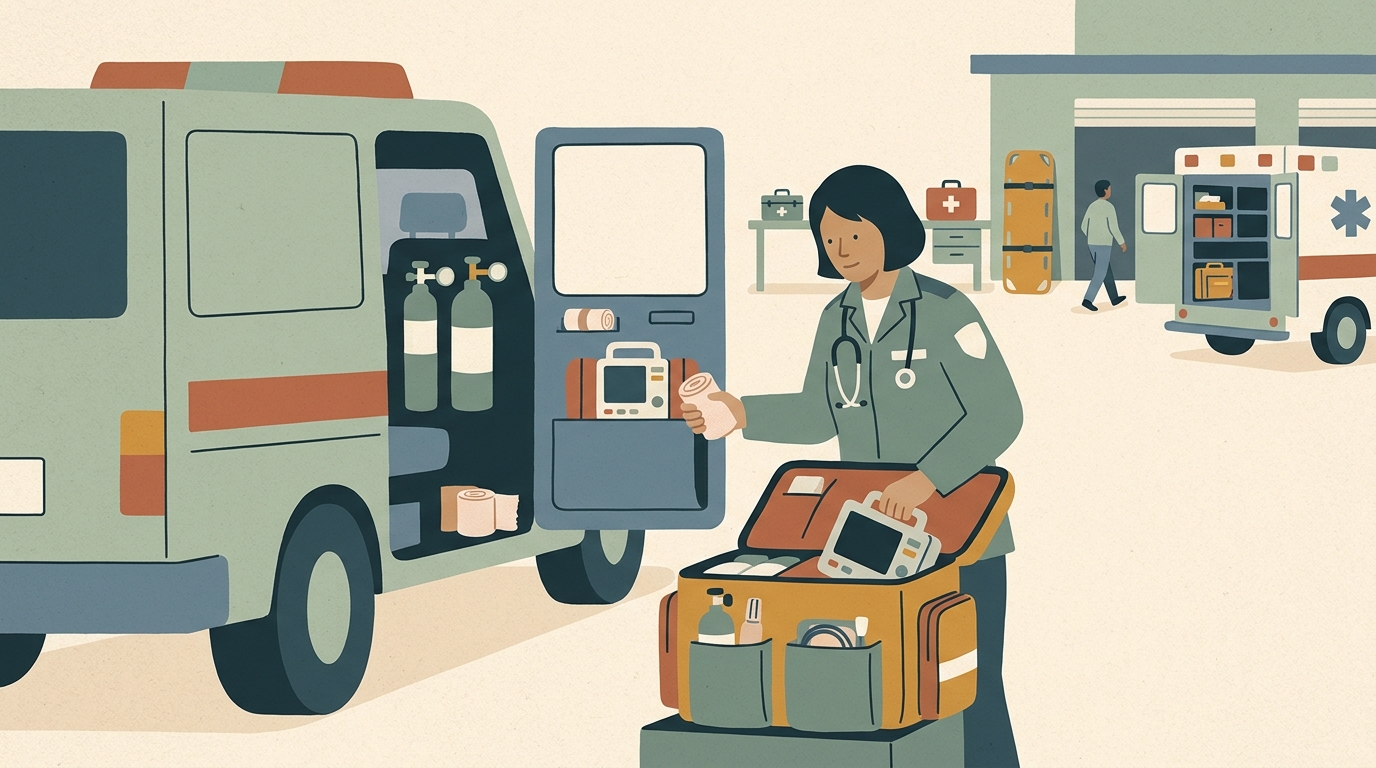
A paramedic interview is rarely a general chat about why you like helping people. Expect a panel that asks you to talk through real calls — cardiac arrests, refusals, combative patients — and listens for how you decided, who you told, and what you wrote down afterward.
Prepare by building four or five call stories you can tell in about a minute each, confirming your license and certification paperwork is current, and finding out which parts of the hiring day are tests rather than conversation.
What This Interview Evaluates
Paramedic panels screen for three or four specific things, all tied to what you do on a shift.
Clinical decision-making inside a protocol. Paramedics provide more extensive prehospital care than EMTs (U.S. Bureau of Labor Statistics, August 2025), and ONET lists core tasks including emergency cardiac care such as cardioversion and manual defibrillation, and performing emergency invasive intervention (ONET OnLine, U.S. Department of Labor, 2026). Interviewers want to hear you reason from assessment findings to a treatment, and to hear where standing orders and online medical control fit.
Scene command and crew direction. ONET also lists instructing the emergency medical response team about interventions and coordinating work with police and fire personnel (ONET OnLine, 2026). Panels test whether you can assign tasks to an EMT partner and a first-arriving engine crew without either freezing or steamrolling people.
Reporting and documentation. Observing, recording and reporting to a physician the patient's condition, treatment provided and reactions to drugs is a listed paramedic task (O*NET OnLine, 2026). Expect questions about handoff, charting, and what you do when a chart is wrong.
Reliability and the physical demands. The work requires bending, lifting and kneeling (U.S. Bureau of Labor Statistics, August 2025), and employers typically require a driver's license and may prefer ambulance driver certification (same source). Questions about attendance, lifting and your driving record are not small talk.
Common Questions and Sample Answers
Walk me through the last cardiac arrest you ran.
Situation: I was lead medic on a witnessed arrest in a second-floor apartment at a service I'll call Lakeview County EMS. Task: Run the code with one EMT partner and a two-person engine crew. Action: I put the engine crew on two-minute compression rotations, had my partner place an i-gel, found coarse V-fib on the pads, defibrillated manually and called every rhythm check out loud. Result: We got ROSC before the third rhythm check and handed off with a 12-lead and a written timeline of each shock and dose.
Tell me about a time you disagreed with another responder on scene.
Situation: A fire captain wanted a trauma patient extricated before I had secured her airway. Task: Settle it without stalling extrication. Action: I stepped beside him and gave a number rather than an argument — "ninety seconds for the airway, then she's yours" — and asked his crew to pre-stage the board. Result: She was moved inside two minutes, and I asked him to walk the call back with me afterward so the next one would run cleaner.
When would you contact medical control rather than act on protocol?
Situation: A narrow-complex tachycardia, borderline unstable, on cardiac medications my standing orders didn't address. Task: Choose between cardioverting and calling. Action: I started a line and applied pads so I was ready either way, then called the physician with a structured report: age, rhythm, vitals, medications, my plan. Result: I got the order, documented it with the physician's name, and the patient converted on the first attempt.
Tell me about a documentation problem you caused or found.
Situation: My chart on a chest-pain transport listed a nitroglycerin time that didn't match the monitor printout. Task: Fix it openly rather than quietly. Action: I pulled the monitor data, wrote an addendum stating what was recorded, what actually happened and how I knew, and told my supervisor the same shift. Result: The record matched the monitor, and the service added a prompt to check drug times against the strip before closing a chart.
How do you handle a combative or intoxicated patient?
Situation: A man swinging in a parking lot with a head laceration and no history. Task: Rule out hypoglycemia and head injury without anyone getting hurt. Action: I kept the stretcher between us, had law enforcement stay in sight, used his name, and got a finger-stick glucose before anything else. It read low. Result: After glucose he was oriented and consented to transport, and I charted the behavior change in time order so the ED could see the sequence.
Tell me about teaching an EMT or a student.
Situation: A paramedic student rode six shifts on my truck. Task: Give her real repetitions without compromising patients. Action: I had her call the size-up and initial impression on every low-acuity call, then talked through my rhythm interpretation out loud on each 12-lead. Result: By the last shift she was applying STEMI criteria correctly on three of four strips, and her preceptor asked to keep her assigned to me.
Answering the Hardest Question
Interviewers ask about a call you would do differently because they want to know whether you can name a clinical miss without hiding it or collapsing into it.
"Tell me about a call where your care fell short."
Early as a lead medic I ran a 62-year-old with weakness and nausea at a service I'll call Harbor Ridge EMS. Situation: no chest pain, so I treated it as general illness. Task: decide what diagnostics she needed. Action: I took vitals and a glucose, started a line and transported without a 12-lead, because she didn't match the picture in my head. In the ED she was found to have an inferior MI. Result: she came to no harm, but my assessment missed it, and the physician told me plainly that my sample was too narrow. Since then I run a 12-lead on every adult with weakness, nausea, syncope or unexplained dyspnea, no exceptions, and I've caught two STEMIs that presented without chest pain.
Day-Of Checklist
- Print current copies of your state paramedic license, National Registry card, CPR-BLS card and driver's license — all states require EMTs and paramedics to be licensed in the state where they work, and requirements vary by state (U.S. Bureau of Labor Statistics, August 2025).
- Check your certification expiry dates; National Registered Paramedic certification is renewed every two years (DOW Civilian COOL/NREMT), so know your renewal date before someone asks.
- Bring a recent motor vehicle record and note whether you hold ambulance driver certification, which employers may prefer (U.S. Bureau of Labor Statistics, August 2025).
- Re-read the last three postings from this employer, list every certification named, and be ready to say where you stand on each.
- Rehearse two cardiac scenarios out loud, including the point you would move to manual defibrillation or cardioversion and the point you would call medical control.
- Practice a 30-second handoff report on a card: age, complaint, findings, treatment, response to treatment.
- Call ahead and ask whether the day includes a written protocol test, a psychomotor station or a physical ability test, and what to wear for each.
- Confirm your continuing-education hours with your state licensing agency, since requirements differ by state (CareerOneStop, U.S. Department of Labor, September 2024).
Frequently asked questions
Will the interview include a skills test?
Often. Many services pair the panel with a written protocol test, a psychomotor station such as a megacode or airway scenario, or a lift and drag test, since the job requires bending, lifting and kneeling (U.S. Bureau of Labor Statistics, August 2025). Ask the hiring contact which stations are scheduled and whether you supply your own equipment, then practice on the gear you will be handed.
How should I handle the panel format?
Expect two to four people: an operations chief, a field training officer, sometimes a medical director or an HR representative. Answer whoever asked, then make eye contact across the group. The training officer usually probes clinical detail, so give doses, rhythms and timelines to those questions rather than general statements about caring for patients.
When should I raise pay?
Let them open it, or ask at the offer stage. Paramedic pay is usually hourly, with shift differentials, overtime on long shifts and sometimes certification or field training stipends, and it varies by employer, agency type and state. Check current posted rates for your area and U.S. Bureau of Labor Statistics occupational data before discussing numbers.
What if I'm certified in one state but applying in another?
Say so plainly and bring your paperwork. Most states require certification, while others require passage of an equivalent state exam, and states may add a minimum age and a background check (U.S. Bureau of Labor Statistics, August 2025). Florida, for example, requires out-of-state or military-trained applicants to hold current National Registry certification during the application (Florida Department of Health). Check your target state's agency through CareerOneStop.
Does my paramedic program come up?
It comes up as a screening question. Since January 1, 2013, initial Paramedic applicants seeking National Registry certification must have completed education from a CAAHEP-accredited program or one holding a CoAEMSP Letter of Review (National Registry of Emergency Medical Technicians). Know your program's accreditation status, your clinical hours and your field internship patient contacts.
Sources
- U.S. Bureau of Labor Statistics — EMTs and Paramedics : Occupational Outlook Handbook (2025-08)
- National Registry of Emergency Medical Technicians — Paramedic Full Education Program Pathway
Your coach for this guide
Desmond covers workplace culture and the unwritten rules that shape who gets ahead. He likes talking to people mid-career, after the certainty has worn off and the real questions start.