 Work Quest Hub
How to Switch to Teaching From a Non-Education Career
Alternative certification routes exist because districts hire adults who already have a bachelor's degree in something else — here is what they ask of you.

By Lena KowalczykNov 15, 2026 · 9 min read
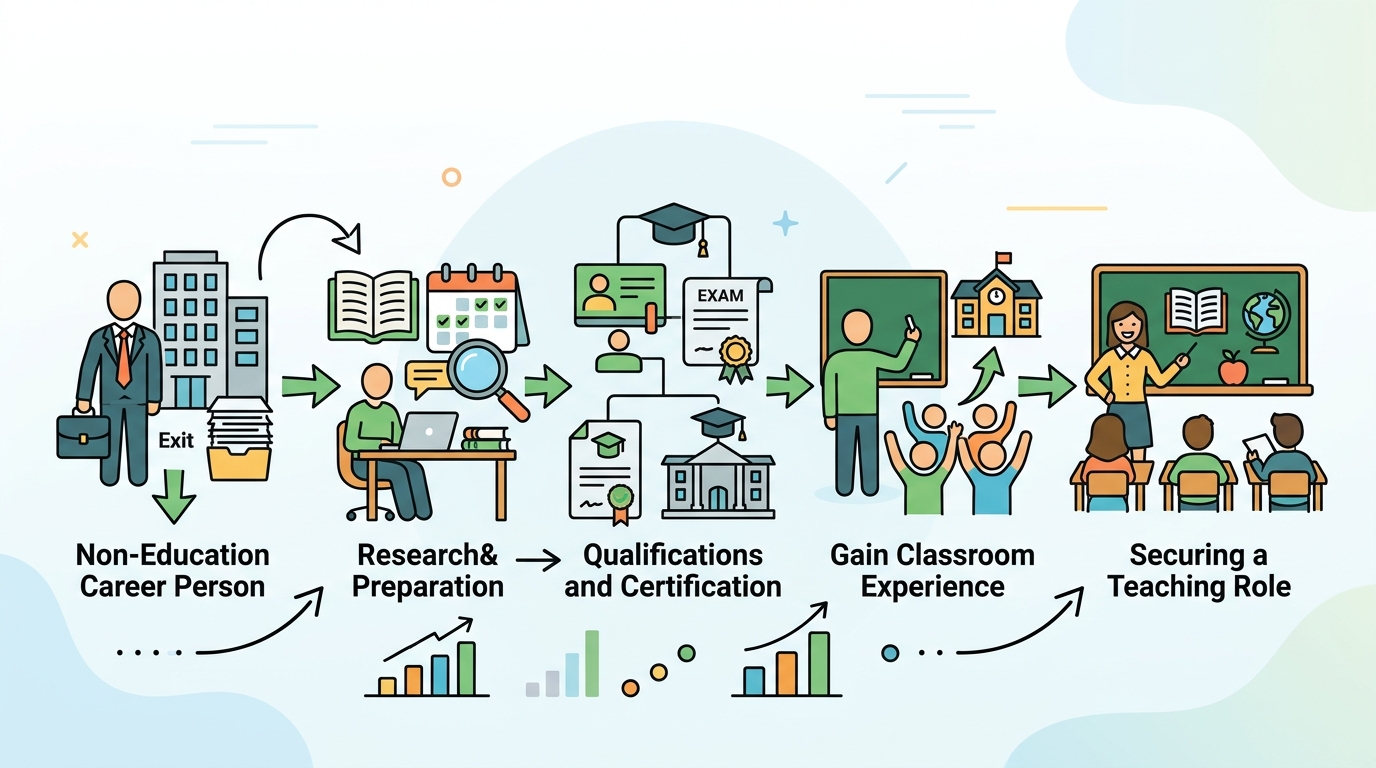
You can move into public school teaching from almost any field, but you cannot skip the license. Every state requires public school teachers to hold at least a bachelor's degree plus a state-issued certification for the grade level they teach (U.S. Bureau of Labor Statistics, 2025), and most career changers get there through an alternative route program built for people whose degree is in something else.
The fastest coursework runs a few months; full certification usually takes one to two years, because states attach a supervised residency or student teaching to it. Expect to be in a classroom before you are fully licensed, not after.
What Changes and What Stays the Same
The job is less like office work than people expect, and more tied to a bell schedule than almost anything outside healthcare or retail.
| Dimension | Most non-education jobs | Public school teaching |
|---|---|---|
| Schedule | Flexible start times, some remote work, movable meetings | Fixed bell schedule, contract day plus grading and planning at home, school holidays off |
| Physical demands | Mostly seated, you choose your breaks | On your feet most of the day, voice-heavy, breaks set by your prep period and duty assignments |
| Required credentials | Degree sometimes optional, certifications employer-driven | Bachelor's degree plus a state-issued license for the grade level, required in every state for public schools (U.S. Bureau of Labor Statistics, 2025); special education carries its own endorsement, and some states require a degree specifically in special education (U.S. Bureau of Labor Statistics, 2025) |
| Pay trajectory | Negotiated offers, raises tied to performance or job moves | Published district salary schedules, with steps for verified years of service and lanes for degrees and graduate credits |
| Oversight | A manager reviews your output | Formal classroom observations by an administrator, plus a performance assessment for licensure in some states |
On pay, structure matters more than any single number. Districts post their salary schedules publicly, and your placement depends on verified teaching years and credits, not on what you earned before. Many districts give little or no step credit for non-education work, so ask the human resources office how they count it. Check the district's posted schedule and the U.S. Bureau of Labor Statistics Occupational Outlook Handbook for current pay in your state.
What stays the same: you still manage a workload against deadlines, present to a room, handle conflict and document everything. Demand is steadiest at the elementary level, with about 99,400 openings for kindergarten and elementary school teachers projected each year on average over the decade (U.S. Bureau of Labor Statistics, 2025).
Transferable Skills and Gaps
Skills that transfer directly
- Deep subject knowledge — an accountant, chemist, journalist or bilingual professional already holds the content a Praxis Subject Assessment tests for a grade level or content area (TeacherCertification.com).
- Presenting to a room and reading whether people followed you.
- Project planning and pacing: a semester unit plan is close to scoping work against a deadline.
- De-escalating an angry customer, patient or client, which maps onto a defiant student or an upset parent.
- Writing plainly for non-experts, which is most of what a parent email or assignment sheet is.
- Reading a spreadsheet of assessment results and acting on it.
Skills you build from scratch
- Classroom management with 25 to 30 students who did not choose to be there — the most common reason career changers struggle.
- Writing lesson objectives aligned to your state's academic standards rather than your own sense of what matters.
- Formative assessment and grading, including defending a grade to a parent.
- Special education compliance: reading an IEP or 504 plan and delivering the accommodations it legally requires.
- Early literacy instruction, including phonics, if you target elementary grades.
- Producing a teacher performance assessment portfolio with video of your own teaching. The edTPA became mandatory for licensure in eight states by 2018 (ScienceDirect), and 19 states had performance assessment requirements by 2019, though about half had dropped them by mid-2024 (Rutgers New Jersey State Policy Lab).
Steps to Make the Switch
- Pick a grade band and subject, then read your own state's rules. Secondary certification usually covers grades 7–12 (U.S. Bureau of Labor Statistics, 2025). Adult education differs again: some states issue a certificate specifically for adult education, while others require an elementary or secondary certificate (U.S. Bureau of Labor Statistics, 2025). Your state education department or standards board is the only authority.
- Check the entry bar and clear the paperwork. Most online alternative certification programs require a bachelor's degree in any field plus a minimum GPA often around 2.5, with a background check and fingerprinting depending on state and placement (Research.com). Order transcripts early.
- Sit the required tests. Praxis Core Academic Skills for Educators is often the entry test for a preparation program, and Praxis Subject Assessments cover your content area (TeacherCertification.com). Rules are specific: New Jersey lets its basic-skills requirement be met with Praxis Core, and the Reading test (code 5713) requires a passing score of 156 for all Certificate of Eligibility endorsements (New Jersey Department of Education).
- Choose an alternative route and understand its shape. Washington's Route 3 for career changers with a bachelor's degree runs one to two years and includes intensive coursework plus a one-year residency and student teaching in a district (Washington Professional Educator Standards Board). Virginia runs a Career Switcher Alternative Route to Licensure for degree holders who never completed a teacher-education program (Teach Away). Illinois requires basic skills and subject tests, an approved prep program, a provisional license, the Teacher Performance Assessment and a recommendation for a second residency year (Indeed). In Texas, iteach charges a program fee of $4,949 excluding state certification fees, runs 12–18 months overall with coursework completable in as little as three months, and lets candidates start full-time teaching in as little as eight weeks (MastersInEducation.org). The American Board offers a self-paced online route completable in as little as two months while you keep working, supporting certification preparation in over 10 states (Research.com). The trade-off with the fast routes is real: you take sole charge of a classroom with far less supervised practice, and a license earned that way may require extra coursework or testing if you later move states.
- Target districts that hire career changers. The federal Transition to Teaching program funds grants to recruit mid-career professionals who did not major in education into high-need schools, with participants supported to serve at least three years (U.S. Department of Education). You cannot apply for that grant yourself — eligible applicants are districts, state agencies, nonprofits, for-profit organizations and universities, which then place participants (U.S. Department of Education). So search for district- and university-run programs near you, and attend district hiring fairs, where principals often interview on the spot.
- Script how you explain the pivot. Principals read a career change as either an asset or a flight risk; your answer settles which.
Interview answer for the pivot question
I spent nine years in commercial insurance, and the part I kept volunteering for was training new adjusters. I decided I wanted that to be the whole job. I'm in the state's alternative route for secondary math, I passed the subject assessment last spring, and I've covered six weeks as a long-term sub in ninth-grade algebra. I'm not sampling this — I've paid for it and I've taught in it.
Realistic Timeline
This assumes you keep working while you prepare and enter through an alternative route, the common career-changer path.
- Months 0–3, decision to program acceptance. Confirm your state's requirements, order transcripts, pass Praxis Core if your state requires it for program entry (TeacherCertification.com), clear the background check and fingerprinting (Research.com), and apply to an approved preparation program.
- Months 2–5, coursework and subject testing. The compressed options land here: the American Board route can be completed in as little as two months (Research.com), and iteach's instructional coursework in as little as three months (MastersInEducation.org). Pass your Praxis Subject Assessment in this window.
- Months 4–12, provisional license and first classroom. Some routes let you begin full-time teaching in as little as eight weeks from enrollment (MastersInEducation.org, on iteach in Texas); others place you in a one-year residency and student teaching first, as Washington's Route 3 does (Washington Professional Educator Standards Board). Hiring is seasonal, so a spring finish usually means an August start and a December finish often means substitute teaching until the next cycle.
- Months 12–24, full certification. Finish program requirements, complete any teacher performance assessment your state still requires, and convert the provisional licence to a full one. Texas's iteach runs 12–18 months overall (MastersInEducation.org), Illinois asks for a recommendation for a second residency year (Indeed), and Washington's Route 3 runs one to two years (Washington Professional Educator Standards Board).
- Year 3, stability. A Transition to Teaching–funded placement commits you to roughly three years in a high-need school (U.S. Department of Education) — about when most new teachers stop rebuilding every lesson from scratch.
Frequently asked questions
Am I too old to start teaching?
An early study of the American Board certification program found it was enrolling candidates with an average age of nearly 40, indicating they were primarily career changers with more work experience than other entry-level teachers (Mathematica Policy Research, via Wikipedia). Alternative routes exist for exactly this group, and principals hiring for high-need subjects often prefer someone who has worked in the field they will teach.
Will I take a pay cut, and can I negotiate?
Possibly, and there is little room to negotiate. Public districts pay from a published salary schedule with steps for verified years of service and lanes for degrees and graduate credits. What you can influence is lane placement, since a master's or extra credits may move you. Compare the district's posted schedule with your current pay, and check the U.S. Bureau of Labor Statistics Occupational Outlook Handbook for your state.
Does my prior work experience count toward anything?
It counts for the subject-matter test and for hiring credibility, rarely for salary steps. Alternative routes require a bachelor's degree in any field, usually with a minimum GPA around 2.5 (Research.com), so your major need not be education. But experience does not substitute for the state-issued license, and it will not excuse you from the residency or student teaching your route requires.
Can I keep my current job while retraining?
Partly. The American Board's self-paced online route is designed to be completed while you keep working, in as little as two months (Research.com). But the residency or student teaching phase fills a full school day — Washington's Route 3 includes a one-year residency and student teaching in a district (Washington Professional Educator Standards Board). Plan for at least one stretch with no weekday job.
Will my certification work if I move to another state?
Not automatically. Every state issues its own license for the grade level taught, and requirements generally include a bachelor's degree with a minimum GPA, student teaching, a background check and passing test scores (Transforming Education). Testing rules also shift: New York eliminated the edTPA as a certification requirement effective April 27, 2022, replacing it with program-integrated assessments (New York State Education Department). Check the receiving state's board first.
Sources
- U.S. Bureau of Labor Statistics — High School Teachers : Occupational Outlook Handbook (2025)
- U.S. Bureau of Labor Statistics — Kindergarten and Elementary School Teachers : Occupational Outlook Handbook (2025)
Your coach for this guide
Lena builds long-form conversations with workers across industries, chasing the specific texture of a job rather than its title. She's most interested in the gap between what a role is called and what it actually asks of someone.