 Work Quest Hub
HVAC Technician or Electrician? How to Decide Which Career Switch Fits You
Two licensed trades with similar median pay but different front doors: one starts with a six-month certificate, the other with a four-year paid apprenticeship.

By Lena KowalczykNov 15, 2026 · 10 min read
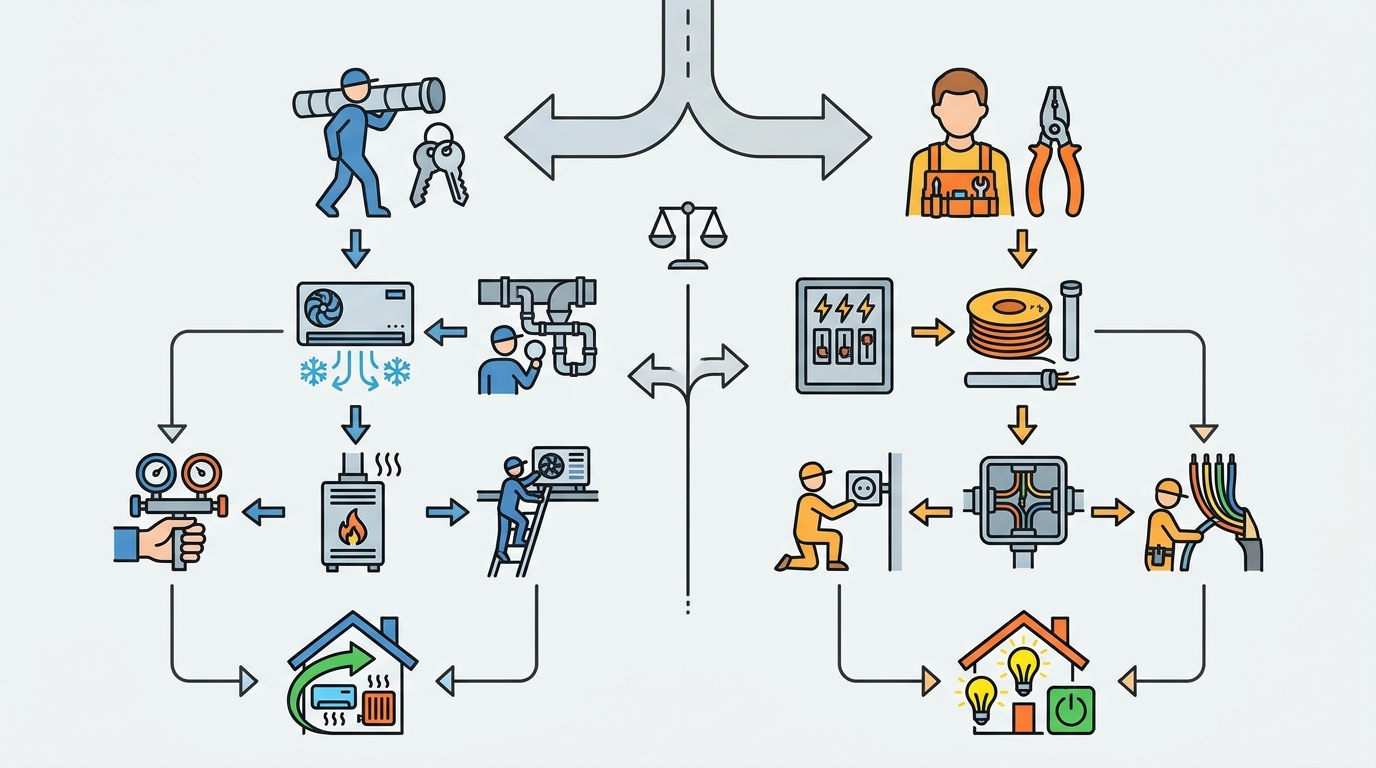
If you are choosing between HVAC and electrical work as a career switch, the biggest practical difference is not pay — it is how you get in. Electricians typically train through a 4- or 5-year apprenticeship with about 2,000 hours of paid on-the-job training a year, while HVAC technicians usually enter through 6 months to 2 years of postsecondary instruction leading to a certificate or associate's degree (U.S. Bureau of Labor Statistics, 2025).
The median annual wage was $63,190 for electricians and $61,010 for HVAC technicians in May 2025 (U.S. Bureau of Labor Statistics, 2025-05), so the decision usually comes down to training time, licensing in your state, schedule patterns and how each trade treats your body.
HVAC Technician vs. Electrician at a Glance
| Dimension | HVAC technician | Electrician |
|---|---|---|
| Median annual wage | $61,010, or $29.33 per hour (U.S. Bureau of Labor Statistics, May 2025) | $63,190, or $30.38 per hour (U.S. Bureau of Labor Statistics, May 2025) |
| Bottom and top 10 percent | Under $40,050 and over $95,210 (U.S. Bureau of Labor Statistics, May 2025) | Under $42,640 and over $108,510 (U.S. Bureau of Labor Statistics, May 2025) |
| Typical schedule | Most work full time, including evening or weekend shifts, on-call emergency work, and overtime or irregular hours during peak heating and cooling seasons (U.S. Bureau of Labor Statistics, 2025) | Almost all work full time, with evenings and weekends possible and overtime common; self-employed residential electricians may set their own schedule (U.S. Bureau of Labor Statistics, 2025) |
| Entry timeline | Postsecondary instruction of 6 months to 2 years leading to a certificate or associate's degree, or an apprenticeship lasting several years (U.S. Bureau of Labor Statistics, 2025) | A 4- or 5-year apprenticeship, with about 2,000 hours of paid on-the-job training per year plus technical instruction (U.S. Bureau of Labor Statistics, 2025) |
| Entry-level education | Postsecondary nondegree award is typical, though some enter with less education (U.S. Bureau of Labor Statistics, 2025) | High school diploma or equivalent, with no prior related work experience required (U.S. Bureau of Labor Statistics, 2025) |
| Credential | EPA certification in proper refrigerant handling is required for nearly all technicians; some states and localities also require an HVAC license (U.S. Bureau of Labor Statistics, 2025) | Most states require passing a licensing exam covering the National Electrical Code plus state and local codes (U.S. Bureau of Labor Statistics, 2025) |
| Physical demands and risk | One of the highest rates of injuries and illnesses of all occupations; hazards include burns from electrical parts or chemicals and muscle strains from handling heavy equipment (U.S. Bureau of Labor Statistics, 2025) | Cramped spaces, long periods of standing and kneeling, exposure to dirt, dust, debris, fumes and hot or cold temperatures, and work at great heights (U.S. Bureau of Labor Statistics, 2025) |
| Upward path | Start on basic tasks beside experienced technicians, then progress to cutting and soldering pipes and checking electrical circuits (U.S. Bureau of Labor Statistics, 2025) | Journey workers may advance to master electrician after meeting additional requirements, or move into supervisor or project-management roles (U.S. Bureau of Labor Statistics, 2025) |
| Job market | 440,900 jobs in 2025, projected 11 percent growth through 2035 and about 40,600 openings per year (U.S. Bureau of Labor Statistics, 2025) | 821,000 jobs in 2025, projected 9 percent growth through 2035 and about 72,700 openings per year (U.S. Bureau of Labor Statistics, 2025) |
Day-to-Day Differences
A July Tuesday for a residential HVAC technician is dispatch-driven. You pick up a route of four to six service calls, and the first is usually a no-cooling complaint: you check the thermostat call, pull the disconnect, test the run capacitor, put gauges on the refrigerant lines and read suction and liquid pressures, then clean a condenser coil. Refrigerant work is the reason nearly all HVAC technicians must hold EPA certification in proper refrigerant handling (U.S. Bureau of Labor Statistics, 2025) — you cannot legally recover or charge without it. New technicians typically ride with experienced technicians first and start with basic tasks such as insulating refrigerant lines or cleaning furnaces, then move up to cutting and soldering pipes and checking electrical circuits (U.S. Bureau of Labor Statistics, 2025). Expect the day to run long in peak season: schedules may include evening or weekend shifts, on-call emergency work and overtime during peak heating and cooling months (U.S. Bureau of Labor Statistics, 2025). The injury exposure is real — HVAC has one of the highest rates of injuries and illnesses of all occupations, with burns from electrical parts or chemicals and strains from moving heavy equipment among the hazards (U.S. Bureau of Labor Statistics, 2025).
An electrician's Tuesday is more often one site, all day. On a commercial fit-out you might spend the morning laying out device boxes to print, bending and hanging EMT conduit, and the afternoon pulling conductors and terminating a panel, with the week's milestone being a rough-in inspection against the National Electrical Code — the same code your state licensing exam tests (U.S. Bureau of Labor Statistics, 2025). Instead of driving between unfamiliar houses, you work the same floor plan for days, which makes the hours more predictable within a shift, though overtime is common and evenings and weekends happen (U.S. Bureau of Labor Statistics, 2025). The physical strain comes from a different source than HVAC's heavy-equipment lifting: electricians occasionally work in cramped spaces, spend long periods standing and kneeling, meet dirt, dust, debris, fumes and hot or cold temperatures, and may be required to work at great heights (U.S. Bureau of Labor Statistics, 2025). If ladders, lifts and attic crawls are a problem for you, that is a disqualifier on the electrical side before pay ever enters the conversation.
The other daily difference is customer contact. HVAC service work puts you in someone's home, explaining a failed compressor and a price; new-construction electrical work puts you with a foreman and a set of drawings. Both occupations are rated Job Zone Three, Medium Preparation Needed, meaning vocational training, related on-the-job experience or an associate's degree is the usual starting point (National Center for O*NET Development).
Pay, Hours, and Entry Requirements Compared
| Measure | HVAC technician | Electrician |
|---|---|---|
| Median annual wage | $61,010 (U.S. Bureau of Labor Statistics, May 2025) | $63,190 (U.S. Bureau of Labor Statistics, May 2025) |
| Median hourly wage | $29.33 (U.S. Bureau of Labor Statistics, May 2025) | $30.38 (U.S. Bureau of Labor Statistics, May 2025) |
| Lowest 10 percent earned less than | $40,050 (U.S. Bureau of Labor Statistics, May 2025) | $42,640 (U.S. Bureau of Labor Statistics, May 2025) |
| Highest 10 percent earned more than | $95,210 (U.S. Bureau of Labor Statistics, May 2025) | $108,510 (U.S. Bureau of Labor Statistics, May 2025) |
| Typical weekly hours | Most work full time, so 40 hours is the baseline (U.S. Bureau of Labor Statistics, 2025); writer's estimate of 45-55 hours in peak summer and winter weeks, because BLS reports on-call emergency work and irregular schedules during peak heating and cooling seasons | Almost all work full time, so 40 hours is the baseline (U.S. Bureau of Labor Statistics, 2025); writer's estimate of 45-55 hours during deadline stretches, because BLS reports that overtime is common |
| Required credential | EPA certification in proper refrigerant handling for nearly all technicians, with the exam typically included in a postsecondary HVACR program; some states and localities also require an HVAC license (U.S. Bureau of Labor Statistics, 2025) | A state licensing exam in most states, covering the National Electrical Code and state and local electrical codes (U.S. Bureau of Labor Statistics, 2025) |
| Typical education to start | Postsecondary nondegree award, with long-term on-the-job training; some enter with less education (U.S. Bureau of Labor Statistics, 2025) | High school diploma or equivalent, with the apprenticeship serving as the on-the-job training (U.S. Bureau of Labor Statistics, 2025) |
| Time to entry | 6 months to 2 years of postsecondary instruction for a certificate or associate's degree; apprenticeship routes usually last several years (U.S. Bureau of Labor Statistics, 2025) | 4 or 5 years of apprenticeship, about 2,000 hours of paid on-the-job training a year plus classroom instruction; military or construction electrical experience may shorten it after testing (U.S. Bureau of Labor Statistics, 2025) |
| Projected growth, 2025-2035 | 11 percent, about 40,600 openings a year (U.S. Bureau of Labor Statistics, 2025) | 9 percent, about 72,700 openings a year (U.S. Bureau of Labor Statistics, 2025) |
Tuition for an HVACR certificate or associate's program and fees for state licensing exams are set by individual schools and by each state's licensing board, so get the published per-credit cost and exam fee in writing from your local community college and your state board before you commit. Apprenticeship pay is a percentage of the journey-worker rate that steps up with hours completed; ask any program for its current wage schedule in writing.
Questions to Ask Yourself Before Choosing
Answer each of these with a yes, a no or a number from your own budget and calendar. If three or more answers push one direction, that is your route.
- Can you spend 4 or 5 years at apprentice wages before reaching journey-worker pay, or do you need a credential inside 6 to 24 months? That single answer separates the electrician apprenticeship from the HVACR certificate route (U.S. Bureau of Labor Statistics, 2025).
- Did you do electrical work in the military or in construction? If yes, check whether your state or a local apprenticeship will shorten your term based on experience and testing (U.S. Bureau of Labor Statistics, 2025).
- Can you lift and carry heavy equipment repeatedly, and are you willing to accept an occupation with one of the highest injury and illness rates of all occupations (U.S. Bureau of Labor Statistics, 2025)? If no, HVAC service is a poor fit.
- Can you work at great heights and in cramped spaces, kneeling for long stretches (U.S. Bureau of Labor Statistics, 2025)? If no, electrical construction will be hard going.
- How many nights a month can you be on call? HVAC technicians may be on call for emergencies and work irregular hours in peak heating and cooling seasons (U.S. Bureau of Labor Statistics, 2025). Write down your real number.
- Have you looked up your state's electrician licensing exam requirements and your state's HVAC license rules, and written down the exam fee and eligibility hours for each? Both are set state by state (U.S. Bureau of Labor Statistics, 2025).
- Do you want to reach master electrician, supervisor or project manager (U.S. Bureau of Labor Statistics, 2025), and are you willing to log the additional required hours to get there?
Frequently asked questions
Does HVAC or electrician pay more?
Electricians edge ahead at both the middle and the top. Median annual wages were $63,190 for electricians and $61,010 for HVAC technicians in May 2025, and the top 10 percent earned over $108,510 versus $95,210 for HVAC technicians (U.S. Bureau of Labor Statistics, May 2025).
Which career can I switch into faster, HVAC or electrical?
HVAC, usually. Postsecondary HVACR instruction runs 6 months to 2 years for a certificate or associate's degree, while most electricians complete a 4- or 5-year apprenticeship with about 2,000 hours of paid on-the-job training each year (U.S. Bureau of Labor Statistics, 2025).
Is HVAC work harder on your body than electrical work?
They strain you differently. HVAC technicians have one of the highest injury and illness rates of all occupations, with burns and heavy-equipment strains common. Electricians face cramped spaces, long kneeling, dust and fumes, and work at great heights (U.S. Bureau of Labor Statistics, 2025).
Sources
- U.S. Bureau of Labor Statistics — Electricians : Occupational Outlook Handbook (2025-05)
- U.S. Bureau of Labor Statistics — Heating, Air Conditioning, and Refrigeration Mechanics and Installers : Occupational Outlook Handbook (2025-05)
Your coach for this guide
Lena builds long-form conversations with workers across industries, chasing the specific texture of a job rather than its title. She's most interested in the gap between what a role is called and what it actually asks of someone.