 Work Quest Hub
Inside a Typical Day as a Software Engineer
A composite weekday on a product team, from the morning stand-up through code review, debugging and the last Git push before logging off.

By Lena KowalczykNov 15, 2026 · 10 min read
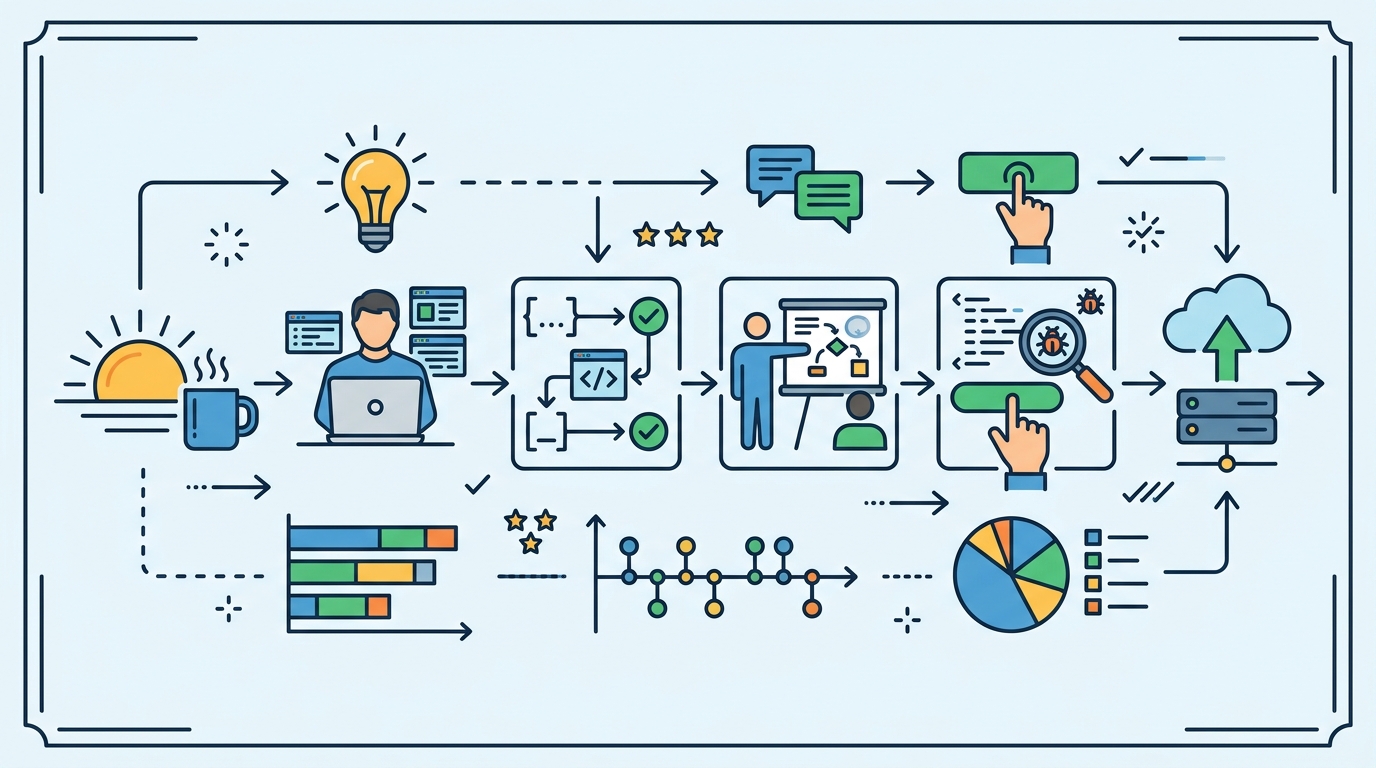
A software engineer's day is mostly building, reviewing and fixing code in short blocks between meetings with teammates, product owners and QA. The U.S. Bureau of Labor Statistics (2026-08-27) describes the work as analyzing users' needs, designing and developing software, testing and maintaining programs, and documenting every part of an application for future maintenance — and engineers in particular take a broad view of a project's requirements, planning scope and order of work.
The timeline below is a composite day drawn from common practice on US product teams, not a profile of a real person. Hours, meeting load and on-call duties vary a lot by employer and industry.
Hour-by-Hour: A Typical Shift
This is a composite day on a product engineering team. Start and end times shift with the employer, the time zones your teammates sit in, and whether you are on call that week.
8:30 a.m.–9:00 a.m. — Triage the inbox and the board. You open Atlassian JIRA (listed by O*NET among the tools frequently required in employer postings for this occupation), read overnight comments on your tickets, and check whether any automated builds failed in Jenkins CI. Anything red gets flagged to the teammate who owns it before stand-up.
9:00 a.m.–9:15 a.m. — Stand-up with the team. Fifteen minutes on video or around a board with your engineering manager, two or three other developers, and often a QA analyst. You say what you shipped, what you are picking up, and what is blocking you. Blockers that need a decision get parked for a follow-up chat.
9:15 a.m.–11:30 a.m. — First deep work block. The longest uninterrupted stretch of the day. You pull a branch in Git, write code against a ticket, and run tests locally as you go. If the ticket touches a database, you are writing and checking queries against something like PostgreSQL; if it is front-end, you are in React or TypeScript. You write the commit messages and inline documentation as you go, because the Bureau of Labor Statistics (2026-08-27) notes that documenting every aspect of an application as a reference for future maintenance is part of the job.
11:30 a.m.–12:00 p.m. — Code review. You read two colleagues' pull requests in the version control tool, leave comments on edge cases and naming, and approve one. Then you answer the comments left on your own branch. This is where attention to detail earns its keep and where disagreements get worked out in writing.
12:00 p.m.–12:45 p.m. — Lunch, away from the screen. Worth taking deliberately: O*NET work context data show 95% of respondents spend time sitting continually or almost continually, so a walk is maintenance for you rather than the code.
12:45 p.m.–1:30 p.m. — Requirements session. You meet a product manager, a systems analyst and sometimes a designer to talk through an upcoming feature. Your job is to judge feasibility and flag effort — the Bureau of Labor Statistics (2026-08-27) describes software engineers as taking a broad view of a project's system and software requirements, planning its scope and order of work. You sketch a sequence diagram on a whiteboard or in a shared doc so the other developers have something concrete to build from.
1:30 p.m.–3:30 p.m. — Second build block, or a bug hunt. If a production defect came in, this block goes to reproducing it: reading logs, stepping through the debugger, and narrowing the change that broke it. You modify the existing code to correct the error, add a regression test, and open a pull request. If no fire is burning, you continue the morning's feature work.
3:30 p.m.–4:15 p.m. — Deployment and verification. You merge an approved branch, watch the pipeline run in Jenkins CI, and check the service comes up clean. Infrastructure changes may mean a Terraform plan reviewed by a platform engineer before anything is applied. You message the QA analyst so they can validate the change in a test environment.
4:15 p.m.–5:00 p.m. — Write-ups and set-up for tomorrow. You update ticket status in JIRA, add a short note on project status for your manager, reply to a support engineer's question about an API, and leave yourself a comment on the branch you will pick up in the morning. Then you close the laptop.
Core Responsibilities Beyond the Clock
- Sprint planning and estimation — usually every one to two weeks. You and the team size the upcoming tickets and commit to a scope of work, producing a planned sprint board that the product manager can report against.
- On-call rotation — typically one week in every four to eight, where the employer runs one. You carry a pager or phone alert for production incidents and produce an incident write-up after anything that wakes you up. Not every team has this; ask about it in interviews.
- Retrospective — end of each sprint. The team agrees on two or three process changes, written down and assigned an owner, rather than a general grumble.
- Design documents — once per significant feature, often monthly. You write an architecture proposal with diagrams and trade-offs, circulate it for comment, and get sign-off before anyone writes code. The Bureau of Labor Statistics (2026-08-27) lists creating models and diagrams for programmers among the occupation's core duties.
- Dependency and security upgrades — monthly or quarterly. You patch libraries, run the test suite, and ship the upgrade with a release note.
- Performance reviews and goal-setting — usually twice a year. You write a self-assessment and peer feedback for colleagues; O*NET reports 50% of respondents have high responsibility for the work outcomes of other workers, and feedback is part of how that shows up.
- Interviewing candidates — ad hoc, sometimes several times a month. You run a technical exercise and file a written hiring recommendation.
- Seasonal freeze periods — annual in retail, finance and other peak-dependent industries. Changes to production are locked down, and the work turns to testing, documentation and preparation.
Who Tends to Thrive in This Role
People who do well here can hold a problem in their head for two hours without being rescued. The 9:15 a.m. to 11:30 a.m. build block and the 1:30 p.m. bug hunt are both long, quiet and unstructured — nobody tells you which log line matters or which function to refactor. O*NET lists Critical Thinking and Active Learning among the occupation's essential skills, and those blocks are where they get used.
You also have to be comfortable being edited. The 11:30 a.m. code review goes both ways: you leave comments on someone else's pull request and absorb comments on your own, sometimes about work you were proud of. The same disposition shows up at the 1:30 p.m. requirements session, where a product manager may want a feature you think is a bad idea and you have to argue it in plain English. O*NET found 71% of respondents call contributing to a work group extremely important, and both those meetings are why.
Precision matters more than speed. The 3:30 p.m. deployment is the moment a missed detail becomes visible to users, and the 8:30 a.m. triage exists because something failed overnight. O*NET names Attention to Detail and Dependability among the work styles most associated with this occupation.
The demanding parts are real. Sitting almost continually — reported by 95% of O*NET respondents — is hard on your back and eyes, and the afternoon bug hunt can run for hours with nothing to show until it suddenly resolves. The satisfying part is concrete: watching the pipeline go green at 3:30 p.m. on a fix you traced yourself, and knowing a user will not hit that error again.
How to Get Started
- Build a foundation in programming — 6 to 18 months. Learn one language properly, use Git for version control from the start, and put finished projects somewhere a hiring manager can read them.
- Earn a bachelor's degree in computer and information technology or a related field — about 4 years. The Bureau of Labor Statistics (2026-08-27) says this is what employers typically require, and O*NET's education survey found 85% of respondents said a bachelor's degree is required, with 5% each citing an associate's and a master's.
- Consider a registered apprenticeship instead of or alongside study — commonly 1 to 3 years. Apprenticeship titles approved by the U.S. Department of Labor for this occupation include Application Developer, DevOps Engineer and Software Developer; availability varies sharply by state and employer.
- Get hands-on with the tools employers actually ask for — 3 to 6 months of practice. O*NET's Hot Technologies list for this occupation includes Git, Jenkins CI, Atlassian JIRA, React, Spring Framework, PostgreSQL, Terraform and TypeScript. Pick the ones that match the jobs you are applying for.
- Add a certification if it fits your target industry — weeks to a few months. O*NET lists CompTIA and the Project Management Institute among the bodies associated with this occupation. Certification is rarely a substitute for demonstrable code.
- Target an internship or junior role, then accumulate experience — several years. O*NET classifies this as Job Zone Four, Considerable Preparation Needed, typically requiring a four-year degree plus several years of related experience or on-the-job training.
- Check current pay and openings before you commit — an afternoon. Use the Bureau of Labor Statistics Occupational Outlook Handbook and its state and metro wage data; pay is usually a salary plus, at some employers, a bonus or equity grant, and it varies by state, industry and company size.
Frequently asked questions
Is a computer science degree required to become a software engineer?
Usually, though not universally. The Bureau of Labor Statistics (2026-08-27) says developers, QA analysts and testers typically need a bachelor's degree in computer and information technology or a related field, and some employers prefer a master's. O*NET's education survey found 85% of respondents said a bachelor's is required and 5% said an associate's. Requirements vary by employer, and registered apprenticeships approved by the U.S. Department of Labor exist as an alternative route.
Which industries hire the most software developers in the US?
The Bureau of Labor Statistics (2026-08-27) reports the largest employers by industry share were computer systems design and related services (29%), finance and insurance (11%), software publishers (10%), manufacturing (8%), and management of companies and enterprises (6%). The industry affects your day: regulated sectors add more review and documentation steps, while software publishers often ship more frequently.
What is the job outlook for software engineers?
The Bureau of Labor Statistics (2026-08-27) projects overall employment of software developers, quality assurance analysts and testers to grow 10 percent from 2025 to 2035, much faster than the average for all occupations, with about 106,100 openings projected each year on average. Projections are national and do not guarantee any individual a position; local conditions differ by state and metro area.
Where can software engineers advance to?
The Bureau of Labor Statistics (2026-08-27) notes developers can advance to project management specialist or computer and information systems manager roles, overseeing the development process. Some engineers instead move along a technical track toward staff or principal roles, where the work shifts further toward architecture, design documents and setting standards across teams. Title structures differ considerably from one employer to another.
Do software engineers work nights and weekends?
Most work full time, according to the Bureau of Labor Statistics (2026-08-27), and 90% of O*NET respondents reported a typical 40-hour week. Extra hours tend to cluster around releases, incidents and on-call weeks. Whether on-call exists, how often it comes round, and whether it is compensated are employer-specific questions worth asking before you accept an offer.
Sources
- U.S. Bureau of Labor Statistics — Software Developers, Quality Assurance Analysts, and Testers : Occupational Outlook Handbook (2026-08-27)
- O*NET OnLine — 15-1252.00 - Software Developers
Your coach for this guide
Lena builds long-form conversations with workers across industries, chasing the specific texture of a job rather than its title. She's most interested in the gap between what a role is called and what it actually asks of someone.