 Work Quest Hub
Is a Career in HVAC Right for You?
A look at the physical demands, on-call hours, refrigerant certification rules and training timelines before you spend money on an HVACR program.

By Priya NatarajanNov 15, 2026 · 9 min read
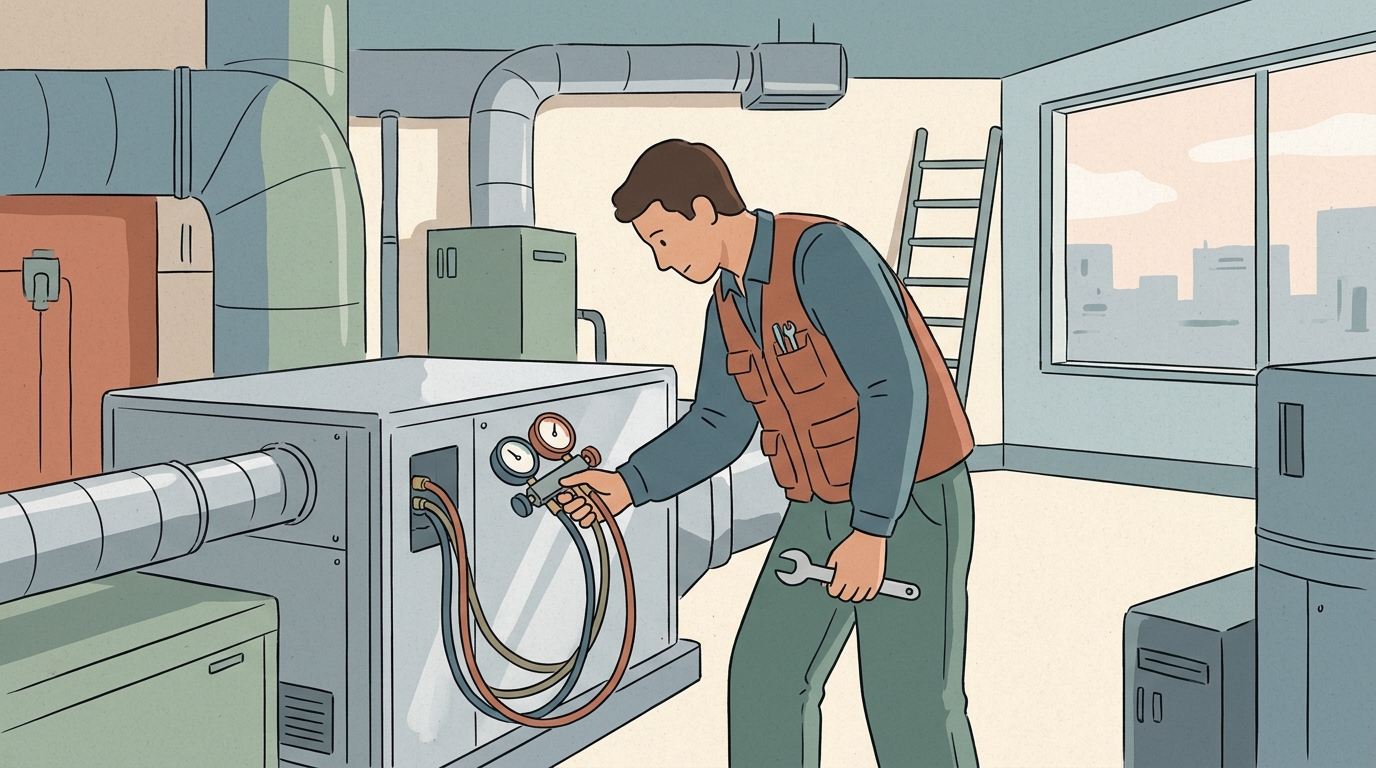
HVAC suits you if you like diagnosing mechanical and electrical faults with your hands, explaining the fix to a homeowner, and working alone most of the day in attics, crawlspaces and on rooftops. It is physically demanding work: the occupation has one of the highest rates of injuries and illnesses of all occupations, and most technicians work full time with evening or weekend shifts, on-call emergencies and overtime during peak heating and cooling seasons (U.S. Bureau of Labor Statistics, 2025).
The entry path is short compared with most career changes. Trade school and community college HVACR programs generally run 6 months to 2 years, while apprenticeships usually last several years and pay you while you train (U.S. Bureau of Labor Statistics, 2025).
What the Job Actually Involves Day to Day
Your day runs on work orders, not a desk. Scheduling work with customers and initiating work orders is a listed task for the occupation (O*NET OnLine, U.S. Department of Labor), usually handled through a dispatch app on a phone or tablet in the truck, and you keep records of work performed (U.S. Bureau of Labor Statistics, 2025).
Five things recur almost every week:
- Talking through symptoms with the caller. You discuss heating or cooling system malfunctions with users to isolate the problem or verify a repair (O*NET OnLine, U.S. Department of Labor) — when it started, whether it runs without cooling, whether the breaker trips.
- Electrical testing. Testing circuits and components for continuity with electrical test equipment, and connecting wiring between controls and equipment according to wiring diagrams (O*NET OnLine, U.S. Department of Labor). A multimeter and the unit's schematic are in your hands constantly.
- Leak work. Testing pipes, lines, components and connections for leaks, then brazing or soldering parts to repair defective joints (O*NET OnLine, U.S. Department of Labor) — torch, nitrogen, gauges.
- Refrigerant handling. Recovery and charging are regulated; nearly all technicians must hold EPA Section 608 certification to do it (U.S. Bureau of Labor Statistics, 2025).
- Install and replace. Installing HVACR systems and electrical components, replacing worn or defective parts, and recommending maintenance (U.S. Bureau of Labor Statistics, 2025).
Meetings are light: a short morning dispatch briefing and perhaps one weekly team or safety meeting. The rest is solo or two-person work in a mechanical room, an attic or on a roof. The largest employer category is plumbing, heating, and air-conditioning contractors (U.S. Bureau of Labor Statistics, 2025), so most jobs mean driving a route of customer addresses rather than staying on one site. Hours are full time, often with evening or weekend shifts, on-call rotations and seasonal overtime (U.S. Bureau of Labor Statistics, 2025).
Signs This Career Fits You
- You have traced a fault yourself — rewired a lamp, diagnosed a no-start car, replaced a thermostat — and enjoyed narrowing the cause down rather than swapping parts at random. Problem-solving and mechanical skills are named qualities for the occupation (U.S. Bureau of Labor Statistics, 2025).
- You can read a diagram and follow it exactly; connecting wiring according to wiring diagrams is routine work (O*NET OnLine, U.S. Department of Labor).
- You are comfortable doing arithmetic on the spot — airflow, pressures, sizing. Math skills are listed as important (U.S. Bureau of Labor Statistics, 2025).
- You have held a job dealing with customers in their homes or vehicles and stayed calm when they were upset about cost; customer-service skills sit alongside the technical ones (U.S. Bureau of Labor Statistics, 2025).
- You already do physical work for most of a shift — lifting, climbing, kneeling. Physical stamina and strength are named qualities (U.S. Bureau of Labor Statistics, 2025).
- You would rather be judged on finished calls than sit in a scheduled meeting block.
- You will study for a proctored exam: Section 608 core tests taken open-book cannot be used to earn Universal Certification (U.S. Environmental Protection Agency, 2026).
Signs It Might Not Be a Fit
- You are not willing to accept elevated injury risk from burns, shock, falls and strain. The occupation has one of the highest rates of injuries and illnesses of all occupations (U.S. Bureau of Labor Statistics, 2025).
- You need a predictable finish time. Evening and weekend shifts, on-call emergency work and seasonal overtime are normal (U.S. Bureau of Labor Statistics, 2025).
- You dislike confined, hot or cold spaces — attics in July, rooftops in January.
- You do not want to deliver bad news. You discuss malfunctions directly with customers and recommend maintenance (U.S. Bureau of Labor Statistics, 2025), including calls where the answer is full replacement.
- You want to skip formal training. Even apprenticeships usually last several years, and this is a Job Zone Three occupation needing one to two years of combined on-the-job and informal training (U.S. Bureau of Labor Statistics, 2025; O*NET OnLine, U.S. Department of Labor).
- You cannot drive a service vehicle between multiple customer addresses each day.
Skills You Already Have vs. Skills You'll Need to Build
| Skill you likely already have | Gap skill, and how to close it |
|---|---|
| Explaining a problem to a non-expert customer | Isolating faults by questioning the user (O*NET OnLine, U.S. Department of Labor) — built in the shop-work portion of a trade school or community college HVACR program, generally 6 months to 2 years (U.S. Bureau of Labor Statistics, 2025) |
| Everyday arithmetic and measurement | Load, pressure and airflow calculations — covered in HVACR coursework; spend a few weeks first on high school level math and physics, the subjects BLS (2025) recommends for entrants |
| Basic hand-tool and DIY repair | Brazing, soldering and leak repair (O*NET OnLine, U.S. Department of Labor) — bench practice hours inside a 6-month-to-2-year program, or supervised repetition in an apprenticeship lasting several years with paid on-the-job training (U.S. Bureau of Labor Statistics, 2025) |
| Following written instructions and checklists | Reading wiring diagrams and testing circuits for continuity (O*NET OnLine, U.S. Department of Labor) — a core module in HVACR certificate programs, typically a term of study |
| Passing workplace tests and compliance training | EPA Section 608 certification — Type I (small appliances), Type II (high-pressure), Type III (low-pressure) or Universal; tests must be given by an EPA-approved certifying organization and do not expire (U.S. Environmental Protection Agency, 2026). The exam is typically included in a postsecondary HVACR program (U.S. Bureau of Labor Statistics, 2025) |
| Keeping accurate records at your current job | State or local licensing, where required — one evening checking your state's board through CareerOneStop, plus any exam it names (U.S. Bureau of Labor Statistics, 2025); manufacturer and industry certifications are often optional, though some employers require specific types (U.S. Bureau of Labor Statistics, 2025) |
One shortcut: apprentices are exempt from Section 608 certification requirements while closely and continually supervised by a certified technician (U.S. Environmental Protection Agency, 2026), so you can start earning before the exam is behind you.
How to Test the Waters Before You Commit
- Spend 30 minutes on CareerOneStop and write down your state's answer. Check whether your state or locality licenses HVAC technicians and what it requires (U.S. Bureau of Labor Statistics, 2025). Outcome: a one-page note naming the licensing body, the requirements and any exam. Cost: your time.
- Do two informational interviews with working technicians, 30–45 minutes each. Plumbing, heating, and air-conditioning contractors are the largest employer category (U.S. Bureau of Labor Statistics, 2025), so start there. Ask about on-call rotation frequency, peak-season overtime, and how pay is structured — hourly, overtime, on-call premiums, commission on replacements. Outcome: written notes from both.
- Arrange one ride-along, 6–8 hours, on a Saturday or a vacation day. Ask to be present for an attic or rooftop call, not just a filter change. Outcome: a yes/no on whether the physical conditions work for you, which matters given the occupation's high injury and illness rate (U.S. Bureau of Labor Statistics, 2025).
- Tour one HVACR program and get the numbers in writing. Programs generally last 6 months to 2 years and lead to a certificate or associate's degree (U.S. Bureau of Labor Statistics, 2025). Ask for total published tuition and fees, the tool list and its cost, evening-class availability, and whether the Section 608 exam is included. Budget about 2 hours per visit. Outcome: a written cost sheet to compare against a second school.
- Sit the Section 608 Type I exam through an EPA-approved certifying organization. Tests are specific to the equipment type, and the credential does not expire; if you later want Universal, the core test must be proctored rather than open-book (U.S. Environmental Protection Agency, 2026). Allow a few evenings of study and one test session. Outcome: a certification card before you leave your current job.
- Apply to one apprenticeship opening while still employed. Apprenticeships usually last several years with paid on-the-job training plus technical instruction each year (U.S. Bureau of Labor Statistics, 2025). Outcome: a submitted application and a written statement of next intake's entry requirements.
Frequently asked questions
How long does it take to become an HVAC technician?
Trade school and community college HVACR programs generally last 6 months to 2 years and lead to a certificate or associate's degree; apprenticeships usually last several years with paid on-the-job training plus technical instruction each year (U.S. Bureau of Labor Statistics, 2025). O*NET classes the work as Job Zone Three — one to two years of combined training.
Do you need a license to work in HVAC?
Nearly all technicians need EPA Section 608 refrigerant certification (U.S. Bureau of Labor Statistics, 2025). Separately, some states and localities require an HVAC license; requirements differ by state, and CareerOneStop lists state licensing board information (U.S. Bureau of Labor Statistics, 2025). Check yours before enrolling in any program.
How much do HVAC technicians get paid?
Pay is usually hourly, with overtime in peak heating and cooling seasons, on-call premiums and sometimes commission on replacement sales (U.S. Bureau of Labor Statistics, 2025). The Bureau of Labor Statistics publishes the current median annual wage for heating, air conditioning, and refrigeration mechanics and installers in its Occupational Outlook Handbook.
Is HVAC a good career to switch into at 40?
Entry is short — 6 months to 2 years of schooling, or a paid apprenticeship (U.S. Bureau of Labor Statistics, 2025) — and employment is projected to grow much faster than average from 2025 to 2035, with about 40,600 openings a year on average. The constraint is physical: one of the highest injury and illness rates of all occupations.
What is the difference between EPA 608 Type I, II, III and Universal?
Type I covers servicing small appliances, Type II high- or very high-pressure appliances, Type III low-pressure appliances, and Universal all types (U.S. Environmental Protection Agency, 2026). Tests must be administered by an EPA-approved certifying organization, and the core test must be proctored, not open-book, to qualify for Universal. The certification does not expire.
Sources
- U.S. Bureau of Labor Statistics — Heating, Air Conditioning, and Refrigeration Mechanics and Installers (2025)
- O*NET OnLine (U.S. Department of Labor) — 49-9021.00 - Heating, Air Conditioning, and Refrigeration Mechanics and Installers
Your coach for this guide
Priya shapes the publication's coverage of job transitions, writing often about the messy middle between leaving one role and starting another. She's drawn to the quiet negotiations people have with themselves before a resignation letter gets written.