 Work Quest Hub
Is Being an HVAC Technician Right for You?
The trade pays by the hour or by the job, rewards people who like diagnosing problems in tight crawlspaces, and punishes anyone who hates being hot.

By Lena KowalczykNov 15, 2026 · 9 min read
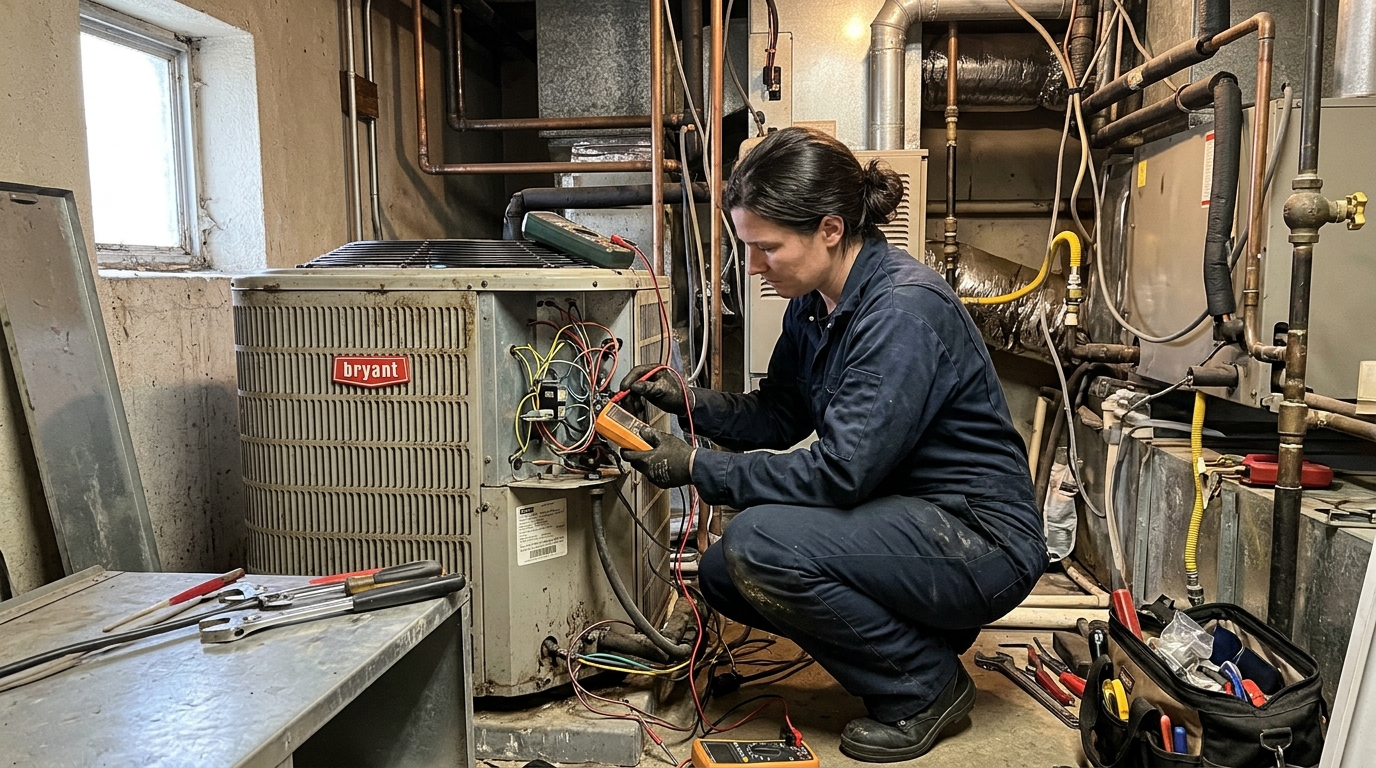
HVAC technicians install, service and repair heating, cooling and refrigeration equipment, usually in houses, rooftops, mechanical rooms and crawlspaces rather than a workshop. It suits people who like electrical and mechanical troubleshooting, can handle physical discomfort and heat, and don't mind standing in a customer's kitchen explaining why their system needs replacing rather than repairing.
Entry is faster than a four-year degree — the Bureau of Labor Statistics lists a postsecondary nondegree award as typical entry-level education (U.S. Bureau of Labor Statistics, 2025) — but the work carries one of the highest injury rates of any occupation, and summer and winter peaks mean long weeks when everyone else is comfortable indoors.
What This Career Actually Involves
A typical residential service day splits roughly like this: 50–60% hands-on diagnosis and repair, 15–20% driving between calls, 15% talking to customers and writing up what you found, and 10% paperwork, parts pickup and truck stock.
Diagnosis means meter work and pressure work. You'll carry a digital multimeter to check capacitors, contactors and control boards, a manifold gauge set or digital probes to read suction and head pressure, a refrigerant recovery machine and vacuum pump for system work, and a brazing torch with nitrogen for line repairs. Combustion work on furnaces adds a combustion analyzer and a draft gauge. Installs are a different rhythm — setting condensers on pads, hanging air handlers, cutting and sealing duct, pulling line sets, then evacuating and charging the system.
The environments are the part people underestimate: baking attics in August, crawlspaces, flat roofs with packaged rooftop units, boiler rooms and walk-in cooler compartments. Commercial and refrigeration work adds ladders, lifts and building automation screens.
Administration is real but light. You'll close tickets in a field service app on a phone or tablet, photograph failed parts, quote repair options, collect payment, and log refrigerant added or recovered. On new installs you may run or check a Manual J load calculation so the equipment is sized to the house. Math shows up constantly — superheat, subcooling, static pressure, amp draw — and the Bureau of Labor Statistics lists math skills for calculating load requirements among the qualities the job demands (U.S. Bureau of Labor Statistics, 2025).
Traits and Skills That Predict Success
- Tolerance for heat and confined spaces — you'll service an air handler in a stifling attic in July, then crawl under a house that afternoon.
- Systematic troubleshooting — when a unit isn't cooling, you have to rule out airflow, charge, electrical and control faults in order rather than swapping parts and hoping.
- Comfort doing arithmetic on the spot — you calculate superheat and subcooling, check amp draw against the nameplate, and size equipment from load requirements (U.S. Bureau of Labor Statistics, 2025).
- Willingness to deliver bad news — you'll tell a customer with a failed compressor that the repair costs nearly as much as a new system, and then stand behind the number.
- Physical strength and stamina — you'll carry condensers, compressors and sheet metal up stairs and onto roofs; muscle strains from handling heavy equipment are a documented hazard in this trade (U.S. Bureau of Labor Statistics, 2025).
- Respect for electrical risk — you work on live high-voltage circuits and charged capacitors, where burns from electrical parts are a leading injury (U.S. Bureau of Labor Statistics, 2025).
- Comfort with technology — modern systems use variable-speed drives, communicating thermostats and computerized controls you diagnose through fault codes and manufacturer apps (U.S. Bureau of Labor Statistics, 2025).
- Reliability under call-out pressure — on-call rotations mean a late-night no-heat call in January, and the customer is waiting.
- Clean habits around other people's homes — drop cloths, shoe covers and explaining what you touched are what produce repeat customers for the contractor who employs you.
This Career vs. a Common Alternative
The trade people most often weigh against HVAC is the electrician. Both involve troubleshooting circuits, both are site-based, and both are projected to grow much faster than average from 2025 to 2035 (U.S. Bureau of Labor Statistics, 2025). The entry routes and the daily work are not the same.
| Factor | HVAC technician | Electrician |
|---|---|---|
| Median annual wage, May 2025 | $61,010, or $29.33 an hour (U.S. Bureau of Labor Statistics, 2025) | $63,190, or $30.38 an hour, with the top 10% above $108,510 and the bottom 10% below $42,640 (U.S. Bureau of Labor Statistics, 2025) |
| Typical entry-level education | Postsecondary nondegree award from a trade school or community college HVACR program (U.S. Bureau of Labor Statistics, 2025) | High school diploma or equivalent, then an apprenticeship (U.S. Bureau of Labor Statistics, 2025) |
| Main credential | EPA Section 608 certification — Type I, II, III or Universal — earned by passing an EPA-approved test administered by an EPA-approved certifying organization (U.S. Environmental Protection Agency, undated) | A state or local license in most states, earned by passing a test on the National Electrical Code and state and local codes (U.S. Bureau of Labor Statistics, 2025) |
| Training structure | ONET places it in Job Zone Three, typically one or two years of combined on-the-job and informal training, sometimes a recognized apprenticeship (ONET OnLine, 2026) | Most learn through an apprenticeship with about 2,000 hours of paid on-the-job training per year plus technical instruction, finishing as a journey worker (U.S. Bureau of Labor Statistics, 2025) |
| Daily task mix | Refrigerant handling, combustion and airflow diagnosis, duct and line-set work, heavy seasonal swings | Conduit, wire pulling, panels, device installation and code compliance, with no refrigerant work and little sheet metal |
| Annual openings, 2025–35 | Openings projected each year over the decade (U.S. Bureau of Labor Statistics, 2025) | About 72,700 per year (U.S. Bureau of Labor Statistics, 2025) |
Practically: choose HVAC if you want a shorter classroom runway and like diagnostic, customer-facing service calls. Choose electrical if you prefer a structured multi-year apprenticeship where you earn while you train and want a license tied to a written code book. Pay at the median is close — about two thousand dollars apart in May 2025 (U.S. Bureau of Labor Statistics, 2025) — and the spread within each trade is wider than the gap between them.
Signs This Career Fits You
Answer each of these yes or no. The more yes answers, the better the fit.
- You've worked a full shift outdoors in summer heat or winter cold and finished it without quitting.
- You've taken apart an appliance, engine or bicycle to find out why it stopped working — and reassembled it.
- You've used a multimeter, torque wrench or torch before, or you're genuinely curious to.
- You've carried something heavy up a ladder or through an attic hatch without needing to be asked twice.
- You've stayed calm while a customer or supervisor raised their voice at you about something that wasn't your fault.
- You've explained a technical problem to someone with no background in it and they understood you.
- You've answered a work call late at night, or taken a weekend shift, without resenting it all week.
- You've passed a written exam on technical material you studied largely on your own.
- You've handled money or quoted a price to a customer face to face.
- You've gone back and rechecked your own work before signing off on it.
Frequently asked questions
Do I need a license to work on HVAC systems?
Federal rules are clear on one point: EPA Section 608 regulations require technicians who maintain, service, repair or dispose of equipment that could release refrigerants into the atmosphere to pass an EPA-approved test given by an EPA-approved certifying organization (U.S. Environmental Protection Agency, undated). On top of that, contractor and technician licensing is set by state and sometimes by city, so requirements in Texas, California and Florida differ from each other. Check your state's licensing board directly before enrolling in any program.
What is EPA Section 608 certification and which type should I take?
There are four types: Type I for small appliances, Type II for high and very high-pressure appliances, Type III for low-pressure appliances, and Universal, which covers all equipment types (U.S. Environmental Protection Agency, undated). Many technicians sit for Universal because it leaves every kind of job open. The credential does not expire once you hold it (U.S. Environmental Protection Agency, undated).
Can I start working before I'm certified?
Yes, in one specific situation. Apprentices are exempt from Section 608 certification as long as they are closely and continually supervised by a certified technician (U.S. Environmental Protection Agency, undated). That is how many helpers get paid while they study. The exemption ends the moment you work on refrigerant-containing equipment on your own.
How long does HVAC training take?
The Bureau of Labor Statistics lists a postsecondary nondegree award as the typical entry-level education, earned at a technical or trade school or a community college and leading to a certificate or associate's degree, though some people enter with less (U.S. Bureau of Labor Statistics, 2025). O*NET classifies the job as Job Zone Three, medium preparation, typically one or two years of combined on-the-job and informal training (O*NET OnLine, 2026). Certification exams are often taken as part of the program itself (U.S. Bureau of Labor Statistics, 2025).
How dangerous is HVAC work?
More dangerous than most jobs. HVAC mechanics and installers have one of the highest rates of injuries and illnesses of all occupations, with hazards including burns from electrical parts or chemicals and muscle strains from handling heavy equipment (U.S. Bureau of Labor Statistics, 2025). Working practices matter: lockout before opening a panel, discharging capacitors before testing, and using a second person or a lift to move condensers.
Will I be self-employed or work for a company?
Most likely a company, at least at first. In 2025, 68% of HVAC technicians worked for plumbing, heating and air-conditioning contractors and 6% were self-employed (U.S. Bureau of Labor Statistics, 2025). Going independent usually means a state contractor license and your own liability insurance, which is why it tends to come after several years in the field.
Sources
- U.S. Bureau of Labor Statistics — Heating, Air Conditioning, and Refrigeration Mechanics and Installers - Occupational Outlook Handbook (2025)
- U.S. Environmental Protection Agency — Section 608 Technician Certification Requirements
Your coach for this guide
Lena builds long-form conversations with workers across industries, chasing the specific texture of a job rather than its title. She's most interested in the gap between what a role is called and what it actually asks of someone.