 Work Quest Hub
Pharmacy Technician Certification: Requirements, Cost, and How to Pass
A plain walk through the PTCE's four knowledge domains, who actually has to be certified, what the fees cover, and how long each training route takes.

By Priya NatarajanNov 15, 2026 · 7 min read
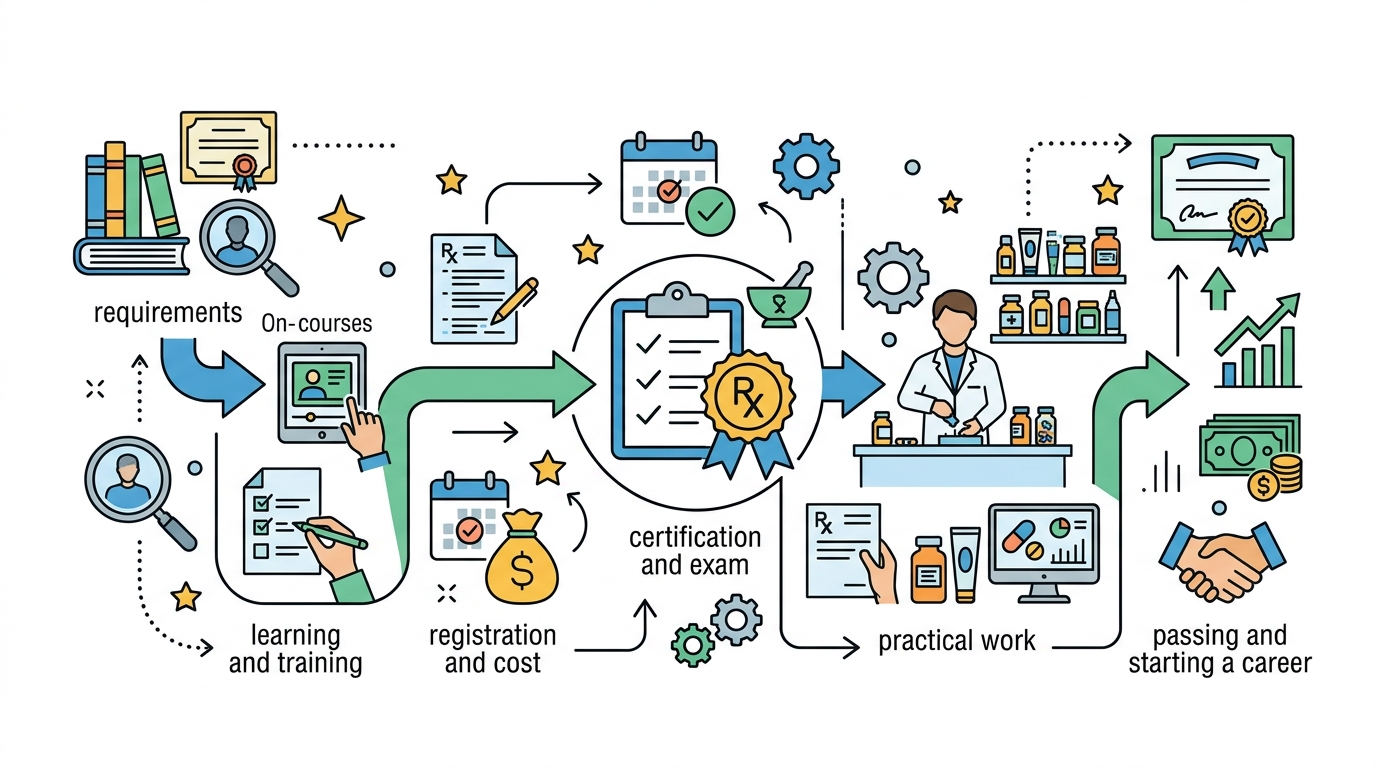
Most pharmacy technicians in the United States get certified through the Pharmacy Technician Certification Board (PTCB), which awards the Certified Pharmacy Technician (CPhT) credential after you pass the Pharmacy Technician Certification Exam (PTCE). Applying for certification and taking the PTCE costs $129, and the credential must be renewed every two years (Pharmacy Technician Certification Board (PTCB), 2026-09-30).
What varies is everything around the exam: the training you do first, what your state board of pharmacy requires for registration, and whether an employer pays part of the cost. This guide covers the eligibility rules, the application sequence, and what each route costs and takes.
What This Certification Covers
The exam is the Pharmacy Technician Certification Exam (PTCE), administered by the Pharmacy Technician Certification Board (PTCB). Passing it earns you the Certified Pharmacy Technician (CPhT) credential.
The PTCE has 90 multiple-choice questions — 80 scored and 10 unscored — with a time limit of 1 hour 50 minutes and a passing scaled score of 1,400 on a 1,000 to 1,600 scale (RxTechExam, 2026). The PTCE content outline effective January 6, 2026 groups scored content into four knowledge domains: Medications (35%), Patient Safety and Quality Assurance (23.75%), Order Entry and Processing (22.5%), and Federal Requirements (18.75%) (MedPreps, 2026). RxTechExam reports the 2025 national pass rate as 69% (RxTechExam, 2026).
Who needs it depends on where you work. PTCB's CPhT is described as the most popular pharmacy technician certification in the nation, is accepted in all 50 states, and most states require pharmacy technicians to earn certification (Stepful, undated). Separately from PTCB, your state board of pharmacy controls registration or licensure as a technician, and the rules differ state to state — check your own board's technician page before you pay for anything. In practice, hospital pharmacy departments and retail chain pharmacies often require or strongly prefer a CPhT for anything beyond a trainee role, and some employers will only let certified technicians handle sterile compounding or controlled substance tasks.
The National Healthcareer Association (NHA) offers a competing credential, the ExCPT. Its exam fee is listed at $115 by GetLicenseMap (2026) and at $125 by Stepful (undated), compared with PTCB's $129. Confirm which one your employer and state board accept before choosing.
Eligibility Requirements
PTCB states that eligibility for CPhT certification requires all of the following (Pharmacy Technician Certification Board (PTCB), 2026-09-30):
- You reside in the United States or its territories.
- You have completed a PTCB-Recognized Education/Training Program, or you have equivalent pharmacy technician work experience. Program completion may fall within 60 days of your application submission; the work-experience route requires at least 500 hours, complete at the time you apply (PTCB, 2026-09-30).
- You fully disclose all criminal convictions and all State Board of Pharmacy registration or licensure actions. This is a disclosure requirement, not a simple yes/no screen — omitting something is a problem in itself.
- You comply with PTCB certification policies.
- You achieve a passing score on the PTCE.
Two practical notes. The 500-hour work experience route means you need a pharmacy job first, which many employers will only give to someone already in a training program. And your state board of pharmacy may impose its own conditions — age, high school diploma, registration before you touch a prescription — that PTCB does not.
Steps to Get Certified
- Meet one of the two eligibility routes. Either enroll in and complete a PTCB-Recognized Education/Training Program (completion can fall within 60 days of application submission), or accumulate at least 500 hours of pharmacy technician work experience, complete at the time you apply (PTCB, 2026-09-30). A listed CPhT training program runs 12 weeks and is priced at $2,700–$2,970 across its payment options, separate from the exam fee (HealthCareerCerts, 2026-08-15).
- Create a PTCB Account on the PTCB website. Creating the account itself carries no fee (PTCB, 2026-09-30).
- Apply for certification by logging into your PTCB Account and submitting the application, including your criminal and State Board of Pharmacy disclosures. The total cost to apply and take the PTCE is $129 (PTCB, 2026-09-30), made up of a $50 application fee and a $79 exam fee; organizations that agree to cover the exam cost for their employees can have the $50 application fee waived (Stepful, undated). Ask your employer before you pay.
- Wait for approval, then schedule. Once the application is approved, you receive an email with authorization to schedule the exam, and the PTCE is administered in person at Pearson VUE test centers (PTCB, 2026-09-30). One guide describes a 90-day scheduling window after approval in which you must sit the exam (MedCertPrep, undated), so confirm your own deadline in the authorization email rather than assuming.
- Sit the PTCE at a Pearson VUE test center. You get 1 hour 50 minutes for 90 questions and need a scaled score of 1,400 to pass (RxTechExam, 2026). Study against the four domains in the content outline effective January 6, 2026, weighting Medications most heavily at 35% (MedPreps, 2026).
- Receive the CPhT credential and plan renewal. CPhTs must renew every 2 years to maintain the credential (PTCB, 2026-09-30). The recertification application fee is $55 (PTCB, undated), and one guide states renewal requires 20 continuing education hours within the certification cycle (MedCertPrep, undated).
From a standing start, a 12-week program plus application, approval and scheduling realistically puts you four to six months out from holding the credential.
Cost and Timeline by Path
| Path or Provider | Total Cost | Time to Complete |
|---|---|---|
| Online training program + PTCB PTCE (typical) | $1,100–$2,200 total, covering an online certification program plus the NHA or PTCB exam fee (Stepful, undated) | About 4–6 months, including application approval and scheduling |
| Listed 12-week CPhT training program + PTCB PTCE | $2,700–$2,970 for the program (HealthCareerCerts, 2026-08-15), plus the $129 PTCB fee (PTCB, 2026-09-30) | 12 weeks of instruction, then exam scheduling |
| 500 hours of on-the-job experience + PTCB PTCE | $129 to apply and test (PTCB, 2026-09-30) | Depends entirely on your hours per week; 500 hours must be complete when you apply |
| NHA ExCPT route | Exam fee listed at $115 (GetLicenseMap, 2026) or $125 (Stepful, undated), plus whatever training you do | Similar; set by your training provider |
The work-experience route is by far the cheapest at $129, and it is the one to take if you already hold a pharmacy job. Its real drawback is that it gives you no structured preparation for the four PTCE domains and no employer-facing proof of training while you accumulate the hours — and you need someone to hire you untrained first, which many retail and hospital pharmacies will not do.
Budget for the extras too. PTCB charges a Recertification Late Application Processing Fee of $25 for applications received after the deadline and a Reprocessing Fee of $10 each time an application is returned for corrections; letting the credential lapse triggers a $95 Reinstatement Fee (PTCB, undated).
Frequently asked questions
How often do I renew, and what does it cost?
PTCB CPhTs renew every 2 years (PTCB, 2026-09-30). The recertification application fee is $55, and a late application received after the deadline adds a $25 processing fee (PTCB, undated). One guide states renewal requires 20 continuing education hours within the cycle (MedCertPrep, undated). Confirm the current CE requirement in your PTCB Account before the deadline.
What counts as continuing education for renewal?
PTCB CE activities eligible toward renewal include event-based activities such as seminars, workshops, conferences and webinars, plus up to 10 CE hours from a relevant college course worth at least 3 academic credit hours passed with a grade of C or better (PTCB, undated). Keep your completion records; PTCB can ask for them.
What happens if my certification lapses?
PTCB charges a CPhT Reinstatement Fee of $95 (PTCB, undated), which is more than the $55 recertification fee you would have paid on time. If your employer or state board requires active certification, a lapse can also affect what tasks you are allowed to perform, so check your state board of pharmacy's rules directly.
If I fail the PTCE, can I retake it?
Yes, but you reapply through your PTCB Account and pay again — the $129 covers one application and one exam attempt (PTCB, 2026-09-30). PTCB sets waiting periods and limits on attempts, so read the current retake policy in your account rather than assuming. For context, RxTechExam reports the 2025 national pass rate as 69% (RxTechExam, 2026).
Does the CPhT transfer if I move to another state?
The PTCB CPhT is accepted in all 50 states, and most states require pharmacy technicians to earn certification (Stepful, undated). State registration or licensure is separate and does not automatically transfer — each state board of pharmacy sets its own application, fees and disclosure rules. Contact the board in your new state before you start work there.
Sources
- Pharmacy Technician Certification Board (PTCB) — Become a Certified Pharmacy Technician (CPhT) | PTCB Certification (2026-09-30)
- Pharmacy Technician Certification Board (PTCB) — Renewal Requirements
Your coach for this guide
Priya shapes the publication's coverage of job transitions, writing often about the messy middle between leaving one role and starting another. She's drawn to the quiet negotiations people have with themselves before a resignation letter gets written.