 Work Quest Hub
Pharmacy Technician vs. Pharmacist: A Day in the Life Comparison
Two people behind the same counter with different licenses, screens and legal duties — this guide splits their shifts hour by hour, task by task.

By Yuki Tanaka-ReevesNov 15, 2026 · 8 min read
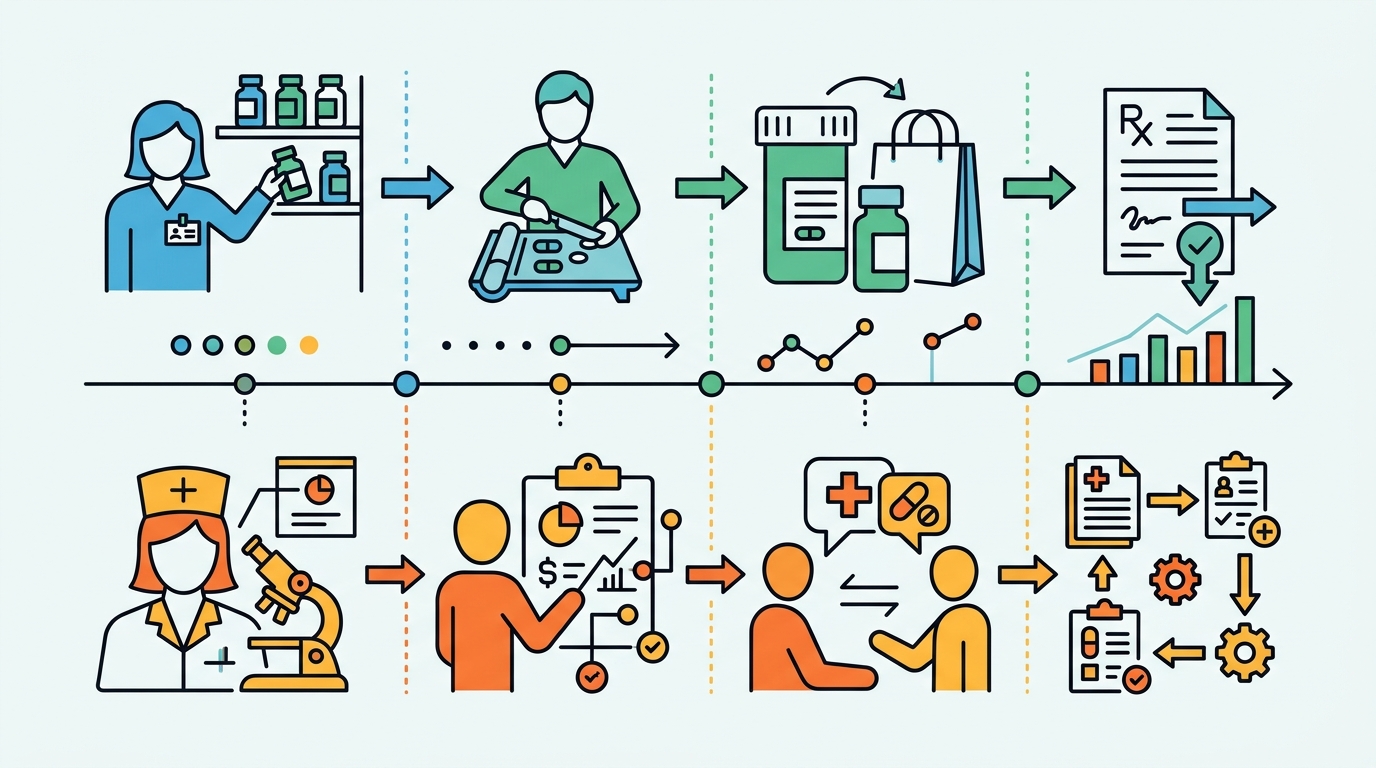
A pharmacy technician and a pharmacist share a counter and a queue, but not a job description. Technicians prepare medications under the direction of a pharmacist — measuring, mixing, counting, labeling and recording dosages against prescription orders (O*NET OnLine, 2025); pharmacists verify that work, counsel patients and hold the license that makes dispensing legal.
Moving between the two is a degree change, not a promotion: technicians typically enter with a high school diploma or equivalent, pharmacists with a doctoral or professional degree (U.S. Bureau of Labor Statistics, 2025).
What Changes With Experience
Technician is the entry point; pharmacist is the licensed tier. Details shift by state board rules and by setting — hospital, chain retail, compounding and mail-order pharmacies divide these duties differently.
| Dimension | Entry-level: pharmacy technician | Experienced: pharmacist |
|---|---|---|
| Education | High school diploma or equivalent is the typical entry-level education (U.S. Bureau of Labor Statistics, 2025), plus employer training at the bench | Doctoral or professional degree (U.S. Bureau of Labor Statistics, 2025), earned as a Pharm.D. from an ACPE-accredited college or school of pharmacy (American Association of Colleges of Pharmacy) |
| Credential | CPhT certification, a designation that appears in ONET's sample reported technician job titles (ONET OnLine, 2025) | Licensure in every state (U.S. Bureau of Labor Statistics, 2025), including passing the NAPLEX plus state-specific requirements (American Association of Colleges of Pharmacy) |
| Autonomy | Prepares medications under the direction of a pharmacist (O*NET OnLine, 2025); cannot release a filled vial without verification | Signs the final check, and decides alone whether to hold a fill and call the prescriber |
| Task types | Measuring, mixing, counting, labeling and recording dosages per prescription orders (ONET OnLine, 2025); answering simple questions, locating items, cleaning equipment and work areas (ONET Code Connector) | Specialized services for diabetes, asthma, smoking cessation or high blood pressure, and analyzing prescribing trends to monitor compliance and prevent excessive usage or harmful interactions (O*NET OnLine, 2025) |
| Decision authority | Refers medication-information questions to the pharmacist (O*NET Code Connector) | Acts on or overrides interaction alerts; counsels directly on dosing and side effects |
| Supervision | Receives direction; finished baskets are checked item by item | Supervises the work of pharmacy technicians and pharmacists in training, or interns (U.S. Bureau of Labor Statistics, 2025) |
| Pay band | BLS lists a 2025 median pay for pharmacy technicians in its healthcare occupations summary table; O*NET also publishes technician median wages | BLS lists a separate, higher 2025 median for pharmacists, stated for May 2025 — check the BLS table for current figures |
| Titles and openings | Certified pharmacy technician (O*NET OnLine, 2025); BLS projects technician growth and annual openings for 2025–2035, as cited by ASHP's careers resource | Clinical Pharmacist, Hospital Pharmacist, Community Pharmacist (O*NET OnLine, 2025); about 12,500 pharmacist openings a year on average, 2025–2035 (U.S. Bureau of Labor Statistics, 2025) |
A Day as an Entry-Level Pharmacy Technician
A composite community-pharmacy shift, assembled from tasks common across retail settings. Hospital and mail-order shifts run on different equipment and hours.
- 8:30 a.m.–9:00 a.m. Open with the pharmacist present, unlock the safe for the controlled substances count, and print the overnight queue from the dispensing software. The pharmacist confirms the count.
- 9:00 a.m.–10:15 a.m. Key new prescriptions and e-scripts into the pharmacy system, matching drug, strength, quantity and directions. An unfamiliar abbreviation goes to the pharmacist, not a guess.
- 10:15 a.m.–11:30 a.m. Work the third-party rejection queue in the adjudication screen — refill-too-soon messages and prior authorization flags — and call the insurer's help line. Any call that turns into a therapy change is handed over.
- 11:30 a.m.–12:30 p.m. Fill: count on the tray and spatula, measure liquids, label vials, record dosages against the order. Each basket goes to the pharmacist's verification bin, not the patient.
- 12:30 p.m.–1:00 p.m. Break. Standing for a full shift and the repetitive counting are the physical cost of this job.
- 1:00 p.m.–2:15 p.m. Will-call: pull bags from alphabetized bins and scan at the register. Asked whether a new antibiotic is safe with a blood pressure medication, you refer the customer to the pharmacist.
- 2:15 p.m.–3:15 p.m. Inventory: scan shelf stock against the ordering system, pull short-dated product, check the wholesaler tote against the invoice. The pharmacist signs for controlled items.
- 3:15 p.m.–4:00 p.m. Clean and maintain equipment and the work area — trays wiped between hazardous and non-hazardous drugs, mortar and pestle washed, balance area cleared.
- 4:00 p.m.–4:30 p.m. Handoff: flag unresolved prior authorizations in the system notes and tell the incoming pharmacist who is waiting on a prescriber callback.
The satisfying part is concrete: catching that a refill was entered at 20 mg when the order says 10 mg, before it reaches verification.
A Day as an Experienced Pharmacist
A composite community-pharmacy shift. A hospital pharmacist's day is built around order verification, rounds and IV room oversight instead of a retail counter.
- 8:00 a.m.–8:30 a.m. Open with the technician and review the perpetual inventory log; you decide independently whether a discrepancy is a count error or a documented investigation.
- 8:30 a.m.–10:00 a.m. Final verification against the prescription image in the dispensing system — drug, strength, directions, drug utilization review alerts. You override a duplicate-therapy alert after confirming a prescriber-intended taper and document why.
- 10:00 a.m.–10:45 a.m. Counsel a patient starting a metered-dose inhaler, demonstrate spacer technique, and add a written action plan — the kind of specialized service ONET lists for pharmacists alongside diabetes, smoking cessation and high blood pressure management (ONET OnLine, 2025).
- 10:45 a.m.–11:30 a.m. Call a prescriber about an antifungal–statin interaction and recommend an alternative. Holding the fill until they respond is your call alone.
- 11:30 a.m.–12:30 p.m. Immunizations: screen history, administer, document in the state immunization registry.
- 12:30 p.m.–1:00 p.m. Break, covered by a floating pharmacist where the state requires continuous pharmacist presence — state board rules differ.
- 1:00 p.m.–2:00 p.m. Mentoring: walk a pharmacy intern through a compounding calculation before they prepare a suspension, and coach a technician on prior authorization documentation. Supervising technicians and interns is a listed pharmacist duty (U.S. Bureau of Labor Statistics, 2025).
- 2:00 p.m.–3:00 p.m. Analyze prescribing and refill trends in the reporting module — chronic therapy overdue, early controlled-substance refills — and choose who gets an adherence call.
- 3:00 p.m.–5:00 p.m. Verification as the queue builds, interleaved with phone triage. The mental load is the demanding part: holding the check steady while a line forms.
- 5:00 p.m.–6:00 p.m. Close out: sign the controlled substance log, brief the evening pharmacist on two pending callbacks, approve order exceptions.
The reward is the catch nobody else was positioned to make — the 10:45 a.m. interaction that would otherwise have reached the patient.
Skills and Credentials That Unlock the Next Level
These are the concrete thresholds, plus the steps that raise a technician's standing without leaving the role.
- Earn the CPhT credential. The Pharmacy Technician Certification Board sets two eligibility pathways for the Pharmacy Technician Certification Exam: a PTCB-Recognized Education/Training Program — PTCB says there are more than 1,400 of them — or equivalent pharmacy technician work experience. PTCB publishes the application and exam fee; check it before budgeting.
- Study to the exam blueprint. The PTCE is divided into knowledge domains with stated weights (freece.com), so weight your study time to the heaviest domains.
- Check your state board's technician rules. Registration, training hours and permitted tasks — immunizations, tech-check-tech — are set state by state.
- Demonstrate measurable bench skills. Accurate compounding, clean third-party adjudication with little rework, and inventory accuracy at the controlled substances count are what a supervisor can observe and reference.
- Complete a Pharm.D. To take the NAPLEX you must have earned a Pharm.D. from an ACPE-accredited college or school of pharmacy (American Association of Colleges of Pharmacy). Prerequisites vary by school.
- Pass the NAPLEX and meet state licensure requirements. Passing sits alongside other state-specific requirements (American Association of Colleges of Pharmacy), and every state requires pharmacists to be licensed (U.S. Bureau of Labor Statistics, 2025).
- Consider residency for clinical roles. ASHP describes the PGY2 residency as building on PGY1 competencies and, in some cases, preparing residents for board certification — the usual route into titles such as Clinical Pharmacy Specialist (O*NET OnLine, 2025).
Frequently asked questions
How long does it take to go from pharmacy technician to pharmacist?
It is a full degree change, not a promotion window. You need a Pharm.D. from an ACPE-accredited college or school of pharmacy to sit the NAPLEX (American Association of Colleges of Pharmacy), plus prerequisite undergraduate coursework, then state licensure — every state requires pharmacists to be licensed (U.S. Bureau of Labor Statistics, 2025). Program length and prerequisites vary by school, so check admission pages directly.
What is the pay difference between the two roles?
BLS lists separate 2025 median pay figures for pharmacists and pharmacy technicians in its healthcare occupations summary table, with the pharmacist median stated for May 2025; O*NET also publishes technician median wages. The pharmacist band is the higher of the two. Check both the BLS Occupational Outlook Handbook and O*NET for current numbers, and expect variation by state and setting.
What triggers advancement for a technician who stays a technician?
Usually a credential plus demonstrated accuracy. CPhT certification through PTCB — via a recognized training program or equivalent work experience — is the common gate, since the certified designation appears in O*NET's sample reported job titles. Beyond that, lead technician, buyer, sterile compounding and billing specialist roles depend on your employer's structure and your state board's permitted technician tasks.
Is there steady demand in both roles?
BLS projects about 12,500 pharmacist openings each year on average over 2025–2035 (U.S. Bureau of Labor Statistics, 2025), and projects employment growth and annual openings for pharmacy technicians over the same period, as cited by ASHP's careers resource. Demand varies by region and setting — hospital, community retail and mail-order markets do not move together.
Sources
- U.S. Bureau of Labor Statistics — Healthcare Occupations : Occupational Outlook Handbook (2025)
- U.S. Bureau of Labor Statistics — Pharmacists : Occupational Outlook Handbook (2025-05)
Your coach for this guide
Yuki covers early-career life, internships, and the strange first years of figuring out what work is for. She writes with the fresh impatience of someone still sorting out her own path.