 Work Quest Hub
What Does a Veterinary Technician Do? A Day-in-the-Life Guide
Restraint, anesthesia monitoring, lab work and a surprising amount of talking to owners — here is how the hours actually break down in practice.

By Marcus BellweatherNov 15, 2026 · 8 min read
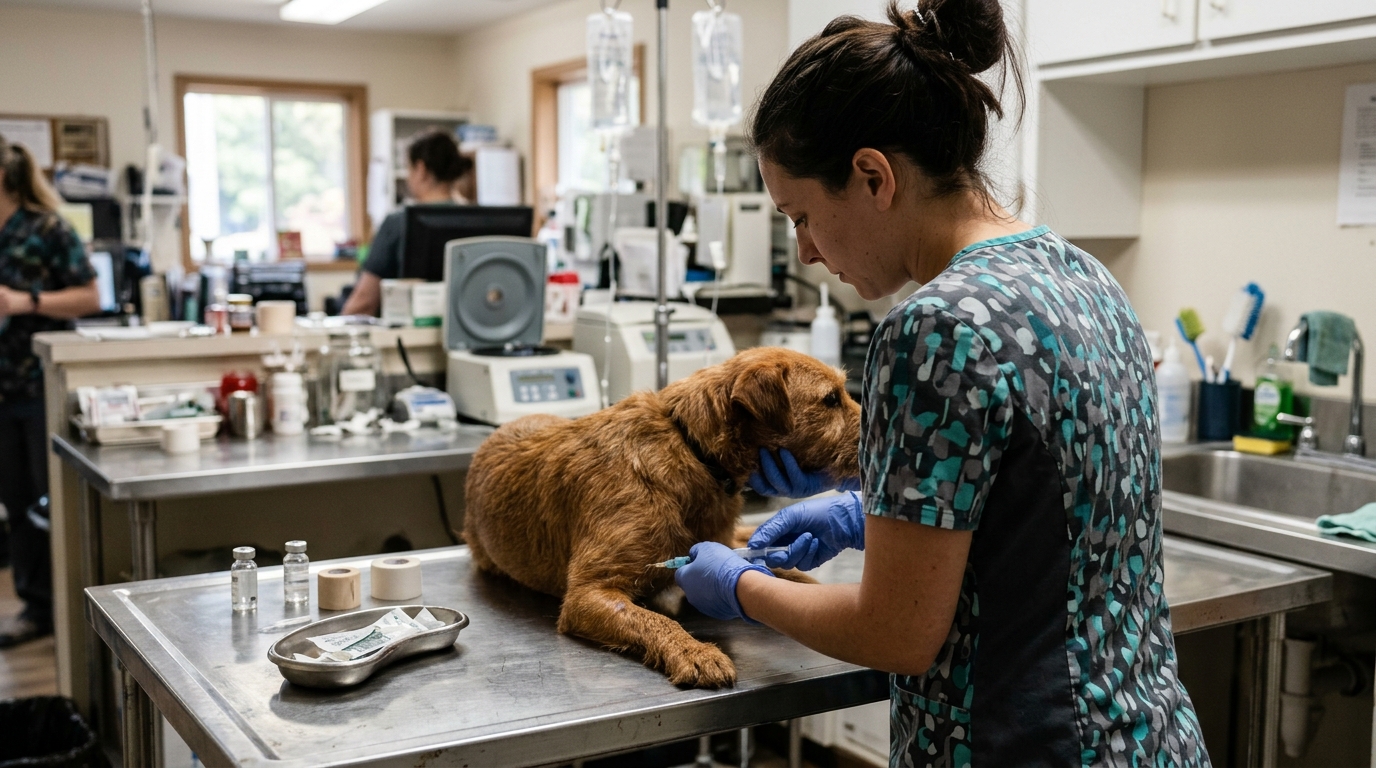
A veterinary technician is the nurse, lab tech, anesthetist and radiographer of an animal hospital, working under the supervision of a licensed veterinarian (U.S. Bureau of Labor Statistics, 2026-08-27). The job runs on medical tests, nursing care, restraint, anesthesia monitoring, x-rays, medication administration and written case histories (U.S. Bureau of Labor Statistics, 2026-08-27).
Most technicians work in private clinics and animal hospitals, though laboratories, colleges and universities, and humane societies also employ them, and the work often includes evenings, weekends or holidays (U.S. Bureau of Labor Statistics, 2026-08-27).
A Typical Day, Hour by Hour
This is a day-shift pattern at a general small-animal practice. Emergency, specialty, shelter and laboratory schedules differ, and evening, weekend and holiday hours are common across the field (U.S. Bureau of Labor Statistics, 2026-08-27).
7:00 AM – Shift handoff and treatment board. You take verbal rounds from the overnight or closing staff, then walk the ward observing each hospitalized animal's behavior and condition — appetite, attitude, urine output, incision appearance — and write it into the record (U.S. Bureau of Labor Statistics, 2026-08-27).
7:45 AM – Morning treatments. Temperature, pulse and respiration on each inpatient, then prescribed medications and fluid-pump rate checks, each entry initialed on the treatment sheet.
8:30 AM – Outpatient appointments. You restrain animals for physical exams, draw blood from a jugular or cephalic vein, and administer vaccines under the veterinarian's direction (U.S. Bureau of Labor Statistics, 2026-08-27).
9:30 AM – In-house lab bench. Spin a urine sample in the centrifuge, read specific gravity on the refractometer, run a blood count on the hematology analyzer and set up a fecal float (U.S. Bureau of Labor Statistics, 2026-08-27).
10:30 AM – Surgery. You place the IV catheter, induce and monitor anesthesia, intubate, watch the capnograph and Doppler blood pressure reading, and have the instrument pack and clippers ready before the first incision (U.S. Bureau of Labor Statistics, 2026-08-27).
12:30 PM – Baths, nail trims and anal gland expression. This surprises people: grooming tasks such as bathing and clipping nails are a standard part of the job description, not an add-on (U.S. Bureau of Labor Statistics, 2026-08-27).
1:30 PM – Radiographs. Positioning a painful dog for a lateral abdominal view in a lead gown, measuring with calipers and reshooting when the spine is rotated.
2:30 PM – Phones and paperwork. The second surprise: a large share of the afternoon is spent talking with owners — explaining a pet's condition and how to give a medication at home — plus recording case histories and signing the controlled drug log (U.S. Bureau of Labor Statistics, 2026-08-27).
4:00 PM – Euthanasia appointment. You place the catheter, stay in the room, and handle the aftercare paperwork.
5:30 PM – Reset. Autoclave instrument packs, restock crash cart and suture, mop the prep table, and hand off to the evening shift.
Core Responsibilities
Ordered roughly from what you do most often to what you do least, in a general practice setting. Every task below is performed under a licensed veterinarian's supervision (U.S. Bureau of Labor Statistics, 2026-08-27).
- Restrain scared, painful or aggressive animals safely for exams, blood draws and nail trims.
- Record case histories, treatment times and medication doses in the practice management software and on the controlled drug log (U.S. Bureau of Labor Statistics, 2026-08-27).
- Observe each hospitalized animal's behavior and condition and report changes to the veterinarian (U.S. Bureau of Labor Statistics, 2026-08-27).
- Administer prescribed medications and vaccines by mouth, injection or IV line (U.S. Bureau of Labor Statistics, 2026-08-27).
- Perform laboratory tests such as urinalyses and blood counts on in-house analyzers (U.S. Bureau of Labor Statistics, 2026-08-27).
- Explain a pet's condition and how to give a medication to the owner at discharge or by phone (U.S. Bureau of Labor Statistics, 2026-08-27).
- Prepare animals and instruments for surgery, then administer anesthesia and monitor the patient's responses (U.S. Bureau of Labor Statistics, 2026-08-27).
- Take x-rays and provide nursing care or emergency first aid, including bathing, clipping nails and grooming (U.S. Bureau of Labor Statistics, 2026-08-27).
Where and How the Work Happens
Technicians typically work in private clinics and animal hospitals, and also in laboratories, colleges and universities, and humane societies (U.S. Bureau of Labor Statistics, 2026-08-27).
| Setting | Schedule type | Typical pace | Supervision level |
|---|---|---|---|
| Private general practice | Daytime appointment blocks, plus rotating Saturdays and some evening clinics | Booked appointments every 20-30 minutes, with surgery stacked in the morning | A licensed veterinarian is on site and signs off on tests and treatments |
| Emergency and referral hospital | Overnight, weekend and holiday coverage built into the rota (U.S. Bureau of Labor Statistics, 2026-08-27) | Unpredictable: three stable patients, then a hit-by-car arrival that takes four hands for an hour | Criticalist or ER veterinarian directs triage minute by minute |
| Laboratory, college or university | Fixed weekday hours tied to study protocols and class timetables | Repeating daily husbandry, sampling and observation rounds on a written schedule | Attending veterinarian plus protocol oversight from a research committee |
| Humane society or shelter | Set opening hours with weekend adoption events | High-volume spay/neuter days: induction, monitoring and recovery for one animal after another | Shelter veterinarian supervises; technicians run intake exams with standing orders |
The Hard Parts and the Good Parts
The hard parts are physical and emotional, and the federal data says so plainly. Veterinary technicians have one of the highest rates of injuries and illnesses of all occupations, because restraining a frightened animal means being bitten, scratched or kicked (U.S. Bureau of Labor Statistics, 2026-08-27). A concrete version: a 70-pound dog with an ear infection that was fine in the lobby twists in your arms the moment the otoscope goes in, and you absorb that with your forearms while keeping the head still.
The emotional load is separate. You may see abused animals and you will help euthanize sick, injured or unwanted ones (U.S. Bureau of Labor Statistics, 2026-08-27). That can mean placing a catheter for a cat you treated for three years while the owner sits on the floor, then washing your hands and walking into a puppy's first vaccine appointment eight minutes later.
The good parts are also specific. You are the person who notices the subtle thing: a hospitalized dog whose respiratory rate climbed from 28 to 44 overnight, which you flag to the veterinarian before it becomes a crisis — that observation is a core duty, not initiative outside your role (U.S. Bureau of Labor Statistics, 2026-08-27). You also own real clinical skills. Running the anesthesia for a spay, reading the capnograph and adjusting the vaporizer is skilled work the veterinarian is relying on you to do correctly.
And there is the client side: explaining to an anxious owner exactly how to pill a cat, then hearing a week later that it worked (U.S. Bureau of Labor Statistics, 2026-08-27). People leaving the field usually cite the bites, the euthanasia days and the schedule rather than the medicine itself. Weigh those three things honestly before you enroll.
Frequently asked questions
What hours do veterinary technicians actually work?
Schedules may include evenings, weekends or holidays, because animals housed overnight need treatments and emergencies arrive outside business hours (U.S. Bureau of Labor Statistics, 2026-08-27). A general practice often runs daytime appointment blocks with rotating Saturdays; an emergency hospital builds overnight and holiday coverage into the rota. Ask any prospective employer how holiday coverage is assigned before you accept a role, since that policy is set practice by practice.
How physically demanding is the job?
Physical strength is listed as an important quality precisely because you need to manage and lift animals, along with manual dexterity for catheters and blood draws (U.S. Bureau of Labor Statistics, 2026-08-27). You will be on your feet for most of a shift, and the occupation has one of the highest injury and illness rates of all occupations, mainly from bites, scratches and kicks during restraint (U.S. Bureau of Labor Statistics, 2026-08-27). There is also routine exposure to disease and infection, which is why gloves, gowns and isolation protocols are standard.
Can any of this be done remotely?
The clinical core cannot be: restraint, anesthesia monitoring, radiographs and lab tests all require you to be physically with the animal and the equipment (U.S. Bureau of Labor Statistics, 2026-08-27). The parts that are phone or computer based — explaining medication instructions to owners and recording case histories — are a real slice of the day, and some technicians move into telephone triage or records roles later (U.S. Bureau of Labor Statistics, 2026-08-27). Treat this as an on-site job when planning your commute and childcare.
How long does it take to qualify, and what exam do I need?
Veterinary technicians usually need a 2-year associate's degree, while veterinary technologists usually need a 4-year bachelor's degree in veterinary technology (U.S. Bureau of Labor Statistics, 2026-08-27). O*NET places the occupation in a job zone where 1 to 2 years of training is typical (O*NET OnLine, U.S. Department of Labor). Most states then require you to pass an exam to become a registered, licensed or certified veterinary technician, and the exact title and requirements vary by state — check your state veterinary board and CareerOneStop for the current rules (U.S. Bureau of Labor Statistics, 2026-08-27).
How is pay structured and where do I check current rates?
Most clinic positions are hourly, with differentials common for overnight and holiday shifts, so your take-home depends heavily on the rota you work. The U.S. Bureau of Labor Statistics publishes a median annual wage for veterinary technologists and technicians in the Occupational Outlook Handbook, drawn from May 2025 wage data, with state and metro breakdowns in the OEWS tables. Check those figures directly rather than relying on job-board averages, since pay varies by state and by whether the employer is a private practice, a university or a shelter.
Sources
- U.S. Bureau of Labor Statistics — Veterinary Technologists and Technicians: What They Do (2026-08-27)
- O*NET OnLine (U.S. Department of Labor) — 29-2056.00 - Veterinary Technologists and Technicians
Your coach for this guide
Marcus writes a running column on the economics of work, from gig platforms to apprenticeships. He's skeptical of easy career advice and prefers questions to conclusions.