 Work Quest Hub
What It's Really Like to Work as a Flight Attendant
The safety checks, reserve calls and galley routines behind a job most passengers only see from seat 14C, and what it takes to get hired.

By Priya NatarajanNov 15, 2026 · 9 min read
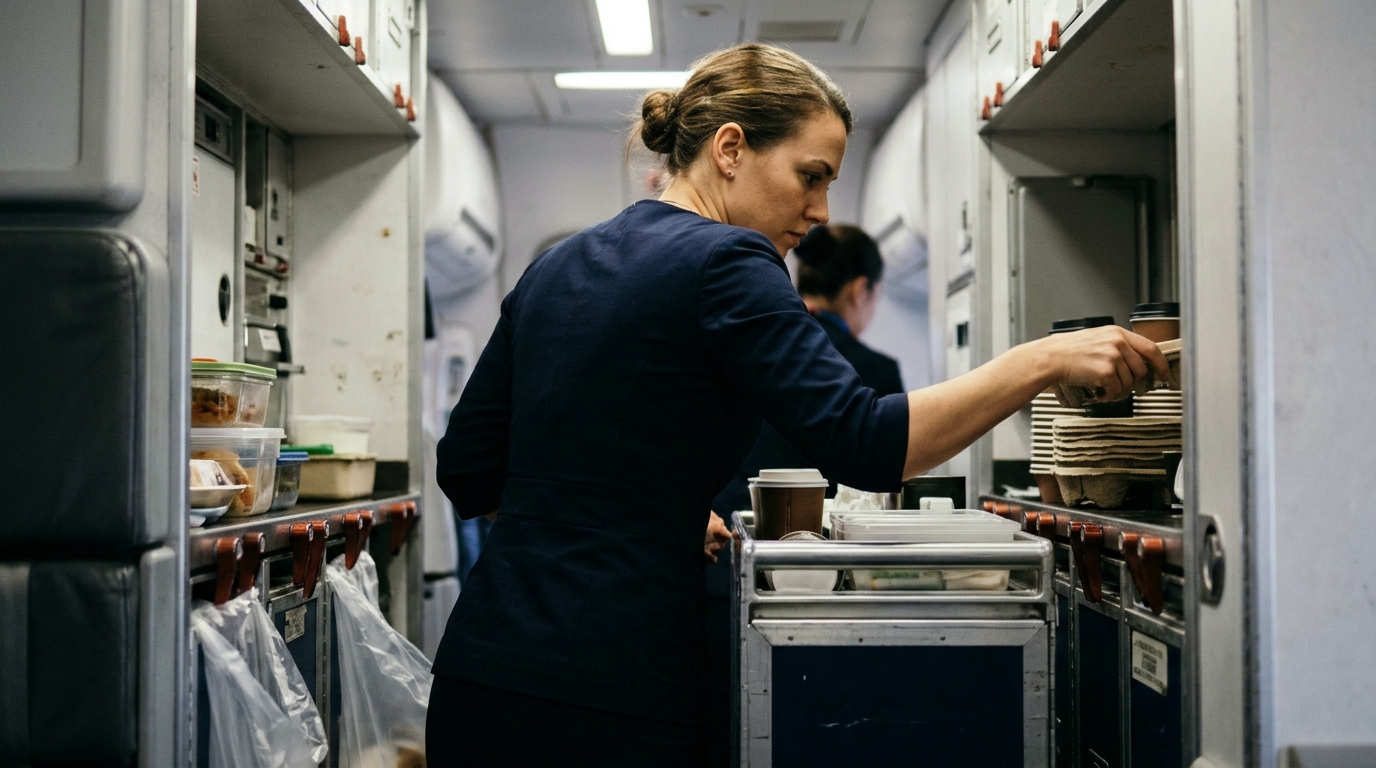
Working as a flight attendant is a safety job with a service layer on top. Your day is built around preflight briefings with the pilots, inspections of emergency equipment, a cabin service run, and the possibility that you will be the one giving first aid at 35,000 feet (U.S. Bureau of Labor Statistics, 2025). Schedule control, base and routes are assigned by seniority, so the first years look very different from year ten (U.S. Bureau of Labor Statistics, 2025).
If you want predictable hours and a fixed desk, this is the wrong job. If you can stay calm while 180 people watch you, and you can live with a phone that rings before dawn, it fits.
A Typical Day, Hour by Hour
This is a two-day domestic trip on a narrowbody aircraft. International long-haul and regional flying run differently, and reserve days can start with a phone call instead of an alarm.
- 4:40 AM - Crew scheduling calls. On reserve, you are assigned a trip with a report time a couple of hours out. BLS notes that almost all flight attendants start on call and that reserve crew usually live near their home airport for exactly this reason (U.S. Bureau of Labor Statistics, 2025).
- 6:00 AM - Sign in at the crew room. You check your mailbox and company tablet for bulletins, aircraft substitutions and gate changes, then clear security with your crew ID and passport.
- 6:20 AM - Preflight briefing with the pilots. Flight time, turbulence forecast, number of passengers needing assistance, and who calls for an evacuation. BLS lists participating in preflight briefings as a core duty (U.S. Bureau of Labor Statistics, 2025).
- 6:35 AM - Emergency equipment check. This is the part outsiders never picture: before a single drink is poured you are counting life vests, checking the pressure gauge on the halon extinguisher, confirming the AED and the medical kit seals are intact, and verifying slide arming indicators and oxygen bottle levels. Preflight inspection of emergency equipment is a listed duty (U.S. Bureau of Labor Statistics, 2025).
- 7:00 AM - Boarding. You watch for intoxication, oversized bags and exit-row passengers who cannot lift a heavy exit door. Another surprise: most airline contracts calculate pay from flight hours, so boarding time is handled differently from in-flight time. Ask about the pay formula in any interview and check the current median wage figure in the BLS Occupational Outlook Handbook (U.S. Bureau of Labor Statistics, May 2025).
- 7:30 AM - Doors closed, slides armed, cross-check. You demonstrate safety equipment, then do a compliance walk for seat belts, tray tables and stowed bags.
- 8:10 AM - Service. Cart out, beverages, trash run, lavatory checks. Galley work is where the sprains and bruises happen - BLS places this occupation among those with the highest injury and illness rates (U.S. Bureau of Labor Statistics, 2025).
- 9:45 AM - A passenger feels faint. Oxygen, a blood pressure check, a call to the ground-based medical service through the flight deck. Administering emergency medical care is a listed duty (U.S. Bureau of Labor Statistics, 2025).
- 10:40 AM - Turn. Forty minutes to deplane, clear seat pockets, restock, board again and repeat the sequence for the next leg.
- 6:30 PM - Layover hotel. You receive an allowance for meals and accommodations away from base (U.S. Bureau of Labor Statistics, 2025), then start the rest period the FAA requires between duty periods, the length of which depends on how long the duty period ran (U.S. Bureau of Labor Statistics, 2025).
Core Responsibilities
Ordered roughly by how often you do them, these are drawn from the duties the BLS lists for the occupation (U.S. Bureau of Labor Statistics, 2025).
- Conduct preflight inspections of emergency equipment - life vests, extinguishers, oxygen bottles, medical kit and door slide indicators - before every departure.
- Demonstrate the use of safety equipment and verify cabin compliance for belts, exits and stowage before takeoff and landing.
- Serve beverages and meals from the galley cart and manage galley stock, trash and lavatory checks through the cruise.
- Participate in the preflight briefing with the pilots and the lead flight attendant on turbulence, passenger needs and emergency signals.
- Monitor the cabin for intoxication, medical symptoms, disruptive behavior and smoke or fume indications.
- Administer emergency medical care, including oxygen, first aid and AED use, coordinating with any medical professional on board and with ground medical support.
- Direct passenger evacuation when required, including opening or blocking exits and commanding the flow to the slides.
- Complete postflight paperwork, including cabin discrepancy reports and irregularity write-ups for maintenance.
Where and How the Work Happens
| Setting | Schedule type | Typical pace | Supervision level |
|---|---|---|---|
| Domestic short-haul turns | Multi-leg days, often three to five flights, with layovers at outstations; BLS describes a range of on-duty shift lengths for the occupation (U.S. Bureau of Labor Statistics, 2025) | Service run compressed into 45-minute cruise segments, then a 30-40 minute turn before boarding starts again | Working alongside a lead flight attendant; the captain holds final authority over the aircraft |
| International long-haul | Single long sector with a required rest period before the return; FAA rest hours are tied to the length of the duty period just completed (U.S. Bureau of Labor Statistics, 2025) | Two full meal services, a long quiet cruise with crew rest breaks, then a second service before descent | Senior attendants frequently oversee the other attendants on international flights (U.S. Bureau of Labor Statistics, 2025) |
| Reserve at home base | On call with a phone that can ring at 4 AM; reserve crew usually live near their home airport (U.S. Bureau of Labor Statistics, 2025) | Hours of waiting, then a report time and a trip you did not choose, sometimes finishing in a different city | Crew scheduling assigns the trip; you meet your crew for the first time at the briefing |
Home base and route assignment are both determined by seniority, which is why new hires commonly commute to a base they did not pick (U.S. Bureau of Labor Statistics, 2025).
The Hard Parts and the Good Parts
The hard part is not rudeness at 30,000 feet, though that happens. It is the structural stuff. Picture a Tuesday on reserve: you have been awake since 4:40 AM, your trip cancels at the gate, scheduling reassigns you to a different pairing ending in a city three time zones away, and your rest period begins only when that duty period ends, under the FAA rest rules tied to duty length (U.S. Bureau of Labor Statistics, 2025). Seniority governs base and routes, so you cannot fix this by working harder (U.S. Bureau of Labor Statistics, 2025). Your body takes a share of it too - BLS reports flight attendants among the occupations with the highest injury and illness rates, with sprains, strains and bruises common (U.S. Bureau of Labor Statistics, 2025), and a galley cart on an unexpected drop is how many of those happen. ONET also records exposure to high places and responsibility for others' safety as standing features of the work (ONET OnLine, U.S. Department of Labor).
The good part is concrete too. On a long-haul leg a passenger goes pale in 42K, you bring oxygen and the AED, patch the flight deck through to ground medical support, and the aircraft lands on schedule with that person stable - a result you can point to. There is an allowance for meals and accommodations away from base, and discounted or standby travel through your airline (U.S. Bureau of Labor Statistics, 2025). Advancement runs on seniority: senior attendants oversee crews on international flights, and some move into recruiting, instructing or scheduling roles (U.S. Bureau of Labor Statistics, 2025). Whether that trade works depends on how much you need a schedule you control.
Frequently asked questions
How long are the shifts, and how much rest do I get between them?
BLS describes a range of on-duty shift lengths for the occupation, and duty days commonly include several flight legs plus boarding and turn time (U.S. Bureau of Labor Statistics, 2025). The FAA requires a specific number of rest hours between duty periods, with the required rest tied to how long the duty period you just finished ran (U.S. Bureau of Labor Statistics, 2025). The exact numbers in your schedule also depend on your airline's contract and whether you are flying domestic turns or long-haul.
Can any part of this job be done remotely?
No. The work happens on the aircraft, and even the waiting is location-bound: reserve flight attendants are on call and usually live near their home airport so they can report within the assigned window (U.S. Bureau of Labor Statistics, 2025). Base assignment is set by seniority, so new hires often commute by air to the base they were given rather than choosing one near home (U.S. Bureau of Labor Statistics, 2025).
What do I need before I can apply, and what happens after I'm hired?
Applicants must meet a minimum age requirement, typically 18 or 21 depending on the airline, be eligible to work in the United States, hold a valid passport, pass a background check and drug test, and have vision correctable to at least 20/40 (U.S. Bureau of Labor Statistics, 2025). After hire, the airline runs initial training that typically lasts several weeks to a few months; graduates receive the FAA Certificate of Demonstrated Proficiency (U.S. Bureau of Labor Statistics, 2025). Check the BLS Occupational Outlook Handbook for the typical entry-level education listed for the occupation.
Is the training finished once I pass initial?
No. You are certified for specific aircraft types, so moving to a different type means new training for that type (U.S. Bureau of Labor Statistics, 2025). On top of that, recurrent training is required every year to keep your certification current, covering emergency procedures, evacuation drills and medical equipment (U.S. Bureau of Labor Statistics, 2025).
How physically demanding is it, and what does it pay?
Expect lifting bags into overhead bins, pushing carts on an uneven floor and standing for most of the flight; BLS places flight attendants among the occupations with the highest rates of injuries and illnesses, with sprains, strains and bruises common (U.S. Bureau of Labor Statistics, 2025). Pay is usually built around flight hours plus a per-diem allowance for meals and accommodations away from base, with seniority driving how many hours you can bid (U.S. Bureau of Labor Statistics, 2025). For the current median annual wage, job numbers and the projected growth and annual openings over the 2025-35 decade, look up the flight attendant entry in the BLS Occupational Outlook Handbook (U.S. Bureau of Labor Statistics, May 2025).
Sources
- U.S. Bureau of Labor Statistics — Flight Attendants : Occupational Outlook Handbook (2025-05)
- O*NET OnLine (U.S. Department of Labor) — 53-2031.00 - Flight Attendants
Your coach for this guide
Priya shapes the publication's coverage of job transitions, writing often about the messy middle between leaving one role and starting another. She's drawn to the quiet negotiations people have with themselves before a resignation letter gets written.