 Work Quest Hub
Your Roadmap to Becoming a Veterinarian
What eight years of science study, the NAVLE and state-by-state licensing actually ask of you — and how to tell early whether the work fits.

By Lena KowalczykNov 15, 2026 · 10 min read
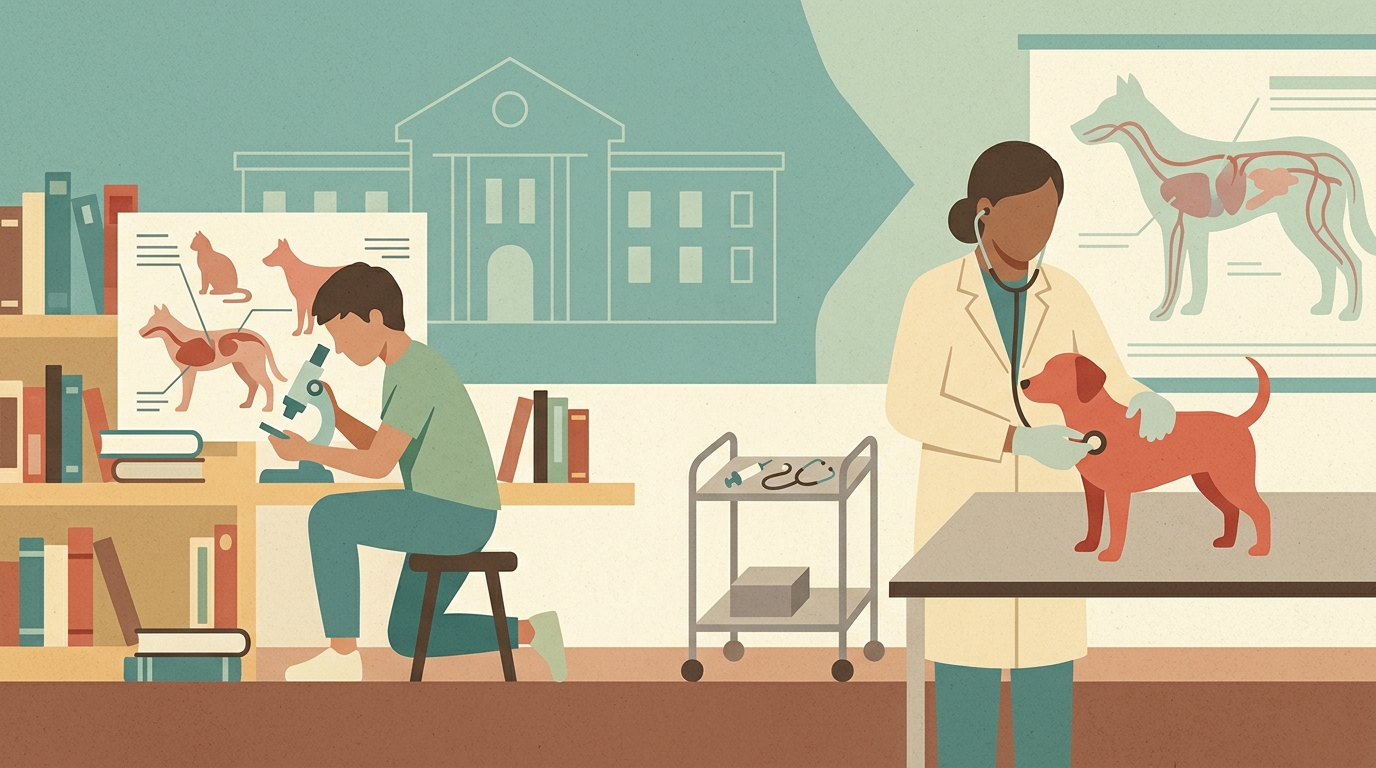
Becoming a veterinarian in the United States means a doctoral-level route: a bachelor's degree heavy in biology, chemistry and animal science, then a four-year Doctor of Veterinary Medicine (DVM or VMD) at an accredited college, then licensure (U.S. Bureau of Labor Statistics, 2025). For most people that is about eight years of full-time study before the first day of licensed practice, with no prior work experience in a related occupation required to start the degree (U.S. Bureau of Labor Statistics, 2025).
The decision point comes early. If restraining a frightened dog for a blood draw, reading a radiograph, and then telling an owner that the estimate is more than they can pay all sound like work you want, the rest of this guide is the sequence of credentials, exams and deadlines that gets you there.
Step-by-Step Path to Entry
Each step below is something you can put on a calendar: an application cycle, a degree, an exam date.
- Finish a bachelor's degree with the science prerequisites — about 4 years. Veterinary applicants typically hold a bachelor's degree, and veterinary medical colleges typically require many science classes, including biology, chemistry and animal science (U.S. Bureau of Labor Statistics, 2025). Your major matters less than completing every prerequisite each target school lists, so pull those lists in your first semester and map them against your degree plan.
- Accumulate animal, veterinary and research hours alongside coursework — start at least 12 months before you apply. Shadowing in a small-animal clinic, working as a veterinary assistant, handling livestock, or running samples in a lab all give admissions committees something concrete to read, and they give you an honest preview: surgical prep, fecal floats, anesthesia monitoring, euthanasia appointments.
- Apply to AVMA Council on Education-accredited colleges during one full application cycle — roughly 9 to 12 months from application to matriculation. The AVMA Council on Education maintains the official list of accredited veterinary colleges and programs, and that list is the accreditation standard for veterinary medical education (American Veterinary Medical Association, undated). Check every school you shortlist against that list before you pay an application fee.
- Complete the DVM or VMD — 4 years. The program generally takes four years at an accredited college of veterinary medicine (U.S. Bureau of Labor Statistics, 2025). Expect preclinical years built on anatomy, physiology, pharmacology and pathology, then clinical rotations through surgery, internal medicine, imaging, theriogenology and emergency.
- Confirm NAVLE eligibility and register in your final year — registration windows open months before the test date. Eligibility requires graduation from, or current enrollment in, a veterinary school accredited by the AVMA Council on Education, or enrollment or certification through the Educational Commission for Foreign Veterinary Graduates (ECFVG) or the Program for the Assessment of Veterinary Education Equivalence (PAVE) for graduates of non-accredited schools (Mometrix, undated).
- Pass the North American Veterinary Licensing Examination — plan 3 to 6 months of structured study. The NAVLE is required for licensure in jurisdictions throughout the United States and Canada and is administered by the International Council for Veterinary Assessment (StudyGuideZone citing ICVA, undated). It is a multiple-choice exam given over a set test-day length with a published passing score; confirm the current question count, day length and scoring on the ICVA site before you build a study plan (StudyGuideZone citing ICVA, 2026).
- Pass your state's licensing exam and file the license application — commonly several weeks from application to license issue. In addition to the national exam, most states require veterinarians to pass a state licensing exam, often covering state law and practice rules (U.S. Bureau of Labor Statistics, 2025). Requirements vary by state; look up your board's specifics through CareerOneStop (U.S. Bureau of Labor Statistics, 2025).
- Decide on optional post-graduate training or certification before you sign your first contract. Certification is not mandatory for veterinarians, but it lets you demonstrate competency in areas such as animal husbandry, health and welfare, and facility administration, with information available from CareerOneStop (U.S. Bureau of Labor Statistics, 2025).
Entry Requirements at a Glance
Minimum thresholds, not preferences. Confirm each one with the specific college and state board you are targeting.
- Bachelor's degree (typical for applicants), including the required science sequence — biology, chemistry and animal science are among the classes veterinary medical colleges typically require (U.S. Bureau of Labor Statistics, 2025).
- Doctor of Veterinary Medicine (DVM) or Veterinariae Medicinae Doctoris (VMD) from an accredited college of veterinary medicine — the entry-level education for the occupation is a doctoral or professional degree (U.S. Bureau of Labor Statistics, 2025).
- Accreditation by the AVMA Council on Education for your degree program — the Council maintains the official accredited list (American Veterinary Medical Association, undated).
- ECFVG certification or PAVE, if you graduated from a non-accredited school — one of these is the route to NAVLE eligibility for graduates of non-accredited programs (Mometrix, undated).
- A passing NAVLE score — the exam is required for licensure in jurisdictions throughout the United States and Canada (StudyGuideZone citing ICVA, undated), and ICVA caps the total number of attempts allowed under its current policy, so check that limit before your first sitting (Mometrix, undated).
- A state licensing exam in most states — most states require one in addition to the national exam (U.S. Bureau of Labor Statistics, 2025).
- An active state license to practice — veterinarians must be licensed in the United States, and requirements vary by state (U.S. Bureau of Labor Statistics, 2025). Background checks, character and fitness questions, and fees are set by each board; verify yours through CareerOneStop (U.S. Bureau of Labor Statistics, 2025).
- No prior work experience in a related occupation and no on-the-job training are required to enter the occupation (U.S. Bureau of Labor Statistics, 2025) — though clinical hours still carry weight in admissions.
- Physical and temperamental fit for the work — you will lift and restrain animals that bite and kick, stand through long surgeries, and keep a steady voice while an owner cries in an exam room. If any of those make you want to leave the room, test it with shadowing hours before you commit to the degree.
Comparing Entry Routes
All three routes end at the same place: a passing NAVLE score and a state license. They differ in how many steps sit between your degree and exam eligibility.
| Route | Time to entry | Costs and exams | Pay after licensure |
|---|---|---|---|
| U.S. college accredited by the AVMA Council on Education | About 8 years: roughly 4 years of undergraduate prerequisites plus a 4-year DVM (U.S. Bureau of Labor Statistics, 2025) | Tuition for two degrees, plus the NAVLE fee — for candidates applying through one of the 42 licensing boards that have ICVA administer NAVLE approvals, the fee is a set amount (Louisiana Board of Veterinary Medicine, undated); 1 national exam plus a state exam in most states (U.S. Bureau of Labor Statistics, 2025) | Same licensed-veterinarian market: BLS published a median annual wage for veterinarians for May 2025, along with figures for the lowest and highest 10 percent (U.S. Bureau of Labor Statistics, May 2025) — check the current Occupational Outlook Handbook page before you borrow |
| AVMA-accredited college outside the U.S. (Caribbean, Canada, United Kingdom, Australia and elsewhere) | Also a 4-year DVM after undergraduate prerequisites; the Council accredits schools outside the United States, including Ross University (American Veterinary Medical Association, undated) | Tuition plus relocation; NAVLE is sat at a test location, and ICVA sets separate fees for U.S. territory or Canada locations and for testing outside the United States, its territories and Canada for the 2026-2027 cycle (StudyGuideZone citing ICVA, 2026) | Identical licensure, so the same BLS May 2025 wage distribution applies once you hold a state license (U.S. Bureau of Labor Statistics, May 2025) |
| Non-accredited foreign veterinary school plus ECFVG or PAVE | The 4-year degree plus the added months of an ECFVG or PAVE certification program before you are NAVLE-eligible (Mometrix, undated) | Degree tuition, the ECFVG or PAVE program fees, and the NAVLE fee; 1 national exam plus a state exam in most states (U.S. Bureau of Labor Statistics, 2025) | Once licensed you are in the same occupation reported by BLS for May 2025 (U.S. Bureau of Labor Statistics, May 2025) |
Frequently asked questions
How long does it take to become a veterinarian from scratch?
Plan on about eight years of full-time study: roughly four years for a bachelor's degree carrying the required biology, chemistry and animal science prerequisites, then a four-year DVM or VMD program (U.S. Bureau of Labor Statistics, 2025). Add the NAVLE and, in most states, a state licensing exam before you can practice (U.S. Bureau of Labor Statistics, 2025). Application cycles add several months between finishing undergraduate work and starting veterinary school.
What does the NAVLE cost and who runs it?
The North American Veterinary Licensing Examination is administered by the International Council for Veterinary Assessment and is required for licensure across the United States and Canada (StudyGuideZone citing ICVA, undated). For candidates applying through one of the 42 licensing boards that have ICVA administer NAVLE approvals on their behalf, the fee is a set amount (Louisiana Board of Veterinary Medicine, undated), and ICVA publishes separate fees for testing in U.S. territories or Canada and for testing outside the United States, its territories and Canada for the 2026-2027 cycle (StudyGuideZone citing ICVA, 2026). Check the current cycle's fee schedule on the ICVA site before you register.
Can I move my veterinary license to another state?
Not automatically. Licensing requirements vary by state, and few states accept licenses issued by other states (U.S. Bureau of Labor Statistics, 2025). In practice that usually means a new application, the state's own exam, and fees for each jurisdiction where you want to practice; look up the specific board's rules through CareerOneStop (U.S. Bureau of Labor Statistics, 2025).
Do I need a state license to work for the government?
Possibly not. Veterinarians employed by state or federal government may not need a state license, because government agencies differ in what they require (U.S. Bureau of Labor Statistics, 2025). You still need the DVM or VMD from an accredited program, and most people entering government roles already hold a license, so confirm the requirement with the hiring agency rather than assuming either way.
How many times can I take the NAVLE if I fail?
ICVA allows a limited total number of NAVLE attempts under its current policy (Mometrix, undated), so this is not an exam you can retake indefinitely. Confirm the current attempt limit and any waiting period between sittings on the ICVA site before your first attempt, and build a study plan of several months rather than weeks. Eligibility itself requires enrollment in or graduation from an AVMA Council on Education-accredited school, or ECFVG or PAVE certification (Mometrix, undated).
Is there demand for new veterinarians?
Employment of veterinarians is projected to grow from 2025 to 2035 much faster than the average for all occupations, with about 3,100 openings projected each year on average (U.S. Bureau of Labor Statistics, 2025). That projection covers the occupation nationally; local demand varies by state and by practice type, with rural and large-animal roles often harder to fill than urban small-animal positions. No projection guarantees any individual a job offer.
Sources
- U.S. Bureau of Labor Statistics — Veterinarians : Occupational Outlook Handbook (2025)
- StudyGuideZone (citing ICVA) — NAVLE North American Veterinary Licensing Practice Questions
Your coach for this guide
Lena builds long-form conversations with workers across industries, chasing the specific texture of a job rather than its title. She's most interested in the gap between what a role is called and what it actually asks of someone.